
AI is taking on the bottlenecks in breast cancer care
Automated scans, screening support, pathology-based predictions and 3D surgical maps show where the technology is becoming useful. Each comes with its own evidence and limits.
- Maturity
- Demonstrated, stage 3 of 4
- Support
- 21 sources · report, government, institution, registry, paper
- Evidence detail
- How we know ↓
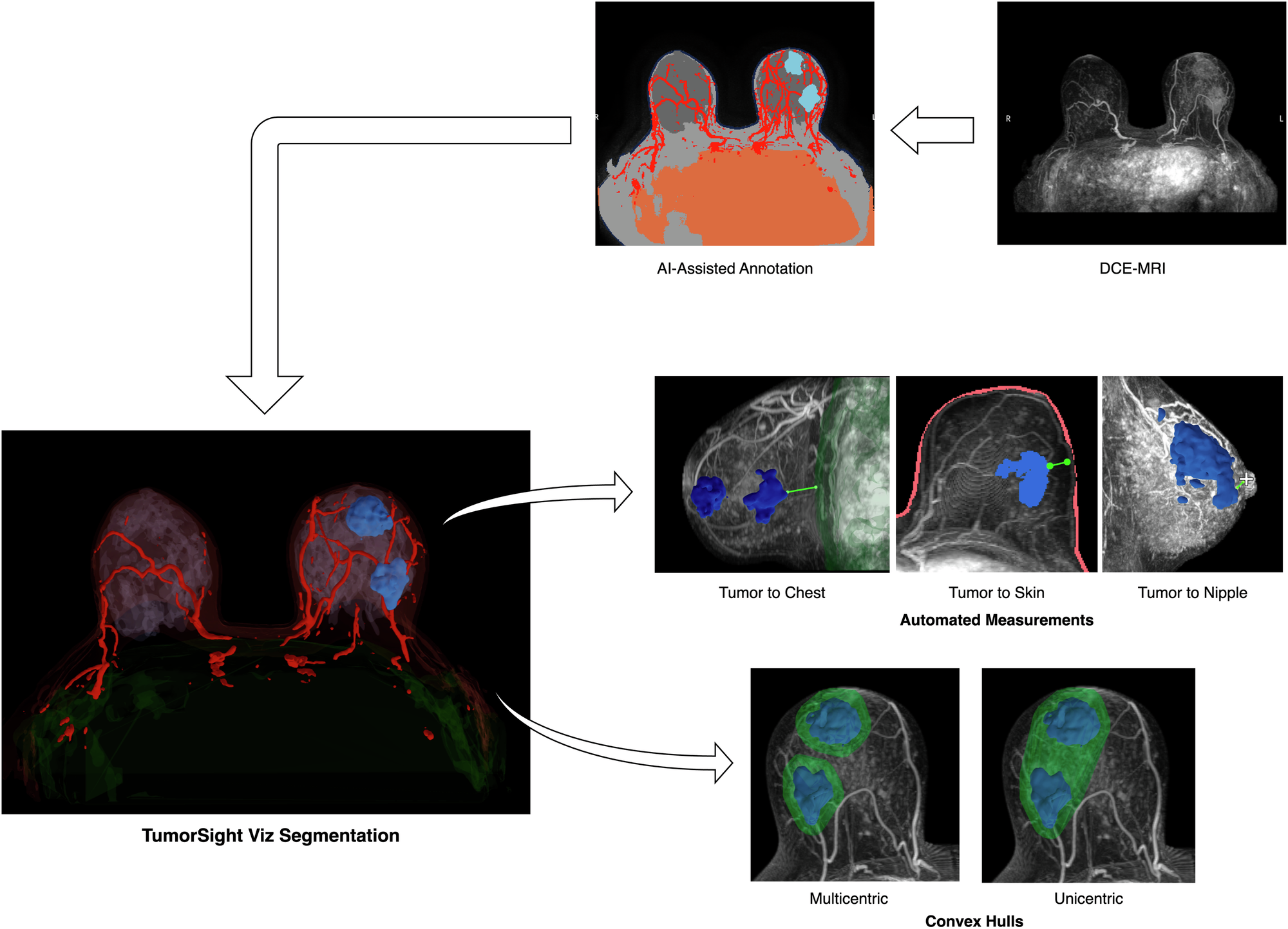
A breast MRI can become a three-dimensional map of a tumor and surrounding tissue. A digitized pathology slide can help estimate the chance of cancer returning. These are some of the practical jobs AI is taking on in breast cancer care. S8 S13
A roundup published by NVIDIA on October 5 spotlights four companies in its Inception startup program: iSono Health, Whiterabbit.ai, Ataraxis AI and SimBioSys. The developments span several years, and NVIDIA supplies technology used by the companies. FDA records and clinical research help distinguish the tools already cleared for specific uses from capabilities still being evaluated. S1 S2 S5 S12 S14
Making scans easier to acquire
iSono Health’s ATUSA automates three-dimensional breast ultrasound acquisition. The company says scanning takes about two minutes per breast once the system is positioned. That is an acquisition-time claim, rather than the duration of a complete appointment or a diagnosis. S3
The ultrasound platform received FDA clearance in April 2022. Its labeling says it does not replace screening mammography. iSono separately identifies the AI features described on its website as investigational. An ongoing U.S. registry is collecting images and biopsy results from women already referred for biopsy after suspicious findings. S2 S3 S4
Helping radiologists with specific tasks
Whiterabbit’s FDA-cleared WRDensity assigns breast-density categories to mammograms to support physicians’ assessment. Its WRRisk software supports longer-term risk estimation and related administrative work. These functions are distinct from the company’s research on automatically ruling out mammograms unlikely to contain cancer. S5 S7 S6
In a 2024 study, researchers simulated that screening approach on previously collected mammograms. In the largest U.S. test set, it reduced examinations needing radiologist interpretation by 41.6% and diagnostic callbacks by 31.1%, with the cancer-detection change inside the study’s predefined noninferiority margin. Those are simulated workflow results; prospective use must establish what happens when radiologists actually work with the system. S6
Extracting more information from a biopsy
Ataraxis combines digital pathology images with clinical information. Its Breast RISK test estimates recurrence risk; NEO estimates response to treatment before surgery; CTX estimates benefit from adding chemotherapy after surgery. Those are different clinical questions. S9 S19 S20
A Nature Communications paper published in May evaluated the prognostic model in 3,502 patients across five external cohorts. It found useful discrimination of recurrence risk. The authors explicitly say that this study evaluated prognosis, rather than whether a particular treatment would benefit a patient. All evaluation patients were women, and about 70% were White. S8
Evidence for the other tasks is developing separately. A 50-patient prospective silent study reported at ASCO evaluated predictions of response to presurgical treatment without using the model to guide care. A September CTX preprint examined chemotherapy-benefit estimates in observational cohorts. S10 S11
A separate September preprint applied CTX to 6,735 participants from TAILORx, a randomized treatment trial. It reported that the model distinguished chemotherapy benefit within the intermediate-genomic-risk subgroup. That is encouraging treatment-prediction evidence, with important boundaries: it is a secondary analysis awaiting peer review, and patients were not assigned treatment using the AI. S21
Turning MRI into a surgical map
SimBioSys’s TumorSight Viz renders MRI-derived anatomy in 3D and provides measurements that clinicians can review. Its cleared use covers patients with biopsy-proven early-stage or locally advanced breast cancer. A published retrospective study assessed imaging performance in 100 cases, rather than measuring whether the software reduced repeat operations or improved survival. S12 S13
There is also a recent regulatory milestone: FDA records show that the separate TumorSight Risk product was cleared on September 25. It combines MRI-derived information with clinical factors to estimate five- and ten-year recurrence risk in adult women with hormone-receptor-positive, HER2-negative, stage I–IIIA disease and N0 or N1 nodal status. The submission reports retrospective validation in 2,129 patients at four U.S. sites. S14 S15
What progress looks like
Together, these projects show a credible direction: making images easier to acquire and interpret, and extracting more information from tests already used in care. The next evidence should measure the consequences for patients, including missed cancers, unnecessary procedures, treatment choices and longer-term outcomes. Clearance, a strong retrospective result and a faster workflow each answer a different question. S2 S5 S6 S8 S12 S14
Source note: Bright examined FDA documentation, study reports and product information after encountering NVIDIA’s roundup. Several studies include company researchers or disclosed financial interests. The evidence reviewed does not establish lives saved by these tools. S1 S6 S8 S13 S14
How we know21 sources · checked 2026-10-05 · no corrections
Original sources
- S1 · NVIDIA breast cancer startup roundup · 2026-10-05 · Commercial source and news peg; October 1 Phoenix panel is a separate event date. ↗ · report
- S2 · FDA ATUSA clearance K213620 · 2022-04-22 · Cleared breast ultrasound indication and screening-mammography exclusion. ↗ · government
- S3 · iSono ATUSA product and regulatory information · accessed 2026-10-05 · Manufacturer acquisition-time claim and investigational AI disclosure. ↗ · institution
- S4 · AUDIBLE trial registry NCT07505797 · updated 2026-09-17 · Primary registry API checked directly; estimated enrollment 800; recruiting. ↗ · registry
- S5 · FDA WRDensity clearance K202013 · 2020-10-30 · Density assessment is adjunctive information, not a diagnostic aid. ↗ · government
- S6 · Semiautonomous screening study · 2024-04-10 · Pedemonte et al.; retrospective simulation; company-funded; CC BY 4.0. ↗ · paper
- S7 · Whiterabbit WRRisk product description · accessed 2026-10-05 · Company description of 10-year and lifetime risk and workflow support. ↗ · institution
- S8 · Ataraxis prognostic validation · 2026-05-20 · Witowski et al.; current version dated July 6; retrospective; disclosed company interests. ↗ · paper
- S9 · Ataraxis Breast RISK analytical validation · 2026-03-29 · Dantone et al.; describes laboratory-developed test in CLIA-certified lab. ↗ · paper
- S10 · Ataraxis prospective silent deployment abstract · 2026 ASCO meeting · Daniel et al., abstract 534; journal abstract published May 27, 2026; 50 women. ↗ · paper
- S11 · Ataraxis CTX causal AI preprint · 2026-09-11 · Biswas et al.; observational chemotherapy comparisons; residual confounding possible. ↗ · paper
- S12 · FDA TumorSight Viz clearance K251766 · 2025-07-08 · MRI visualization and analysis; clinical decisions cannot rest solely on the output. ↗ · government
- S13 · TumorSight Viz external validation · 2024-11-14 · Weitz et al.; 100 cases from 98 women; retrospective imaging-performance study; CC BY 4.0. ↗ · paper
- S14 · FDA TumorSight Risk clearance K260023 · 2026-09-25 · Actual FDA PDF retrieved and reviewed, including indications and retrospective validation. ↗ · government
- S15 · FDA TumorSight Risk decision record · 2026-09-25 · Independent confirmation of substantial-equivalence decision; database updated September 28. ↗ · government
- S16 · TumorSight Viz Figure 1 · 2024-11-14 · Authentic MRI-derived visualization; no separate restrictive credit in the figure caption. ↗ · institution
- S17 · Creative Commons Attribution 4.0 · license · Required attribution, license link and indication of changes for Figure 1 reuse. ↗ · institution
- S18 · NVIDIA SimBioSys feature with video · 2024-10-31 · Potential source footage only; reuse permission not established. ↗ · report
- S19 · Ataraxis NEO product description · accessed 2026-10-05 · Manufacturer description of predicted pathologic complete response. ↗ · institution
- S20 · Ataraxis CTX product description · accessed 2026-10-05 · Manufacturer description of estimated adjuvant chemotherapy benefit. ↗ · institution
- S21 · Ataraxis CTX TAILORx secondary analysis · 2026-09-22 · Chan et al.; preprint v2; independent trial dataset, company-associated analysis; indexed primary abstract reviewed. ↗ · paper
Institutions: iSono Health · Whiterabbit.ai · Ataraxis AI · SimBioSys
- Maturity
- Demonstrated
- Event date
- 2026-10-05
- Source published
- 2026-10-05
- Captured
- 2026-10-05T17:56:01Z
- Last source review
- 2026-10-05
- Editorial method
- AI-assisted source review
Bright compared this account with the linked original and supporting sources and kept reported, budgeted, projected, and observed claims distinct. Bright did not independently audit the underlying records.
Maturity describes the tested or operational setting. Confidence describes support for the particular claim; one does not determine the other.
Revision & correction history
2026-10-05T17:56:01Z · AI is taking on the bottlenecks in breast cancer care
No corrections recorded.
Keep exploring
Explore the shared question in another setting. These connections do not imply replication.