See what AI is making possible.

AI is doing real work across an astonishing range of the world — from the rain over a subcontinent to the shape of a single protein. Watch it, try it, and check the evidence behind every claim.

14 scales, one fallA curated edition of 65 source-checked records — all of them in the IndexPoint at a scale to open it · scroll to fall ↓
  1. 1025 mA ripple from spaceA ripple from 1.3 billion years ago. Hear it.AI is now helping quiet the instrument that caught it.DemonstratedGo there ↓
  2. 12,700 kmA planetA global forecast used to need a supercomputer.Now it needs about forty minutes — and the measurements nobody made.DeployedGo there ↓
  3. 2,000 kmA monsoon38,845,214 farmers got an AI monsoon forecast by text.India, 2025. Many surveyed farmers said they changed when they planted.DeployedGo there ↓
  4. 1 kmA computing campusAn AI-found rule frees 0.7% of Google’s computing — continuously.In production for more than a year.Deployed · company-reportedGo there ↓
  5. 100 mA fieldOne plant at a time.A field stops being one thing to treat and becomes thousands of decisions.DeployedGo there ↓
  6. 10 mA classroomAI helped students learn — and got in the way.Two randomized trials, one honest lesson.DemonstratedGo there ↓
  7. 1 mTwo people talkingALS took Casey’s clear speech. His words come back anyway.A brain implant and AI — now used at home.Emerging · one participantGo there ↓
  8. 30 cmThe laptop in front of youCapable AI you can run yourself.Slide your memory and see what fits.DeployedGo there ↓
  9. 12 cmA heartAn AI-guided heart procedure beat the standard one in a randomized trial.88% vs 70% free of atrial fibrillation a year after one procedure.DemonstratedGo there ↓
  10. 8 cmA gripA robot that knows when to stop squeezing.Try it: sight alone, or sight and touch.Deployed · company-reportedGo there ↓
  11. 3 cmA carved letterHistorians and an AI restore damaged Latin better together.Better than either alone.DemonstratedGo there ↓
  12. 12 mmA shadow on a scanTwelve millimetres, or three centimetres.The difference is whether anyone was looking.Emerging · company-reported deploymentGo there ↓
  13. 10 µmA micro-colonyFinding bacteria among the crumbs.Faster food-safety checks — in the lab so far.ExperimentalGo there ↓
  14. 10 nmOne proteinSee where AI is sure about a cancer protein’s shape.Light shows the model’s confidence.Demonstrated · a predictionGo there ↓
Scales are approximate: size of the subject · size of the setting · contextual
1025 mabout 1.3 billion years of travel at the speed of lightcontextual scale1 / 14how far the ripple traveled — the AI work itself happened at LIGO’s 4-km detector

Two black holes merged about 1.3 billion years ago. On 14 September 2015, the ripple reached Earth.

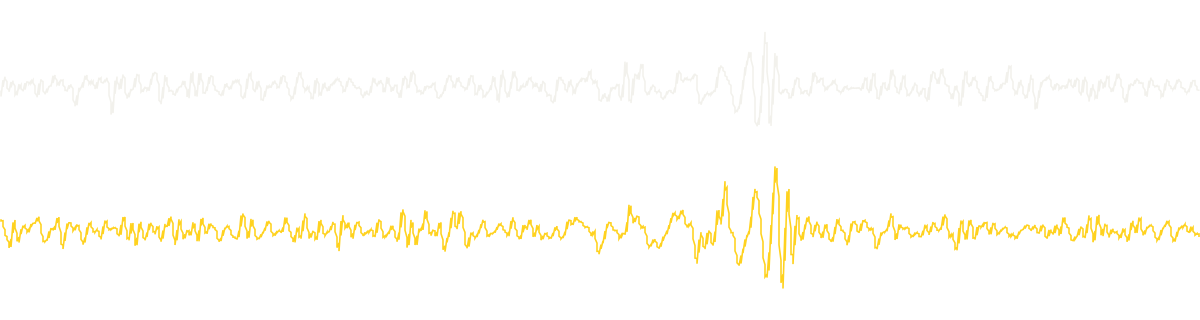
LIVINGSTON · L1HANFORD · H1Detector data from Livingston (top) and Hanford (bottom) around GW150914. Both show a rising burst about 0.3 seconds into the half-second window.
Real detector data from GWOSC (CC BY 4.0), whitened and filtered to 35–350 Hz with GWOSC’s published recipe, then played at its true speed. The sound is a way to perceive the recording, not a sound that crossed space. GWOSC event data

Two machines, 3,000 km apart

The signal reached Livingston first and Hanford about 7 milliseconds later. The detectors face different ways, so it appears inverted in one. Shift one trace and flip it, as GWOSC documents, and two independent recordings line up.

Where AI comes in

AI didn’t find this signal. In 2025, researchers showed a reinforcement-learning controller that made one of LIGO’s hardest mirror-control loops 30 to 100 times quieter, running stably on the real Livingston hardware.

DemonstratedThe projected benefit of hundreds more events per year depends on applying the method across all LIGO mirror-control loops.Using AI to perceive the universe in greater depth · 2025-09-04 · Open the record

The scale of it

The ripple traveled for about 1.3 billion years — roughly 1025 meters. At its peak, it changed LIGO’s 4-km arms by only about 4 × 10⁻¹⁸ m, roughly 400 times smaller than the width of a proton.

Bright arithmetic: published peak strain 1.0 × 10−21 × 4 km. Proton width from the CODATA charge radius.

The full GW150914 instrument

12,700 kmthe whole atmospheresize of the subject2 / 14

0.3% of the computing its own supercomputer forecast needs. That is what NOAA reports for a single 16-day global forecast from its AI model, which finishes in about 40 minutes.

DeployedEvery one of these models is trained on a reanalysis built from the observing network. No model can supply a measurement that was never made.NOAA deploys new generation of AI-driven global weather models · 2025-12-17 · Open the record
Two people in uniform inspecting a small white instrument package before releasing it under a weather balloon.
Context A radiosonde is checked before a weather-balloon launch at Camp Lemonnier, Djibouti, 16 June 2026. The package measures the atmosphere as it climbs and radios the numbers down. Not a national weather service station, and not part of the observing gap this station describes. U.S. Air Force photo by Staff Sgt. Nicholas Ross, U.S. government work.

Weather forecasting spent fifty years as one of the largest users of supercomputing. It is quietly ceasing to be one.

This is not a demonstration. ECMWF has run an AI forecast operationally since 25 February 2025, on a 28 km grid against 9 km for its physics model, reporting gains of up to 20% on tropical cyclone tracks. NOAA followed on 17 December 2025. In January 2026 NVIDIA published open weights spanning the whole chain — turning raw observations into a starting atmosphere, forecasting fifteen days out, and predicting the next six hours over your own town.

DeployedDeployment is not a guarantee of superiority for every variable, place, or event.ECMWF’s AI forecasts become operational · 2025-02-25 · Open the record

What did not get cheap

Less than 10% of the required basic weather and climate data are available from least developed countries and small island developing states. Germany has more stations meeting the global baseline than the whole of the African continent.

Every one of these models learned the atmosphere from a record built out of instruments like this one — balloons, buoys, aircraft, satellites. A model can fill a gap it has seen before. It cannot measure a place where nothing was measured. The barrier moved from silicon to sensors, and sensors are the part still waiting to be paid for.

Systematic Observations Financing Facility · WMO on the gaps in the observing network

And where it still loses

NOAA says plainly that version 1.0 degrades tropical cyclone intensity forecasts. Knowing where a storm will go is not the same as knowing how hard it will hit.

From observation to warning

A satellite view of western India with a monsoon storm’s rainfall rendered in green, yellow and red.

Context NASA GPM satellite data: a monsoon over western India, 28 July 2014. Not the 2025 forecast pilot. Context for scale. NASA’s Scientific Visualization Studio, U.S. government work.

Describe the video

Silent, 25 seconds. The camera descends from orbit toward India’s western coast. Scale bars shrink from 200 km to 10 km as a cutting plane opens the storm, showing rain rates in green, yellow and red, heaviest in dark red.

2,000 kma subcontinent’s rainssize of the setting3 / 14

38,845,214 farmers across India received an AI-based forecast of the monsoon’s arrival — by text message, in five regional languages.

Farmers bent over, transplanting bright green rice seedlings in a flooded field.
Context Farmers transplanting rice in Kuttanad, Kerala. Not people identified as pilot recipients. Achuthan K V, CC BY-SA 4.0.

Knowing when the rains will come changes when you plant.

In the Kharif 2025 pilot, a blend of Google’s NeuralGCM, ECMWF’s AIFS and 125 years of India Meteorological Department rainfall records produced local forecasts of the monsoon’s onset for farmers in 13 states.

DeployedThe reported decision changes are self-reported survey results from Bihar and Madhya Pradesh, not measured yield or income impacts.Indian Ministry of Agriculture and Farmers Welfare parliamentary response on an AI-based monsoon-onset pilot · 2025-12-02 · Open the record
A long row of supercomputer cabinets with perforated doors receding across a tiled floor.
Context NASA’s Pleiades supercomputer, Ames Research Center, 2008. Not Google’s data centers. NASA Ames Research Center (ARC-2008-ACD08-0272-003, cropped), U.S. government work.
1 kma computing campussize of the setting4 / 14

0.7% of Google’s worldwide computing, recovered continuously for more than a year — by a scheduling rule an AI system discovered.

At this scale a fraction of a percent is a lot of machines. Google DeepMind’s AlphaEvolve found the rule; it reclaims capacity that would otherwise go unused.

Deployed · company-reportedThis is a company-reported, Google-specific operational result.AlphaEvolve: A Gemini-powered coding agent for designing advanced algorithms · 2025-05-14 · Open the record · Also: The same system lifted a grid-planning model’s workable solutions from 14% to over 88% — a computational result, not yet on a live grid. Record
A long row of farm workers, bent double, cutting lettuce across a wide flat field in 1935.
Context Dorothea Lange, “Filipinos cutting lettuce. Salinas, California,” June 1935. The same valley, the same crop, ninety-one years before the machine. Not a field any laser weeder has worked. Library of Congress, Prints & Photographs Division, Farm Security Administration/Office of War Information, LC-USF34-008268, no known restrictions on publication.
100 ma fieldsize of the setting5 / 14

One plant at a time.

A machine drives the bed, photographs every plant, decides which are weeds, and burns them with light. In peer-reviewed trials across peas, spinach and beets, it left at least 97% less weed biomass by season’s end — matching or beating the standard herbicide programme, with crop stunting under 1%.

DeployedThe peer-reviewed trial used an autonomous demonstration unit, not a machine a farm can buy, and collected no economic data. Its authors thank Carbon Robotics for donating the unit, though the study was publicly funded and declares no conflicts.Deep learning-based laser weed control compared to conventional herbicide application across three vegetable production systems · Pest Management Science · 2025-06-24 · Open the record

It aims at the growing point

The model sorts each weed by type and by stage — one to three leaves, three to five, five to nine — and sets how long the laser dwells on it. It prefers weeds at the two-leaf stage or smaller, when the meristem is easy to see and a short pulse is enough. Published targeting precision: within 1 mm of it.

A young redroot pigweed plant, its growing point visible at the centre of a rosette of small leaves.
Context Redroot pigweed, Amaranthus retroflexus — the species the published laser-energy measurements were made on. Not a plant photographed by a laser weeder or used to train one. Krzysztof Ziarnek, Kenraiz, CC BY-SA 4.0.

Asset requested: Carbon Robotics’ own field footage and camera frames, requested from the company. Until they are cleared, Bright shows documentary context, a photograph of the plant the published energy measurements were made on, and its own labelled diagram — never a staged “detection.”

Why anyone built this

Two things ran out at once. Weeds have now evolved herbicide resistance in 275 species worldwide, with 138 unique cases in the United States — more than any other country. And since 2004 California has not permitted hand weeding in a stooped position unless there is no reasonable alternative, with one carve-out: fields registered as organic, which have no chemical option at all.

The window is about ten days wide

If you get to a field too early, you can sink because the machines are heavy. But if you get there too late, the weeds are too big and the lasers cannot kill them. Getting in the field 7-10 days after germination is ideal because it’ll give you the most efficient kill.

Kyle Harmon, Director of Farming at Braga Fresh, in a Western Growers case study, March 2024

What it costs a farm

On one audited organic grower, hand weeding cost $900.00 an acre in 2022. In 2023 the machine cost $267.72 an acre and the hand weeding that remained cost $282.28 — a combined $550.00, and about a 39% saving. Hand weeding did not go to zero.

What it is not

It is not a sprayer. A laser weeder is held to roughly 4 to 6 km/h by the need to see and aim, against 6 to 12 km/h for a herbicide applicator over a boom ten times wider. It was less effective on purslane and on annual grasses, whose growing points sit at or below the soil. And on one audited farm’s direct-seeded romaine it cost more than hand weeding, while two competing mechanical cultivators did the job for less.
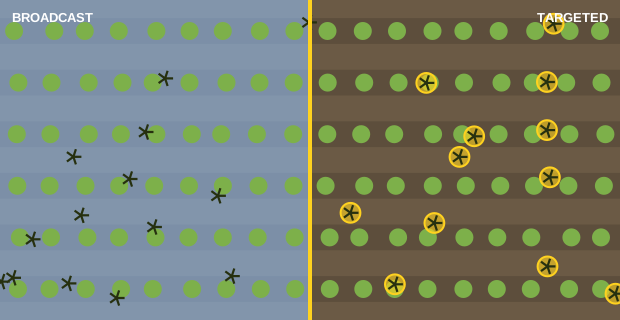
Bright illustration · not Carbon Robotics data

Illustration: the same field twice. On the left, the whole ground is tinted as sprayed. On the right, only a small patch around each of 26 weeds is treated.
Spray everything100%of the drawn ground treated
Target each weed≈ 4%of the drawn ground treated
Drag the divider (or use the arrow keys). Illustrative arithmetic, not a measurement: in this drawing, 26 weeds each get a small treated patch. Together those patches cover 4% of the drawn field. Real coverage depends on how many weeds there are. This is not Carbon Robotics’ model, machine or field data.
10 ma classroomsize of the setting6 / 14

AI helped students learn. Without teachers’ guardrails, it also got in the way.

Nigeria, 2025. Six weeks of teacher-supported, after-school AI tutoring raised scores by 0.31 standard deviations in a World Bank randomized trial.

DemonstratedThe intervention was short and teacher-supported, so it does not establish effects of unsupervised chatbot use.From Chalkboards to Chatbots: Evaluating the Impact of Generative AI on Learning Outcomes in Nigeria · 2025-05-19 · Open the record

Turkey, 2025. High-school students who studied math with an unrestricted GPT-4 chat did worse on exams taken without it. A tutor designed with teachers’ guardrails largely mitigated that harm.

DemonstratedThe study examined short-term exam outcomes in one high-school mathematics setting.Generative AI without guardrails can harm learning: Evidence from high school mathematics · 2025-06-25 · Open the record
Casey Harrell, wearing a head-mounted interface, at home with family members around him.
Documentary Casey Harrell at home with family, May 2026. Regents of the University of California, Davis, Credit as required by UC Davis.
1 mtwo people talkingsize of the setting7 / 14

Casey Harrell’s account

Not being able to communicate is so frustrating and demoralizing. It is like you are trapped. … Something like this technology will help people back into life and society.

Casey Harrell, quoted by UC Davis Health, August 2024

ALS left Casey’s thoughts intact but took his clear speech. Electrodes read the brain activity of the words he tries to say; AI decodes them into text, read aloud in a voice that sounds like his before ALS. The 2024 study reported 97.5% word accuracy. By 2026 he was using it at home, without researchers in the room.

EmergingOne participant with an implanted investigational device. Caregivers still helped set up the system. This is not general clinical availability or independent replication.Long-term independent use of an intracortical brain–computer interface for speech and cursor control · Nature Medicine (PubMed) · 2026-06-15 · Open the record · The 2024 study

The full human account

Researcher Nicholas Card adjusting equipment beside Casey Harrell.

Documentary Nicholas Card, the study’s lead author, readies the system. UC Regents, Credit as required by UC Davis.

Requested: UC Davis video of Casey’s first session — one visitor-started clip, captions on — and UC Davis’s view on featuring his quotation this prominently.

30 cmthe laptop in front of yousize of the setting8 / 14

Some capable AI now runs on the computer in front of you — and a few come with the whole recipe.

gpt-oss-20b fits. A reasoning model can run entirely on this machine — your questions don’t have to leave it.

OpenAI states gpt-oss-20b can run within 16 GB of memory and gpt-oss-120b within 80 GB.

What running on your own machine can change, once a model fits:

  • Once downloaded, it can work without an internet connection
  • Your questions can stay on your machine
  • No per-question API fee

Depends on the app you run it in. You still supply the hardware and electricity. OpenAI on self-hosting

DeployedA stated 16 GB memory requirement does not guarantee equally accessible hardware, energy use, or easy setup.Introducing gpt-oss · 2025-08-05 · Open the record
What each open model release includes
ReleaseWeightsCodeTraining dataFull recipe
OLMo 2 32BYesYesYesYes
Nemotron 3 SuperYesStatedStated
gpt-ossYesYesNoNo
Qwen3Yes

From each record’s reviewed source. “Stated” means the developer says it is released; “—” means not stated in that source.

Open intelligence, in depth

12 cma human heartsize of the subject9 / 14

In a double-blind randomized trial, an AI that finds where to treat an irregular heartbeat helped more patients stay free of atrial fibrillation a year later.

70%

Standard procedure · 183 patients

88%

AI-guided procedure · 187 patients

Free of atrial fibrillation 12 months after one procedure. Each dot is one patient; filled dots show the reported percentage, rounded.

DemonstratedThere was no significant between-arm difference in freedom from any atrial arrhythmia after one ablation.Artificial intelligence for individualized treatment of persistent atrial fibrillation: a randomized controlled trial · 2025-02-14 · Open the record
8 cman item in a robot’s gripsize of the setting10 / 14

A robot that knows when to stop squeezing.

Bright illustration · not Amazon’s robot or data

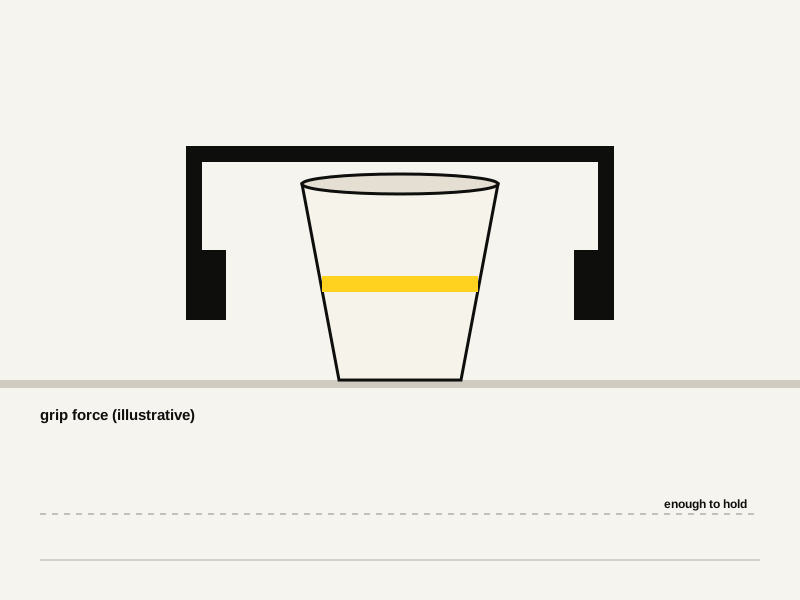
Illustration: a robot's two fingers around a paper cup, above a graph of grip force.

With sight only, the fingers close to the width they planned and crush the cup. With touch, the robot feels contact and stops at a gentle hold.

Bright illustration of why touch matters. The forces are drawn to explain the idea; they are not Amazon’s controller, telemetry or data.

Amazon’s Vulcan robot pairs cameras with force sensors, so it can feel how hard it’s pressing as it picks and stows items in crowded bins — and hands difficult cases to a person.

Amazon says Vulcan works in fulfillment centers in Spokane and Hamburg and can handle about 75% of the item types stored there.

Deployed · company-reportedAmazon's capability, ergonomics, and worker-development statements are company-reported; it provides no independent injury, error, pace, or job-quality results.Introducing Vulcan: Amazon's first robot with a sense of touch · source shows no date · Open the record

Requested: Amazon Vulcan footage, requested through the company newsroom.

A weathered stone block carved with Roman capitals; its upper left edge is broken away.
Context Inscription of a guild of flute players, Capitoline Museums, Rome. Not an inscription from the Aeneas study. Marie-Lan Nguyen, CC BY 2.5.
3 cma carved lettersize of the subject11 / 14

Historians working with an AI restored damaged Latin inscriptions better than either could alone.

Aeneas finds parallels among thousands of other inscriptions, proposes text for what’s missing, and estimates where and when a text was made. Historians found its parallels a useful starting point 90% of the time.

DemonstratedA generated restoration or attribution is a hypothesis, not recovered ground truth.Contextualizing ancient texts with generative neural networks · 2025-07-23 · Open the record
The inside of a mobile mammography unit: a screening machine, a control console and a narrow window.
Context Inside a mobile mammography trailer at Lysekil hospital, Sweden — a screening room that drives to the patient. Not a van in this record, and not a photograph taken in India. W.carter, CC BY 4.0.
12 mmwhat imaging findssize of the subject12 / 14

12 mm is the median size of a breast cancer found by imaging. Found by a hand — the woman’s own, or a clinician’s — the median is 21 mm. That is most of a stage.

Where almost nobody is looking

In India’s national hospital registry, among 40,526 women whose tumour size was recorded, 80.9% were already 3 cm or larger. In the last national survey, 0.9% of women aged 30 to 49 had ever had a clinical breast examination.

So the room drives to you

A mammography unit in a vehicle, a technician, a generator, and a way to move the images to someone who can read them. MedCognetics says its software runs on screening vans operated by Health Within Reach in India, and that more than 3,500 women have been screened. That account is the companies’ own; no independent evaluation of it exists.

Emerging · company-reported deploymentThe screening numbers and any account of lives saved come from the participating companies. No independent evaluation, audit or named patient exists, and early detection is not the same as a life saved.FDA 510(k) clearance K252482 — CogNet AI-MT+ (MedCognetics) · 2025-12-11 · Open the record

What the AI is allowed to do

One narrow thing: lift a suspicious exam up the radiologist’s reading queue. The FDA cleared it for triage and worklist prioritization only. It does not mark the lesion, it does not take a study out of the queue, and its own labelling says it must not be relied on to make or confirm a diagnosis. A person still reads every image.

The strongest trial of AI-assisted mammography, in more than 100,000 women in Sweden, found more cancers caught and about 12% fewer that surfaced between screens. Its authors state that it did not measure deaths.

And then the hard part

Finding it is not the end of it. In a camp-based screening programme across 148 villages in Varanasi district, only 220 of 732 people who screened positive — 30.1% — completed follow-up, with navigation, free transport and free diagnostics all offered.

Bright is publishing this because access is the whole story and it is a real one. It is not publishing a number of lives saved, because no source states one.

Illustration: small bright clusters of bacteria among larger grey fragments of debris.
Bright illustration Bright illustration: bacterial micro-colonies (bright) among look-alike food debris (grey). Not study data or a micrograph. Bright, drawn in code.
10 µma bacterial micro-colonysize of the subject13 / 14

Finding bacteria among the crumbs.

Food-safety screening has to spot tiny bacterial colonies hidden among look-alike debris. A deep-learning detector trained on both — chicken, spinach and cheese crumbs included — reported zero false positives in its tests.

ExperimentalThis is laboratory validation with selected bacteria and food matrices, not evidence of regulatory or commercial deployment.Deep learning enabled rapid detection of live bacteria in the presence of food debris · 2025-11-21 · Open the record

Placeholder: A micrograph from the study, or a clearly labeled public-domain micrograph, to replace this illustration.

10 nmone proteinsize of the subject14 / 14
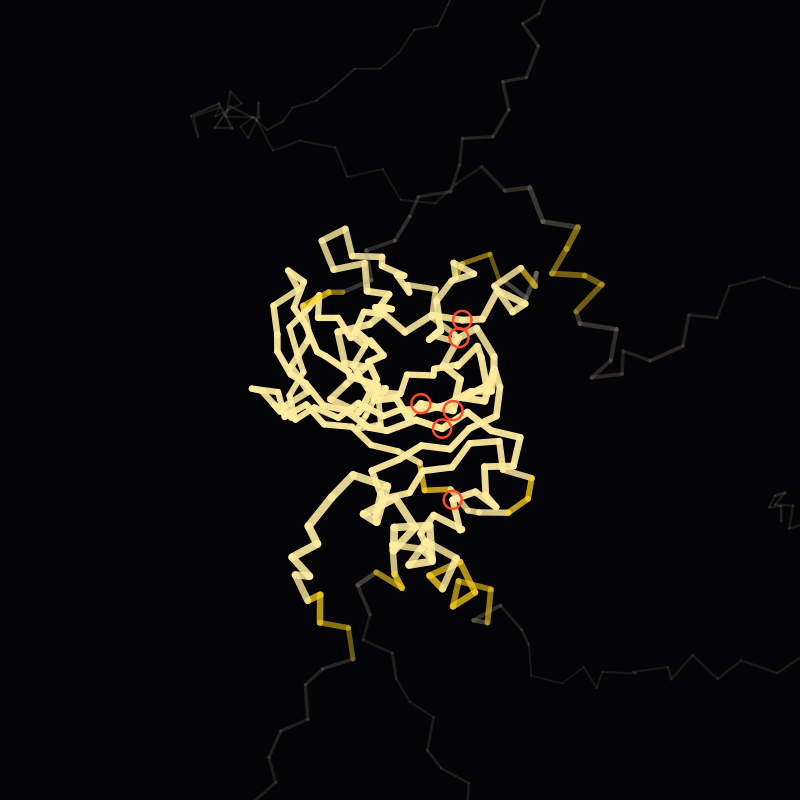
The predicted shape of human p53 drawn as a line of light. The confident core is bright; the long tails at both ends are dim. Six mutation hotspots are ringed in red inside the bright core.Drag or use arrow keys to turn

Interactive 3D drawing of the predicted p53 structure. Arrow keys turn it; plus and minus zoom. The text beside it describes what changes.

p53 helps stop damaged cells from becoming cancer. AlphaFold predicted its shape. Here, light is the model’s confidence.

393 of 393 building blocks shown

Shape
AlphaFold’s prediction
Light
its confidence (pLDDT), per building block
Rings & words
Bright’s editorial notes

All six sit in what’s left: the confident core that grips DNA. Confidence in the shape doesn’t explain why they matter — decades of cancer research does.

Demonstrated · a predictionPredictions carry uncertainty. A predicted structure does not establish function or prove a treatment works.Highly accurate protein structure prediction with AlphaFold · Nature · 2021-07-15 · Open the record · AlphaFold DB AF-P04637-F1, model v6 · CC BY 4.0

Across 12 major cancer types, TP53 is the most frequently mutated gene (42% of samples). Six positions — R175, G245, R248, R249, R273 and R282 — are widely regarded as mutation hotspots; all lie in p53’s DNA-binding domain. Sources: Kandoth et al., Nature 2013; Freed-Pastor & Prives, Genes & Development 2012; UniProt P04637.

Walk inside the molecule

Original Bright illustration · AI-generated

You just fell from 1025 meters to 10−8.

Thirty-three powers of ten, and 14 places where AI is doing documented work. Some of it is early. Some of it is already in people’s lives. All of it comes with sources you can check.

These 14 are a curated edition. The rest of Bright — 65 records, including programs and software releases with no honest physical size — lives in Now, the Index and search.

The future is something humanity builds.