
OpenAI wants its future data centers to turn down when communities need power
Its new Grid Protectors Program would make flexible electricity demand part of future campuses. A Georgia agreement shows the idea, but household savings remain a forecast.
- Maturity
- Emerging, stage 2 of 4
- Support
- 3 sources · institution
- Evidence detail
- How we know ↓
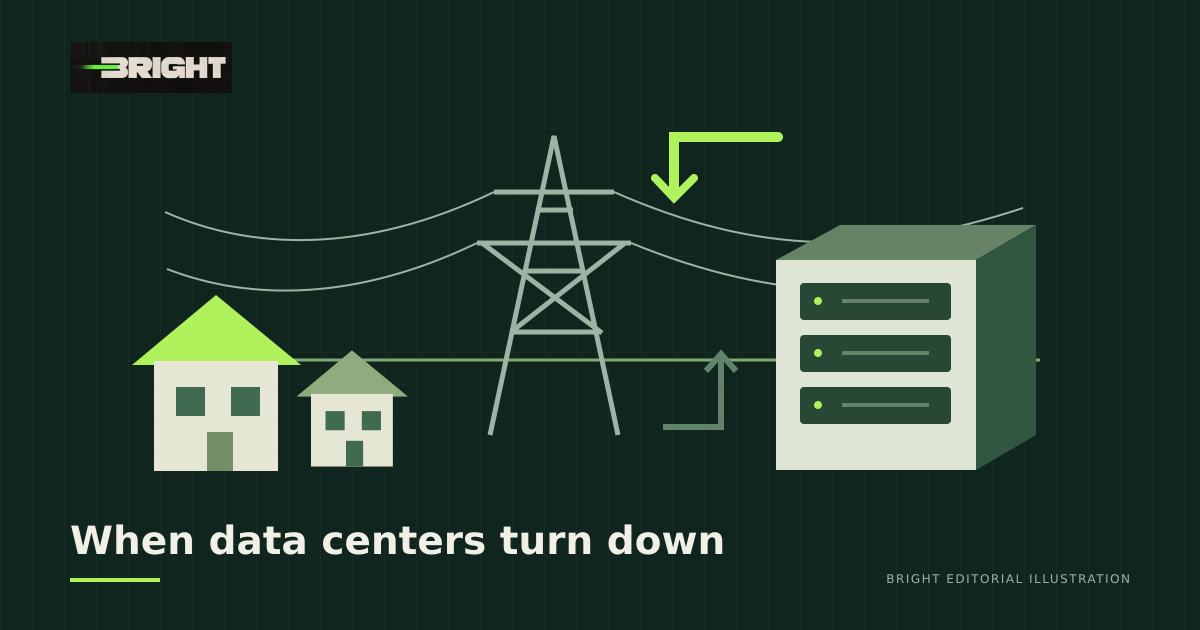
On a very hot afternoon, a household needs its air conditioning to work. A nearby AI campus needs electricity too. OpenAI’s new Grid Protectors Program proposes making its future campuses more flexible about how much power they draw when the system is under pressure.
Announced November 2, the national program aims to build arrangements with utilities and regulators that allow campuses to reduce demand during strain. OpenAI says the amount of power available, the speed of a reduction and its duration will depend on local agreements. Depending on the site, generation, storage and batteries could also play a role. Those arrangements are still being developed. OpenAI’s announcement
The everyday question is straightforward: can the infrastructure behind AI grow without leaving nearby families and small businesses to absorb its costs?
Georgia provides an existing example
OpenAI points to its planned campus in Effingham County, Georgia, as an intended pilot once it operates. The site is still in development. Grid Protectors
The electricity agreement is not new today. Georgia Power announced it in July and reported regulatory approval in August. The utility says the facility is expected to need about 3,200 megawatts, with up to 1,000 megawatts of flexible demand response under a 25-year agreement. That gives Georgia Power the ability to reduce electricity delivered to the facility at certain times. OpenAI is to pay the infrastructure and electric-service costs needed to serve it. July agreement
The distinction matters. One thousand megawatts is the stated upper limit of a demand-response commitment, not a record of power already released during an emergency. A contract describes what the parties agree to make possible. Operating evidence would show what happens when the utility actually needs that flexibility.
For residents, the useful reporting will be concrete: how often was the campus called on to reduce demand, how quickly did it respond, and how much reduction was sustained? Those questions turn a large headline number into an account of service to a community.
A forecast is not a lower bill today
Georgia Power’s August announcement forecasts approximately $950 million in annual customer savings beginning in 2029, equivalent to at least $15 a month for a typical residential customer using 1,000 kilowatt-hours. That projection covers the utility’s portfolio of large-load agreements and expected growth. It is not a claim that OpenAI alone produces all those savings, nor evidence that customers have already received them. Georgia Power’s August explanation
The utility says revenue from additional large customers can contribute to those projected benefits. Its account is primary evidence for what it expects, not an independent assessment of the eventual effect on bills.
OpenAI also acknowledges that flexible demand does not replace new electricity supply and transmission investment. Its announcement identifies long-term contracts and financial assurances as ways to protect other customers if projects change or do not proceed. Program commitments
What would make this valuable
Bright’s reading is that the program offers a useful standard against which future projects can be judged. A community should be able to ask not only how much power a campus wants, but what obligations accompany that demand.
A strong public account would distinguish promised flexibility from delivered flexibility, forecast savings from actual bills, and project costs from costs allocated to other customers. It would explain what happens if construction is delayed or the business needs less electricity than planned.
There is a constructive possibility here: AI infrastructure designed to be a more cooperative electricity customer, rather than simply a bigger one. Grid Protectors is a proposal to pursue that possibility. Whether it protects households will depend on the agreements, the physical systems and the results once they operate.
AI-assisted, source-reviewed Bright reporting. Cover: Bright editorial illustration, conceptual artwork rather than documentary evidence or measured outcomes. Bright has not firsthand-tested the systems described; interpretations are identified in the article.
How we know3 sources · checked 2026-11-02 · no corrections
Original sources
- OpenAI · Grid Protectors Program · November 2, 2026 ↗ · institution
- Georgia Power · Effingham County agreement · July 22, 2026 ↗ · institution
- Georgia Power · contract approval and portfolio savings forecast · August 26, 2026 ↗ · institution
Institutions: OpenAI · Georgia Power
- Maturity
- Emerging
- Event date
- 2026-11-02
- Source published
- 2026-11-02
- Captured
- 2026-11-02
- Last source review
- 2026-11-02
- Editorial method
- AI-assisted source review
Bright compared this account with the linked original and supporting sources and kept reported, budgeted, projected, and observed claims distinct. Bright did not independently audit the underlying records.
Maturity describes the tested or operational setting. Confidence describes support for the particular claim; one does not determine the other.
Revision & correction history
2026-11-02T23:30:00.563Z · Initial Bright publication with linked primary sources, source/publication date distinctions and explicit outcome limitations.
No corrections recorded.
Keep exploring
Explore the shared question in another setting. These connections do not imply replication.