
Johnny C. Taylor Jr. on the human opportunity in AI
SHRM President and CEO Johnny C. Taylor Jr. joins Justin Brady and Brandon Brooks to explore what people can build, how employers recognize talent, and why leaders should make room for human creativity.
- Maturity
- Emerging, stage 2 of 4
- Support
- 4 sources · report, institution
- Evidence detail
- How we know ↓
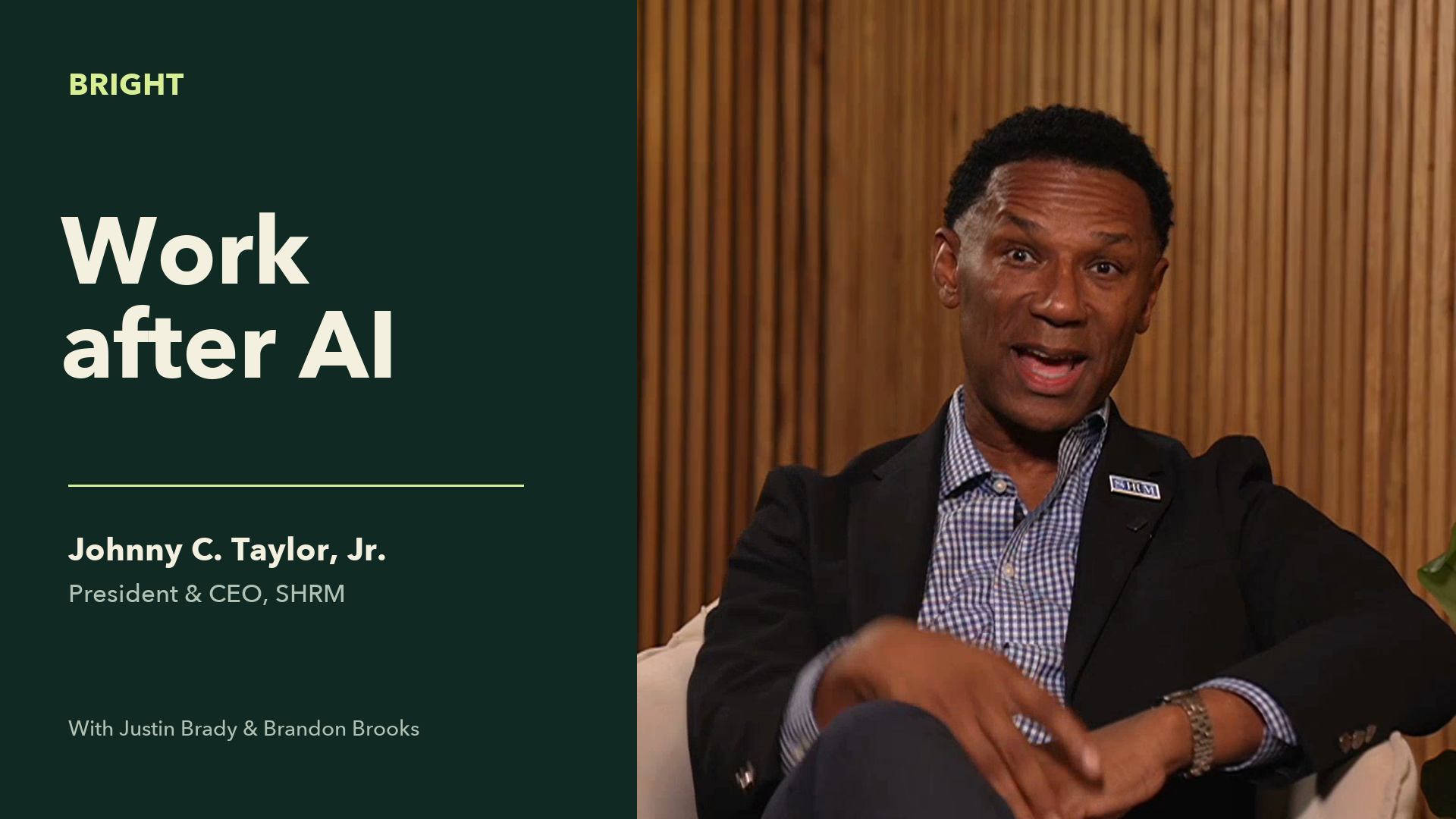
Loading this player connects to YouTube, which may collect data and use cookies. No video loads until you choose to load it.
Watch on YouTube ↗ (opens a new tab)Bright interview with Johnny C. Taylor Jr., hosted by Justin Brady and Brandon Brooks.
What could people do if less of their working day went to repetitive tasks?
For Johnny C. Taylor, Jr., that question starts with the potential already inside the person doing the work. In his conversation with Bright, the President and CEO of SHRM offers an encouraging view of the choices facing employers: recognize people’s skills, take their experience seriously, and think carefully about what new technology could give them room to create.
Joining hosts Justin Brady and Brandon Brooks, Taylor brings the conversation back to people who are building things. An employee with an idea. A candidate whose experience does not fit a conventional résumé. A founder whose business did not work out. His examples make a large conversation about AI and work feel concrete.
Making room for the creativity already there
Taylor’s starting point is generous: someone assigned to mechanical work still has creativity and ideas. A leader’s task is to help that potential find an outlet.
He illustrates the possibility with a hypothetical. If 80 percent of someone’s time went to rote work, and a bot could handle it, an employer could consider what the person might do with that freed time. Taylor points to developing a new product, innovating or reaching a different audience.
In that thought experiment, the benefit depends on what leaders choose to do with the newly available time. Before treating automation as a reason to eliminate a person, a leader can ask what else that person could contribute.
“You have so much more,” Taylor says, describing the message leaders can give their people. It is a simple, hopeful starting point for a conversation that can otherwise leave workers feeling like spectators.
Recognizing what people can do
Taylor also describes a shift in how HR looks at talent. He points to people who have worked at a startup or built an app, and to the skills those experiences can reveal.
“Can you do the work? Do you have the skills?” he asks.
In his account, this is already changing hiring conversations. Employers have more to consider than whether a candidate followed a familiar educational path. Building something can give an applicant another way to show what they can do.
Taylor is clear that college still has value and that some employers continue to favor a degree. His argument leaves room for both formal education and experience gained elsewhere. That is an important distinction for anyone making decisions about learning, hiring or their next career step.
Seeing the learning in an unsuccessful venture
The conversation becomes especially encouraging for people whose first attempt at building a business did not succeed.
Taylor says employers increasingly want people who have built things and failed, because of what they have learned from the experience. In his view, successful entrepreneurs are not the only people worth considering.
That perspective gives hiring teams a more interesting question to ask about an unsuccessful venture: what did the person learn from trying? It also gives founders a reason to explain their experience fully, rather than reducing it to whether the business survived.
His emphasis on learning invites employers to look closely at the person behind the outcome.
Building toward another possibility
Taylor describes another example he is seeing: an employee working a full-time job while creating a company in the evening.
The goal, as he describes it, is to grow that company to a point where it can support the person. That could make a future move possible or help them prepare for a change they did not choose. He sees opportunity in people being able to attempt things they could not have done before.
The appeal of this example is its sequence. The person is building toward another possibility while still employed. It makes Taylor’s optimism tangible: keeping today’s work going while giving a new idea a chance to grow.
A welcome conversation about work
Across these examples, Taylor keeps attention on human capability: creativity waiting for an opening, skills demonstrated through building, and lessons earned by trying.
Taylor offers a welcome perspective on AI and work. We are interested in the ways AI can help people do more, and in the decisions that make those possibilities real. Taylor gives employers and workers concrete questions to carry into that discussion.
His broader work offers readers ways to continue it. Taylor leads SHRM, writes the USA Today column Ask Johnny, and is the author of RESET: A Leader’s Guide to Work in an Age of Upheaval. Explore his official SHRM biography and RESET for more on his work and leadership thinking.
We are grateful to Johnny for joining the conversation, and to Justin for helping bring it to audiences.
Watch the full interview with Johnny C. Taylor Jr. on YouTube.
Guest: Johnny C. Taylor, Jr., President and CEO of SHRM. Hosts: Justin Brady and Brandon Brooks.
For more evidence-led stories about AI and human possibility, join the free Bright Weekly newsletter.
How we know4 sources · checked 2026-10-29 · no corrections
Original sources
- Bright interview with Johnny C. Taylor Jr. — full conversation ↗ · report
- SHRM — Johnny C. Taylor Jr. official biography ↗ · institution
- SHRM ↗ · institution
- RESET — official book site ↗ · institution
Institutions: SHRM
- Maturity
- Emerging
- Source published
- 2026-10-30
- Captured
- 2026-10-29
- Last source review
- 2026-10-29
- Editorial method
- AI-assisted source review
Bright compared this account with the linked original and supporting sources and kept reported, budgeted, projected, and observed claims distinct. Bright did not independently audit the underlying records.
Maturity describes the tested or operational setting. Confidence describes support for the particular claim; one does not determine the other.
Revision & correction history
2026-10-30T00:18:00.000Z · Original interview feature, with attributed views and qualifications; not an independent study or measured AI outcome.
2026-10-30T13:20:00.000Z · Replace prelaunch private-video status with dated public-availability verification; no audio/playback verification claimed. Article and sources unchanged.
No corrections recorded.
Keep exploring
Explore the shared question in another setting. These connections do not imply replication.