
AI imagined the ceramic panel. Clay changed the design.
In an interview with Bright, designer Saniye Fışgın Korkmaz describes what happened when a promising AI image met shrinking clay, a kiln and the knowledge of a ceramic artist.
- Maturity
- Experimental, stage 1 of 4
- Support
- 2 sources · paper, report
- Evidence detail
- How we know ↓
A picture was only the beginning
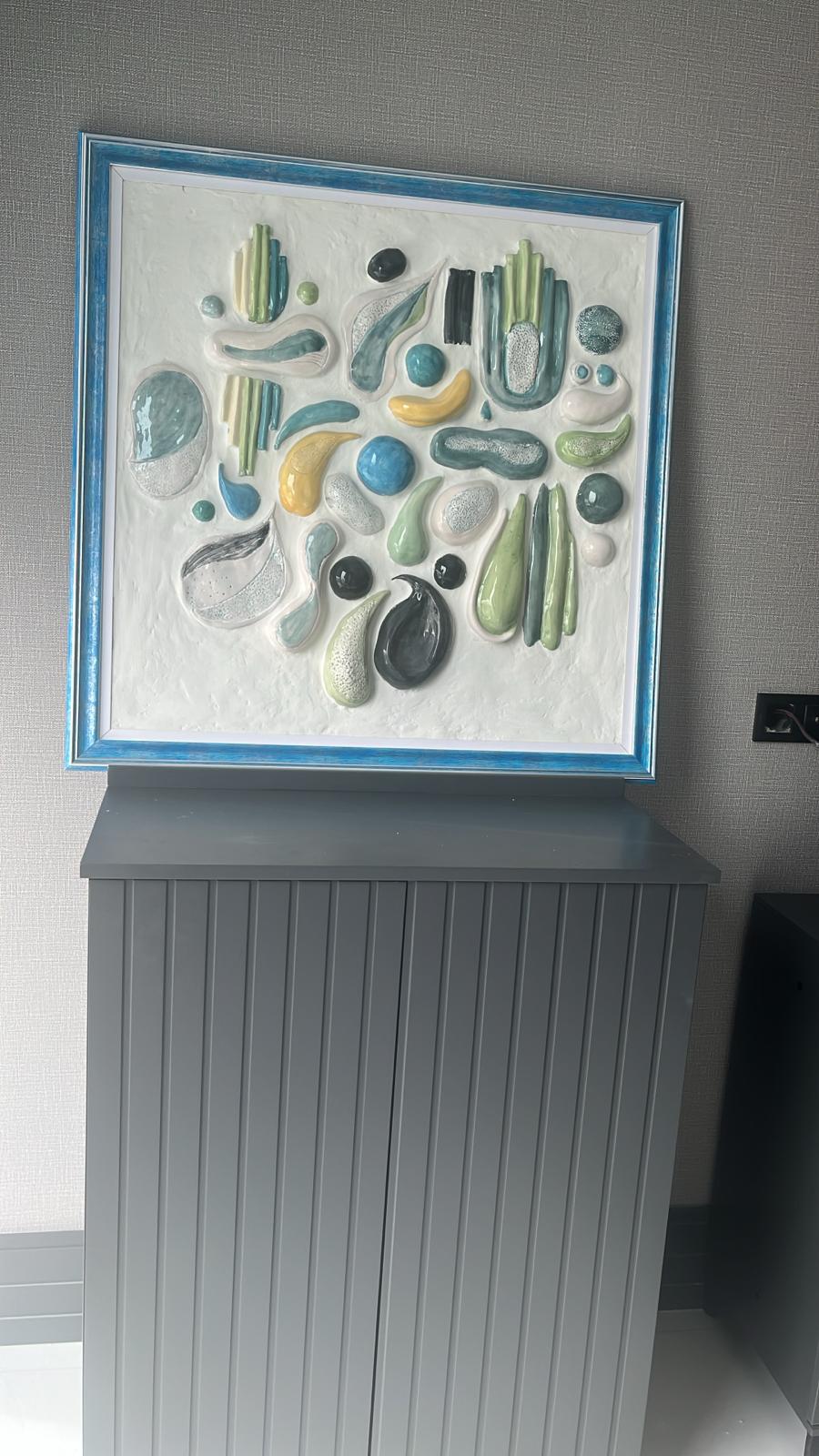
The finished wall panel is a collection of rounded shapes, ridges and glossy pools of color, set inside a blue frame. It began as an AI-generated concept. Getting it into clay required decisions the image could not make.
Dr. Saniye Fışgın Korkmaz, an industrial designer and design educator, wanted to experience that gap herself. She had been making ceramics at Şenay Öztürk’s studio for about a year when she decided to explore how AI-assisted design would change a familiar creative process. The practical work took place in 2024. In email answers to Bright on November 10, 2026, she described both the finished objects and the choices behind them.
The result was not a machine producing a ceramic object. Fışgın Korkmaz selected and interpreted visual concepts, while Öztürk helped turn them into physical forms. Their work shows where a quick way to explore ideas can be useful, and where making still depends on a person who understands the material.
The pieces would not simply fit
A plate and a door number presented relatively few technical difficulties, Fışgın Korkmaz said. The wall panel was different. Its scale and intricate, fragmented structure made it much harder to reproduce.
“The AI designed a highly fragmented, multi-piece structure where each unique part had to interlock perfectly,” she told Bright.
Clay changes during production. It shrinks as it dries and is fired, and the panel’s pieces did not keep the relationships suggested by the generated image. Fışgın Korkmaz said she was also working primarily by eye rather than from precise measurements. Proportions shifted, and some smaller components were lost along the way.
The finished panel consequently diverged substantially from its digital starting point. She described it as aesthetically mature and highly individual, but the route to it involved resolving physical problems, not simply copying a picture.
“It taught me a vital lesson about the friction between flawless digital generation and unpredictable material realities,” she said.
For someone looking at a polished AI concept, that is a useful distinction. A convincing image can suggest a direction without establishing how its parts will be formed, joined, glazed or fired.
Two kinds of experience mattered
Fışgın Korkmaz brought professional design knowledge to the experiment. Geometry, color, proportion and design styles helped her write prompts and choose among the generated concepts. The selection was part of the design work, not a neutral step performed automatically by the model.
Öztürk supplied the ceramic expertise: building and shaping forms, preparing and applying glazes and underglazes, and helping with details beyond Fışgın Korkmaz’s own making skills at the time.
“For the complex, AI-generated details that were physically challenging for me to execute at my current skill level, I leaned heavily on her exceptional craftsmanship and production capabilities,” Fışgın Korkmaz said.
This was an experienced designer learning a craft with guidance from a ceramic artist. It does not establish that someone without either background would get the same result. Fışgın Korkmaz recommends basic material knowledge and direct guidance from a ceramic artist for a newcomer attempting something similar.
More possibilities, sometimes more work
Asked whether AI saved effort, Fışgın Korkmaz drew a clear line between imagining and making.
“AI didn't exactly save me physical time,” she said. It expanded the options available during ideation, but the intricate structures it suggested could create extra manual work when she tried to realize them.
She also resisted the idea that AI had made possible something she otherwise could not design. Her existing skills would have allowed her to design the products without it, she said. What changed was the creative journey and the eventual outcome.
That is a modest but tangible benefit: another way to investigate possibilities. In this case, faster ideation did not remove the need for patience, judgment or skilled help. It could increase the difficulty of the object a maker chose to pursue.
What happened afterward
The panel remains on display, Fışgın Korkmaz told Bright, although it developed some cracks during repeated firing. That is her account of the object’s condition, not an independent durability or safety assessment.
She continues to use AI for two-dimensional visual concepts, but has not used it extensively for physical craft since this project. She enjoys the tactile process of sketching and designing from scratch. A new AI-assisted ceramic trial is something she plans to attempt, not a completed follow-up with results to report.
The existing panel offers its own conclusion. The generated image helped start a process. Design judgment, ceramic knowledge and repeated work with a changing material determined what could actually be made.
How we know
Bright interviewed Dr. Saniye Fışgın Korkmaz by email on November 10, 2026. She authorized publication of her answers by name and supplied the finished-panel photograph for Bright’s website. Photo: Saniye Fışgın Korkmaz. Her practice-based paper provides the project’s published background.
This is one practitioner’s account, not a controlled comparison of AI-assisted and conventional craft. The work occurred in 2024; the interview is a later update. Bright has not independently inspected or tested the objects. No measured time saving, product-safety result or general claim about copyright is established here.
Keep the evidence together · share a card
BRIGHT / EVIDENCE TO KEEP
AI imagined the ceramic panel. Clay changed the design.
Possible benefit · Bright interpretation
The practitioner describes expanded design possibilities while showing why material skills and human guidance remained necessary.
Documented result · source-backed
The finished panel consequently diverged substantially from its digital starting point. She described it as aesthetically mature and highly individual, but the route to it involved resolving physical problems, not simply copying a picture.
Limits & unknowns
This is one practitioner’s account, not a controlled comparison of AI-assisted and conventional craft. The work occurred in 2024; the interview is a later update. Bright has not independently inspected or tested the objects. No measured time saving, product-safety result or general claim about copyright is established here.
What would a later trial with newer tools and greater ceramic experience show?
How would beginners without professional design experience perform with comparable guidance?
Evidence state: Experimental. Source check: 2026-11-10T13:26:13Z. A source check is not independent replication.
Ceramic Design and the Role of Generative AI: A Practice-Based Exploration · Arts: https://doi.org/10.3390/arts15110252
Bright original interview with Dr. Saniye Fışgın Korkmaz · November 10, 2026: https://brightaifuture.com/discoveries/ai-ceramic-panel-clay-craft#how-we-know
https://brightaifuture.com/discoveries/ai-ceramic-panel-clay-craft
How we know2 sources · checked 2026-11-10T13:26:13Z · no corrections
Original sources
- Maturity
- Experimental
- Event date
- 2024
- Source published
- 2026-11-10
- Captured
- 2026-11-10T13:26:13Z
- Last source review
- 2026-11-10T13:26:13Z
- Editorial method
- AI-assisted source review
Bright compared this account with the linked original and supporting sources and kept reported, budgeted, projected, and observed claims distinct. Bright did not independently audit the underlying records.
Maturity describes the tested or operational setting. Confidence describes support for the particular claim; one does not determine the other.
Revision & correction history
2026-11-10T13:26:13Z · Original interview follow-up on 2024 practice-based ceramic work; limits and attribution preserved.
No corrections recorded.