
AI freelance projects have bigger budgets. What are clients buying?
A new OpenAI–Upwork report points to broader assignments, with a much smaller difference in hourly rates. For freelancers, the useful question is what a finished project requires.
- Maturity
- Emerging, stage 2 of 4
- Support
- 3 sources · paper, institution
- Evidence detail
- How we know ↓
A larger project budget can look like an opportunity until the extra work arrives. For a freelancer deciding what to offer or how to price an assignment, the difference between charging more and doing more matters.
Research released by OpenAI and Upwork on November 10 offers an early view of that distinction. Its most useful finding is also easy to misread: AI-related projects had higher advertised budgets, but that does not establish higher earnings for an individual worker. OpenAI’s announcement
Three numbers that need to stay together
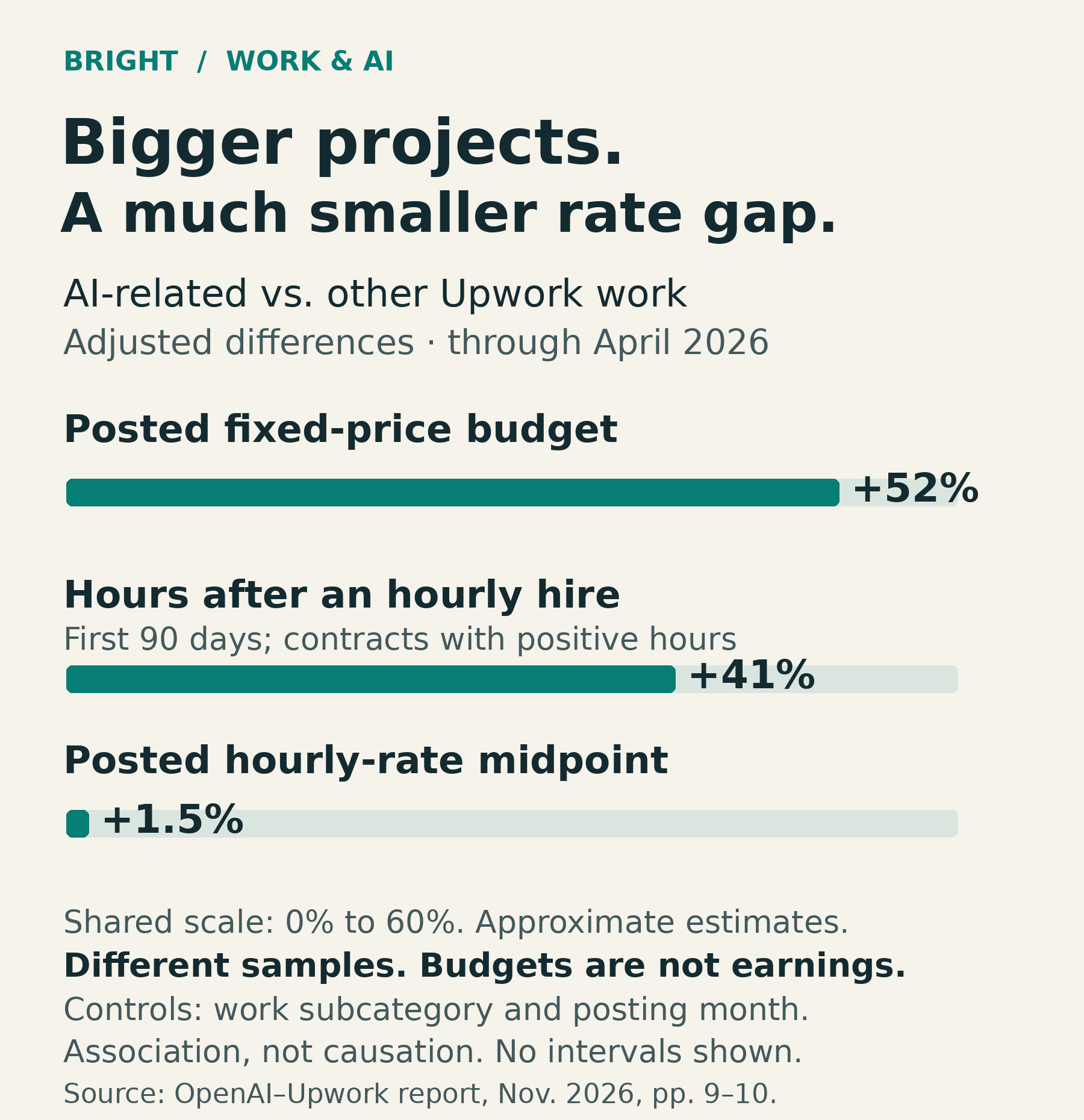
The report compares AI-related and other Upwork work through April 2026, adjusting for work subcategory and posting month. It reports about 52% higher fixed-price budgets, 1.5% higher midpoints of posted hourly-rate ranges and 41% more first-90-day hours among hired hourly contracts with positive recorded hours. Those are different samples and outcomes. Posted budgets are not payments; these are descriptive comparisons, not causal estimates. Full report, section 2.2 and Appendix B
You cannot combine those percentages into a freelancer’s expected raise. Nor does controlling for category and month make the projects identical. A more demanding client, a longer assignment or a different mix of expertise could still distinguish the work on either side of the comparison.
Consider an illustrative assignment: a business wants a product video. Generating clips might be one part of the job. Selecting usable footage, checking product claims, securing appropriate rights, editing the sequence and handling revisions all affect what it takes to deliver. The price that makes sense depends on that complete commitment. This is a hypothetical example, not an observed client outcome.
The opportunity is in the whole assignment
Across AI-related postings, the task mix broadened between early 2023 and late 2025. Individual AI-related postings also contained more historically unusual task combinations than other postings. Upwork used an AI-based classifier that considers the posting’s title, description, requested skills and other context. The analysis describes one marketplace, not the entire labor market. Its ChatGPT and Upwork datasets do not track the same people. Full report
Bright’s reading is that this makes the project brief worth examining closely. A freelancer could test a service built around a complete, verifiable result: a working integration, an edited video or a reviewed document. The offer should explain what will be delivered, what will be checked and where the freelancer’s responsibility ends. That is a practical response to the evidence, not a promise that adopting AI will win more work.
For clients, the same logic favors clear acceptance criteria. A request to “use AI” says little about the quality, reliability or rights required in the final product. Describe the result and the review process before choosing the tool.
Bigger projects can coexist with lost work
Earlier research by Xiang Hui, Oren Reshef and Luofeng Zhou found reduced employment and earnings among freelancers in occupations more exposed to generative AI. Their study, published in Organization Science in 2024, concerns the short-term effects of earlier model releases. It is a separate piece of evidence, not a replication of the new report. Published study
Both patterns can exist at once. Some workers can lose assignments while other clients commission larger ones. Measuring the size of a selected group of projects does not tell us whether enough opportunities exist, who can obtain them or how the proceeds are distributed.
What would make the opportunity real?
The new report is jointly authored by staff at OpenAI and Upwork, companies with a stake in this market. Bright reviewed its methods, but has not independently reproduced the analysis. Report and authorship
The next useful evidence would follow workers over time: completed contracts, take-home earnings, unpaid bidding and training time, repeat clients and access to work for newcomers. A larger posted budget is a reason to investigate a service opportunity. A durable improvement in people’s working lives needs evidence beyond the brief.
What was shown, and what wasn’t
Shown
OpenAI–Upwork reports adjusted differences of about 52% in posted fixed-price budgets, 1.5% in midpoints of posted hourly-rate ranges and 41% in first-90-day hours among hired hourly contracts with positive hours. These are distinct outcomes, not a worker pay increase.
Not shown · limits
- Posted budgets and rates are not realized earnings. The hours analysis includes only hired hourly contracts with positive recorded hours.
- Adjusted associations do not establish causation or comparisons of identical projects. Upwork and ChatGPT do not represent the entire labor market; their users are not directly matched.
- OpenAI and Upwork authored the report. Bright has not independently reproduced its analysis. Earlier employment research covers a different period and does not validate these new estimates.
Bright editorial interpretation
Freelancers can assess complete deliverables, verification duties and scope before treating a larger advertised budget as an attractive opportunity.
Still open
Do completed projects improve take-home earnings after bidding, training, tools and review time?
Who gains access to the larger assignments, and who loses work?
Do benefits persist for repeat clients and newcomers over time?
Keep the evidence together · share a card
BRIGHT / EVIDENCE TO KEEP
AI freelance projects have bigger budgets. What are clients buying?
Possible benefit · Bright interpretation
Freelancers can assess complete deliverables, verification duties and scope before treating a larger advertised budget as an attractive opportunity.
Documented result · source-backed
OpenAI–Upwork reports adjusted differences of about 52% in posted fixed-price budgets, 1.5% in midpoints of posted hourly-rate ranges and 41% in first-90-day hours among hired hourly contracts with positive hours. These are distinct outcomes, not a worker pay increase.
Limits & unknowns
Posted budgets and rates are not realized earnings. The hours analysis includes only hired hourly contracts with positive recorded hours.
Adjusted associations do not establish causation or comparisons of identical projects. Upwork and ChatGPT do not represent the entire labor market; their users are not directly matched.
OpenAI and Upwork authored the report. Bright has not independently reproduced its analysis. Earlier employment research covers a different period and does not validate these new estimates.
Do completed projects improve take-home earnings after bidding, training, tools and review time?
Who gains access to the larger assignments, and who loses work?
Do benefits persist for repeat clients and newcomers over time?
Evidence state: Emerging. Source check: 2026-11-10T17:01:34.029Z. A source check is not independent replication.
OpenAI and Upwork · November 2026 · full report, section 2.2 and Appendix B; descriptive marketplace analysis: https://cdn.openai.com/pdf/openai-upwork-full-report.pdf
OpenAI · November 10, 2026 · research announcement: https://openai.com/index/ai-effect-on-freelance-work/
Hui, Reshef and Zhou · Organization Science, 2024 · earlier study of employment and earnings after generative AI releases: https://doi.org/10.1287/orsc.2023.18441
https://brightaifuture.com/discoveries/ai-freelance-work-bigger-projects
How we know3 sources · checked 2026-11-10T17:01:34.029Z · no corrections
Original sources
- OpenAI and Upwork · November 2026 · full report, section 2.2 and Appendix B; descriptive marketplace analysis ↗ · paper
- OpenAI · November 10, 2026 · research announcement ↗ · institution
- Hui, Reshef and Zhou · Organization Science, 2024 · earlier study of employment and earnings after generative AI releases ↗ · paper
Institutions: OpenAI · Upwork
- Maturity
- Emerging
- Event date
- 2026-11-10
- Source published
- 2026-11-10
- Captured
- 2026-11-10T16:36:29Z
- Last source review
- 2026-11-10T17:01:34.029Z
- Editorial method
- AI-assisted source review
Bright compared this account with the linked original and supporting sources and kept reported, budgeted, projected, and observed claims distinct. Bright did not independently audit the underlying records.
Maturity describes the tested or operational setting. Confidence describes support for the particular claim; one does not determine the other.
Revision & correction history
2026-11-10T16:36:29Z · Initial source report on freelance project budgets, hours and scope, with causal and worker-outcome limits.
No corrections recorded.