
Amazon’s Built Together puts a new promise to data-center communities on the record.
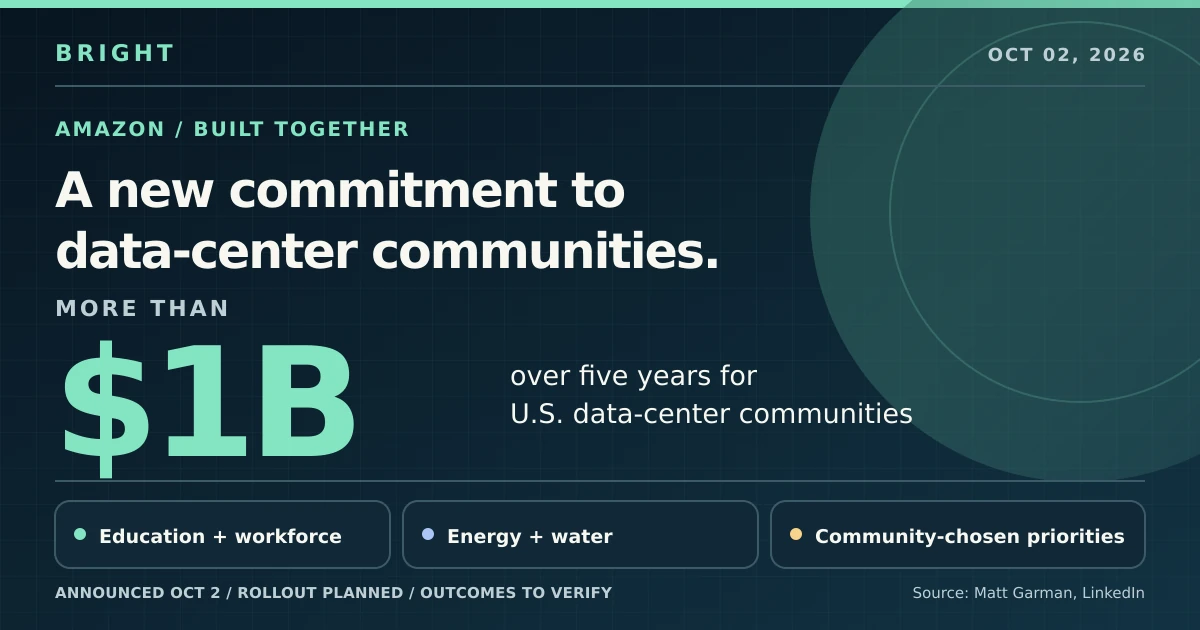
Amazon announced more than $1 billion over five years for U.S. data-center communities on October 2. Its Built Together framework covers education and workforce pathways, energy and water solutions, and locally chosen priorities. Rollout is planned; benefits delivered to residents remain to be verified.
- Maturity
- Emerging, stage 2 of 4
- Support
- 3 sources · institution, report
- Evidence detail
- How we know ↓
People living near a data center need a clear answer to a practical question: what will this investment make possible for their household and community? Jobs, public services and affordable utilities matter alongside the infrastructure’s demands on land, power and water.
A large investment headline does not tell a resident whether they qualify for help, when a program will open, or who can hold its delivery accountable. Local benefits depend on rules, participation and results that people can inspect.
This is a community-investment announcement connected to the infrastructure used for cloud services and AI. Bright is not claiming that an AI system awarded grants or produced the promised community benefits.
What was shown, and what wasn’t
Shown
AWS CEO Matt Garman’s October 2 announcement introduces Built Together, beginning in U.S. data-center communities, with more than $1 billion in additional investment over five years. The announced priorities are education and workforce pathways, energy affordability and water solutions, and flexible funding for community-selected needs. The education proposal includes filling remaining student costs after financial aid; it is not a promise that every student everywhere can attend any college at Amazon’s expense. Energy upgrades and local funding are planned programs, not reported outcomes of this new commitment.
Not shown · limits
- The October 2 announcement establishes a commitment and planned rollout, not that the new funds have been paid or the promised benefits delivered. Eligibility, partner-specific rules and application details are still forthcoming.
- Education and training access, energy savings and local projects must be assessed as they are implemented. The funding headline does not establish a job guarantee, a measured household saving or an independently verified community outcome.
- Community investment does not by itself settle a data center’s electricity rates, water use, noise or public costs. Those questions still need local utility, government and operating evidence.
Bright editorial interpretation
Bright’s analysis: a useful community agreement makes an opportunity concrete enough for people to act on. A resident should be able to identify the administrator, eligibility, application date and funding rules without relying on a corporate headline. If communities can influence the priorities and see spending and outcomes reported, this commitment could become a more accountable part of the AI buildout. The next evidence should trace money to an actual service: a completed course, a verified bill reduction, or a local project residents helped choose. Spending, access and benefit are separate milestones. A dollar disbursed is not proof that the intended people were reached, and a participant count is not proof of a lasting improvement.
Still open
Which communities and residents will qualify, who will administer each program, and when will applications open?
What spending and outcome reports will distinguish money committed, money paid, people reached and benefits delivered?
How will residents influence priorities and challenge decisions when needs differ?
How we know3 sources · checked 2026-10-02 · no corrections
Original sources
- Matt Garman’s Built Together announcement · October 2, 2026 · company primary source ↗ · institution
- Bright’s approved companion report · Amazon Built Together and data-center communities ↗ · report
- AP coverage of Amazon’s Built Together announcement ↗ · report
Institutions: Amazon · Amazon Web Services
- Maturity
- Emerging
- Event date
- 2026-10-02
- Source published
- 2026-10-02
- Captured
- 2026-10-02
- Last source review
- 2026-10-02
- Editorial method
- AI-assisted source review
- Place / relevance
- United States · unspecified
Bright compared this account with the linked original and supporting sources and kept reported, budgeted, projected, and observed claims distinct. Bright did not independently audit the underlying records.
Maturity describes the tested or operational setting. Confidence describes support for the particular claim; one does not determine the other.
Revision & correction history
2026-10-02 · Amazon’s Built Together puts a new promise to data-center communities on the record.
No corrections recorded.
Keep exploring
Explore the shared question in another setting. These connections do not imply replication.