
CERN and Mistral plan a physics model for the next era of collider data
A statement of intent opens a new research effort. Existing particle-reconstruction work shows why the idea is promising, and how much evidence a broader model will need.
- Maturity
- Emerging, stage 2 of 4
- Support
- 5 sources · institution, paper
- Evidence detail
- How we know ↓
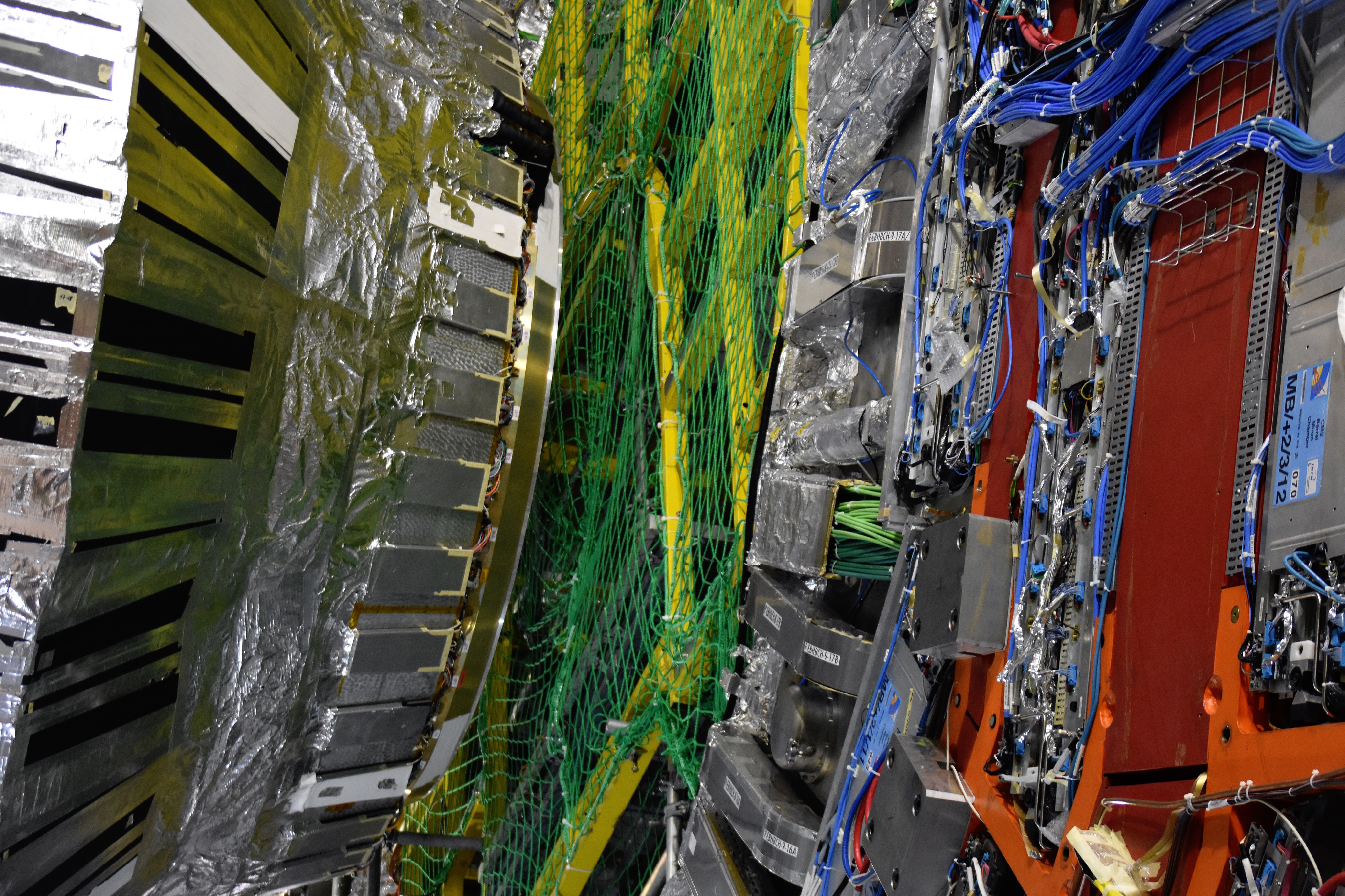
CERN and Mistral have announced plans to develop a Large Physics Model: a shared AI foundation for several tasks in collider research. CERN’s 15 October 2026 announcement reports a signed statement of intent, with training envisaged on billions of simulated proton-proton collisions. The proposed uses include reconstructing events, identifying particles, investigating unusual signals and assessing detector designs. No working model, performance results, budget or delivery schedule accompany the announcement. CERN announcement
The scientific opportunity is easier to understand through work already under way. Particle detectors record signals that researchers must turn into a usable account of a collision. CMS, one of the LHC experiments, has traditionally combined information from different detector systems using a particle-flow algorithm with many hand-crafted rules. In February, the collaboration described a machine-learning approach that replaces much of that logic with a model trained on simulated collisions. CMS’s February account
That separate project offers evidence, rather than just ambition. A CMS paper first submitted on 24 January 2026 and updated to its published version on 2 September reports performance comparable to conventional particle-flow reconstruction in both simulation and data. It also reports better jet-energy resolution in specified simulated events and faster inference in its test setup. Those findings belong to the CMS algorithm, not the proposed CERN–Mistral model. Published CMS research
The new partnership raises a broader question: can a common pretrained representation support several scientific jobs, instead of requiring a separate starting point for each? Bright’s reading is that the potential payoff lies in reuse. If knowledge learned for reconstruction transfers reliably to another task, researchers could spend less effort rebuilding the same foundations and more on testing their scientific ideas.
The timing gives that question practical weight. CERN’s High-Luminosity LHC upgrade is expected to operate from around 2030. Its stated target is ten times the integrated luminosity of the LHC’s original design, meaning a much larger accumulated dataset. The upgrade also brings more simultaneous collisions for experiments to disentangle. Better reconstruction could help turn that complexity into useful measurements. CERN’s upgrade overview
But a common model will need more than an impressive average score. A sensible assessment would compare it with strong specialist methods, examine rare cases and test performance on real detector data. Researchers will also need to know how failures vary when conditions change. These are evaluation priorities suggested by the proposal, not capabilities demonstrated in the announcement.
Sharing is another question to watch. CERN expresses an ambition for capabilities that benefit the wider physics community, but the announcement does not specify release terms. Readers should not infer that weights, training data or software will be publicly available under a particular licence. CERN announcement
The next meaningful milestone would be a technical account with reproducible comparisons, a defined scope and a clear route for researchers to use or scrutinise the work. Existing CMS results make the direction credible. The partnership now has to show whether a broader model can earn its place alongside the specialised tools physicists already trust.
What was shown, and what wasn’t
Shown
CERN’s 15 October 2026 announcement reports a signed statement of intent with Mistral to develop a Large Physics Model; no working model or performance results accompany the announcement.
Not shown · limits
- This is an announced research effort, not a demonstrated model, discovery or production deployment; no budget or delivery schedule is provided.
- The cited CMS reconstruction findings concern a separate algorithm and must not be attributed to the proposed CERN–Mistral model.
- The announcement does not specify release terms for weights, training data or software.
- The tenfold upgrade target concerns integrated luminosity relative to the original LHC design; the collider schedule is not a model deadline.
- Reuse benefits and evaluation priorities are conditional Bright analysis, not partner promises.
Bright editorial interpretation
A common pretrained representation could support reuse across scientific tasks if it demonstrates reliable gains over strong specialist methods.
Still open
Will a shared foundation improve on strong specialist methods on real detector data and rare cases?
What scope, reproducible comparisons and release terms will be provided?
How we know5 sources · checked 2026-10-16 · no corrections
Original sources
- CERN announcement ↗ · institution
- CMS’s February account ↗ · institution
- Published CMS research ↗ · paper
- CERN’s upgrade overview ↗ · institution
- Published CMS article DOI (separate reconstruction research) ↗ · paper
Institutions: CERN · Mistral AI · CMS Collaboration
- Maturity
- Emerging
- Source published
- 2026-10-15
- Captured
- 2026-10-16
- Last source review
- 2026-10-16
- Editorial method
- AI-assisted source review
- Place / relevance
- CERN · institution-location
Bright compared this account with the linked original and supporting sources and kept reported, budgeted, projected, and observed claims distinct. Bright did not independently audit the underlying records.
Maturity describes the tested or operational setting. Confidence describes support for the particular claim; one does not determine the other.
Revision & correction history
2026-10-16T09:45:02.265Z · Initial account of CERN and Mistral’s statement of intent, distinguishing proposed capabilities from separate CMS research; includes an archival CMS photograph.
No corrections recorded.