
What happens when an epilepsy monitor listens to its patient?
A small hospital study lets patients ask questions about their own brain recordings and help researchers improve how those signals are interpreted.
- Maturity
- Experimental, stage 1 of 4
- Support
- 2 sources · institution, paper
- Evidence detail
- How we know ↓
An epilepsy monitor records signals from the brain. The person wearing it has another kind of information: what the experience felt like. Bringing those perspectives together could give patients a more active part in understanding the technology around them.
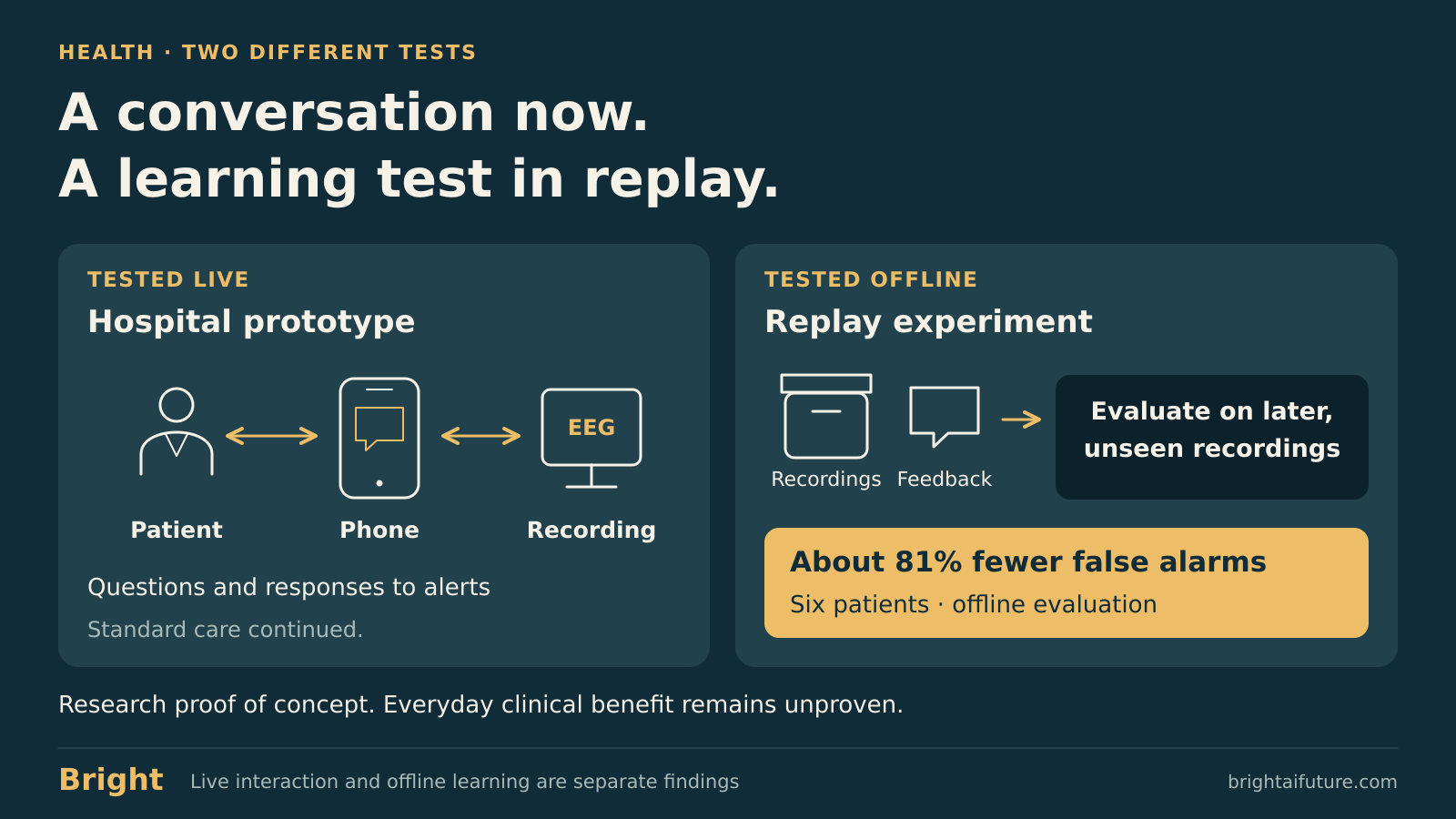
Researchers at the University of Pennsylvania built a smartphone interface linking patients to their EEG monitoring data. Participants could ask questions about their records, receive notifications and respond to alerts. More than 1,300 messages passed between patients and the system. Several participants asked whether they could keep using it at home, according to the NIH’s account. They could not: this was a research prototype. NIH announcement, 13 October
The study involved 13 hospitalized adults at one center. The conversational AI was separate from the seizure detectors. Patients continued to receive standard care. Nature Medicine paper
The interesting possibility is a two-way relationship with a medical device. A patient could ask what a record means, flag something that felt unusual or say that an alert did not match their experience. A useful interface would also make room for uncertainty. Being able to answer “I’m not sure” matters when neither a signal nor a recollection can settle a question alone.
Two different tests
The strongest detector result came from an offline replay. Using app feedback from six patients, researchers reported about 81% fewer false alarms when fine-tuned models were tested on later, unseen recordings. The detectors were not shown improving through live adaptation during care. Methods and Figure 5c
Live alerts exposed a substantial weakness. For the 11 participants with the annotation feature, alerts identified eight of 59 clinician-confirmed seizures; eight of 58 alerts corresponded to seizures. The first two participants did not have that feature. The study did not establish better health outcomes or reliable home use. Seizure-detection results
A replay can test whether earlier feedback helps interpret later recordings. Everyday use adds further questions: will people answer an alert while working, sleeping or caring for someone? What happens when they miss it? Can a correction be made without creating more work than it saves?
The distinction matters for patients. A promising learning method still needs a dependable way to decide when to interrupt someone, how to explain uncertainty and when a person should review the result.
Participation should be worth the effort
For Bright, the next useful milestone is whether two-way interaction makes life with a monitoring device more understandable and manageable.
That calls for more than counting messages. A busy conversation might reflect curiosity, confusion or the effort needed to fix misunderstandings. Researchers could ask whether patients get answers they can use, whether unwanted alerts decrease and whether the system leaves them with less work overall. People who prefer fewer interactions should have a place in that assessment, too.
Feedback also needs a clear destination. Someone answering a device should know what their response may change, whether anyone is reviewing it and how to reach the care team. Those expectations belong in the design and in future testing.
A wider evaluation would need to include people with different communication needs and different levels of comfort with technology. It should examine what happens after the novelty wears off, when an interface becomes one more thing competing for attention.
This early study makes patient participation a concrete research possibility. The encouraging idea is that people’s questions and corrections can help shape a system built around them. The test ahead is whether that participation produces a benefit they can recognize in daily life.
Evidence note
Goldblum, Shi and colleagues’ paper was published on 13 October 2026. Goldblum, Shi and Litt disclose a pending Penn provisional patent covering the system. Bright’s discussion of future evaluation is editorial analysis, not medical advice or an independently replicated result.
How we know2 sources · checked 2026-10-15 · no corrections
Original sources
- NIH announcement, 13 October ↗ · institution
- Nature Medicine paper ↗ · paper
Institutions: University of Pennsylvania
- Maturity
- Experimental
- Source published
- 2026-10-13
- Captured
- 2026-10-15
- Last source review
- 2026-10-15
- Editorial method
- AI-assisted source review
Bright compared this account with the linked original and supporting sources and kept reported, budgeted, projected, and observed claims distinct. Bright did not independently audit the underlying records.
Maturity describes the tested or operational setting. Confidence describes support for the particular claim; one does not determine the other.
Revision & correction history
2026-10-15 · First prepared version of the reviewed manuscript, with primary sources and explicit evidence limits.
No corrections recorded.