
Google’s AI helps a robot sort car parts. What would make it useful all day?
Google reports a promising factory result with Gemini Robotics 2.5. For the people working beside it, reliable recovery and less tiring work will matter just as much.
- Maturity
- Emerging, stage 2 of 4
- Support
- 3 sources · institution, government
- Evidence detail
- How we know ↓
A tray of correctly sorted car parts is an unglamorous kind of progress. It can also be a useful one. Before a technician fits a component, someone has to get the right pieces to the right place. A robot that reliably takes over part of that preparation could give people a less repetitive working day.
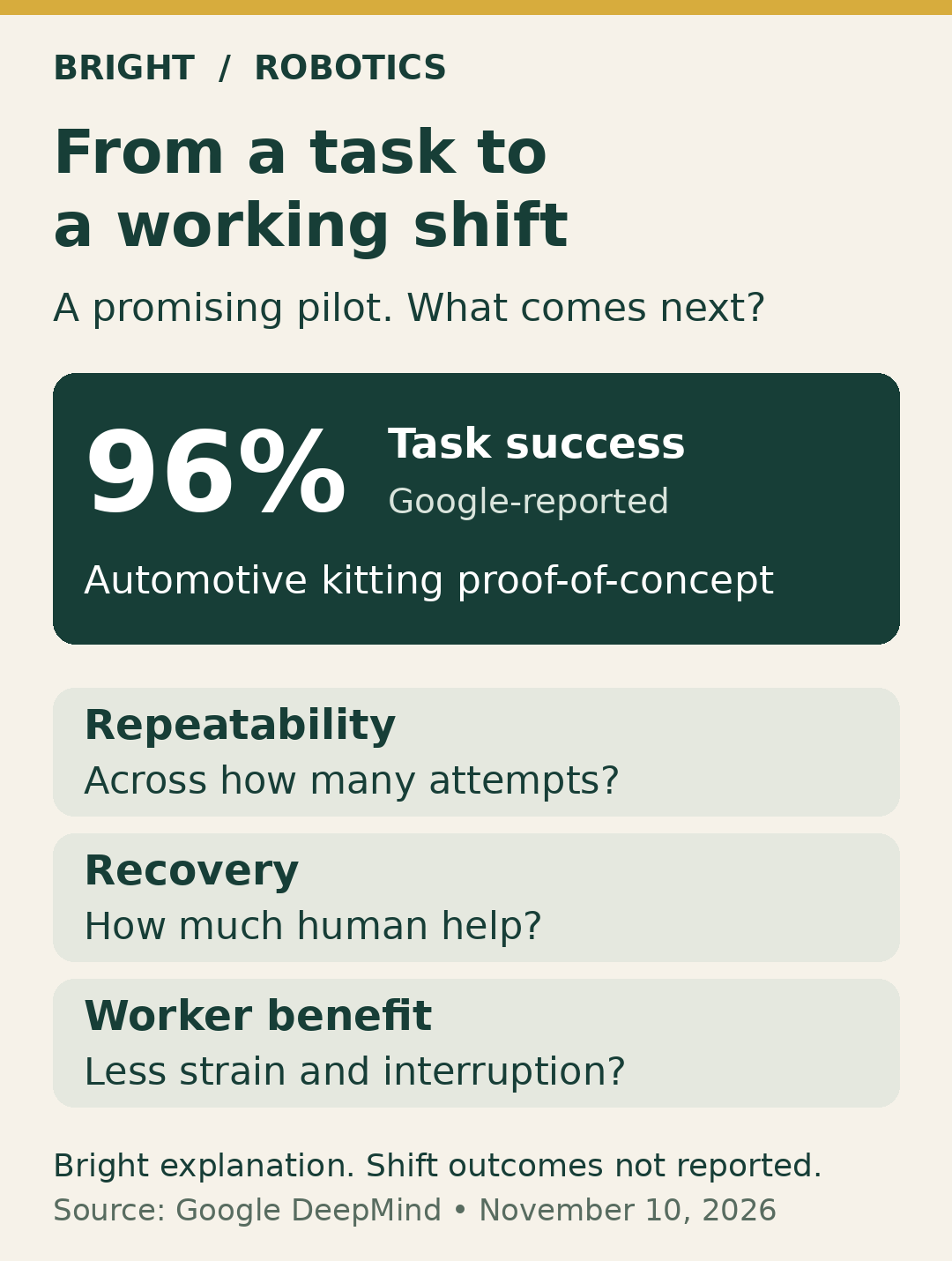
Google DeepMind’s November 10 announcement offers a concrete example to examine. The company reports a 96% success rate for Apptronik Apollo 2 robots sorting automotive brackets into containers at Mercedes-Benz production lines in Kecskemét, Hungary, and Sindelfingen, Germany. It describes a proof-of-concept, rather than a completed factory-wide rollout. The release is going to robotics partners. Google’s announcement
The practical advance
Google says its embodied-reasoning model tracks the workflow while Gemini Robotics 2.5 controls the robot’s hands and arms. That division connects a plan with the physical business of picking up a part and putting it where it belongs. How Google describes the system
The longer development story helps explain why a factory trial matters. Apptronik described Apollo 2 in June as a platform for collecting training data, using both human remote operation and autonomous execution. It named Mercedes-Benz among the sites contributing experience and said that work would inform its future Apollo 3 commercial product. That is background to this result, not separate verification of the new success rate. Apptronik’s account
Bright’s interpretation: testing a task inside an existing workplace can expose problems that a polished demonstration leaves out. Parts arrive in different positions. Work pauses and resumes. People need to know when it is safe to approach. The value comes from fitting into that routine without quietly giving a colleague a second job supervising the machine.
What 96% leaves open
The announcement does not give the pilot’s attempt count, duration, precise scoring unit or human-intervention rate. It also does not report measured changes in worker strain, injuries or staffing. Bright has not independently tested the system. The reported evidence
A percentage alone cannot tell a production manager how much help to budget. Imagine two hypothetical robots with the same task score: one pauses safely and requests help; the other puts an incorrect part into a tray and needs someone to find the mistake later. Those outcomes create very different amounts of work. Neither scenario is a reported result from this pilot.
The useful follow-up questions are specific. What counted as one attempt: a grasp, a placement or a finished tray? Did the robot detect its own errors? How long did recovery take, and who performed it? How much output remained correct after checking? Those answers would make the headline number usable for decisions about a workplace.
A successful task must also be a safe one
Google describes improved hazard avoidance and a new test of disguised unsafe instructions. These are company-reported evaluations, not evidence that an entire workplace is safe. Google’s safety discussion
There is a practical reason to look beyond normal operation. The US Occupational Safety and Health Administration notes that many robot accidents happen during activities such as maintenance, setup, testing and adjustment. That is general safety context, not an assessment of these European sites or this model. OSHA’s robotics overview
For a worker, the important moment may be the interruption: a dropped component, an unfamiliar object, or a machine that needs attention. A worthwhile evaluation should include those moments, along with the training and safeguards people need to handle them. Completing more tasks and managing exceptions safely are connected goals.
What would make this a better working day?
The next convincing account would follow the whole job over time: correctly prepared parts, delays and recoveries, the human minutes needed to keep the system running, and what changes for the people doing the work. Interviews with those workers would add something a benchmark cannot: whether the task actually feels easier, safer and more manageable.
This is a promising direction for physical AI because the potential benefit is concrete. Sorting fewer bins and spending less time repeating an awkward movement would matter. The factory result gives researchers and manufacturers a reason to pursue that benefit. Measuring the complete shift would show how much of it reaches people.
What was shown, and what wasn’t
Shown
Google reports a 96% success rate for an automotive kitting proof-of-concept with Apptronik and Mercedes-Benz. The evidence does not establish whole-shift productivity or worker benefit.
Not shown · limits
- The pilot result is company-reported, without a disclosed attempt count, duration, precise scoring unit or human-intervention rate in the announcement. Bright has not independently tested the system.
- The announcement does not report measured changes in worker strain, injuries or staffing. The complete-shift questions are Bright analysis, not measured outcomes.
- Apptronik’s June account supplies historical platform context, not independent verification of the new pilot. OSHA supplies general safety context, not a jurisdictional or system-specific assessment.
- Access is described as a robotics-partner rollout, not general consumer availability.
Bright editorial interpretation
If dependable assistance reduces repetitive preparation without creating new supervision and recovery burdens, workers could gain a less tiring day. That is the potential benefit to measure next.
Still open
What was the pilot denominator and success definition?
How often did people intervene, and how long did recovery take?
What changed in worker strain, interruptions and safety over complete shifts?
Keep the evidence together · share a card
BRIGHT / EVIDENCE TO KEEP
Google’s AI helps a robot sort car parts. What would make it useful all day?
Possible benefit · Bright interpretation
If dependable assistance reduces repetitive preparation without creating new supervision and recovery burdens, workers could gain a less tiring day. That is the potential benefit to measure next.
Documented result · source-backed
Google reports a 96% success rate for an automotive kitting proof-of-concept with Apptronik and Mercedes-Benz. The evidence does not establish whole-shift productivity or worker benefit.
Limits & unknowns
The pilot result is company-reported, without a disclosed attempt count, duration, precise scoring unit or human-intervention rate in the announcement. Bright has not independently tested the system.
The announcement does not report measured changes in worker strain, injuries or staffing. The complete-shift questions are Bright analysis, not measured outcomes.
Apptronik’s June account supplies historical platform context, not independent verification of the new pilot. OSHA supplies general safety context, not a jurisdictional or system-specific assessment.
Access is described as a robotics-partner rollout, not general consumer availability.
What was the pilot denominator and success definition?
How often did people intervene, and how long did recovery take?
What changed in worker strain, interruptions and safety over complete shifts?
Evidence state: Emerging. Source check: 2026-11-10T16:53:03.878Z. A source check is not independent replication.
Google DeepMind · Gemini Robotics 2.5 launch, company-reported pilot and evaluations: https://deepmind.google/blog/gemini-robotics-2-5-accelerates-real-world-physical-intelligence/
Apptronik · June 30, 2026 account of Apollo 2 and Robot Park, historical context: https://apptronik.com/news-collection/welcome-to-robot-park-where-apptroniks-apollo-goes-to-work
OSHA · general robotics safety overview, not an assessment of this system: https://www.osha.gov/robotics/
https://brightaifuture.com/discoveries/gemini-robotics-25-factory-work
How we know3 sources · checked 2026-11-10T16:53:03.878Z · no corrections
Original sources
- Google DeepMind · Gemini Robotics 2.5 launch, company-reported pilot and evaluations ↗ · institution
- Apptronik · June 30, 2026 account of Apollo 2 and Robot Park, historical context ↗ · institution
- OSHA · general robotics safety overview, not an assessment of this system ↗ · government
Institutions: Google DeepMind · Apptronik · Mercedes-Benz
- Maturity
- Emerging
- Event date
- 2026-11-10
- Source published
- 2026-11-10
- Captured
- 2026-11-10T16:37:25Z
- Last source review
- 2026-11-10T16:53:03.878Z
- Editorial method
- AI-assisted source review
- Place / relevance
- Kecskemét, Hungary, and Sindelfingen, Germany · deployment-location
Bright compared this account with the linked original and supporting sources and kept reported, budgeted, projected, and observed claims distinct. Bright did not independently audit the underlying records.
Maturity describes the tested or operational setting. Confidence describes support for the particular claim; one does not determine the other.
Revision & correction history
2026-11-10T16:37:25Z · Initial source report separating a company-reported factory task result from the evidence needed for dependable assistance and worker benefit.
No corrections recorded.