
Legato puts hearing assistance in eyeglass frames. The tradeoffs matter.
Legato says its U.S. launch pairs on-frame speech processing with open-ear audio and prescription-lens options. Listed prices start at $999; listening, fit and availability will determine its usefulness.
- Maturity
- Emerging, stage 2 of 4
- Support
- 7 sources · institution, government
- Evidence detail
- How we know ↓
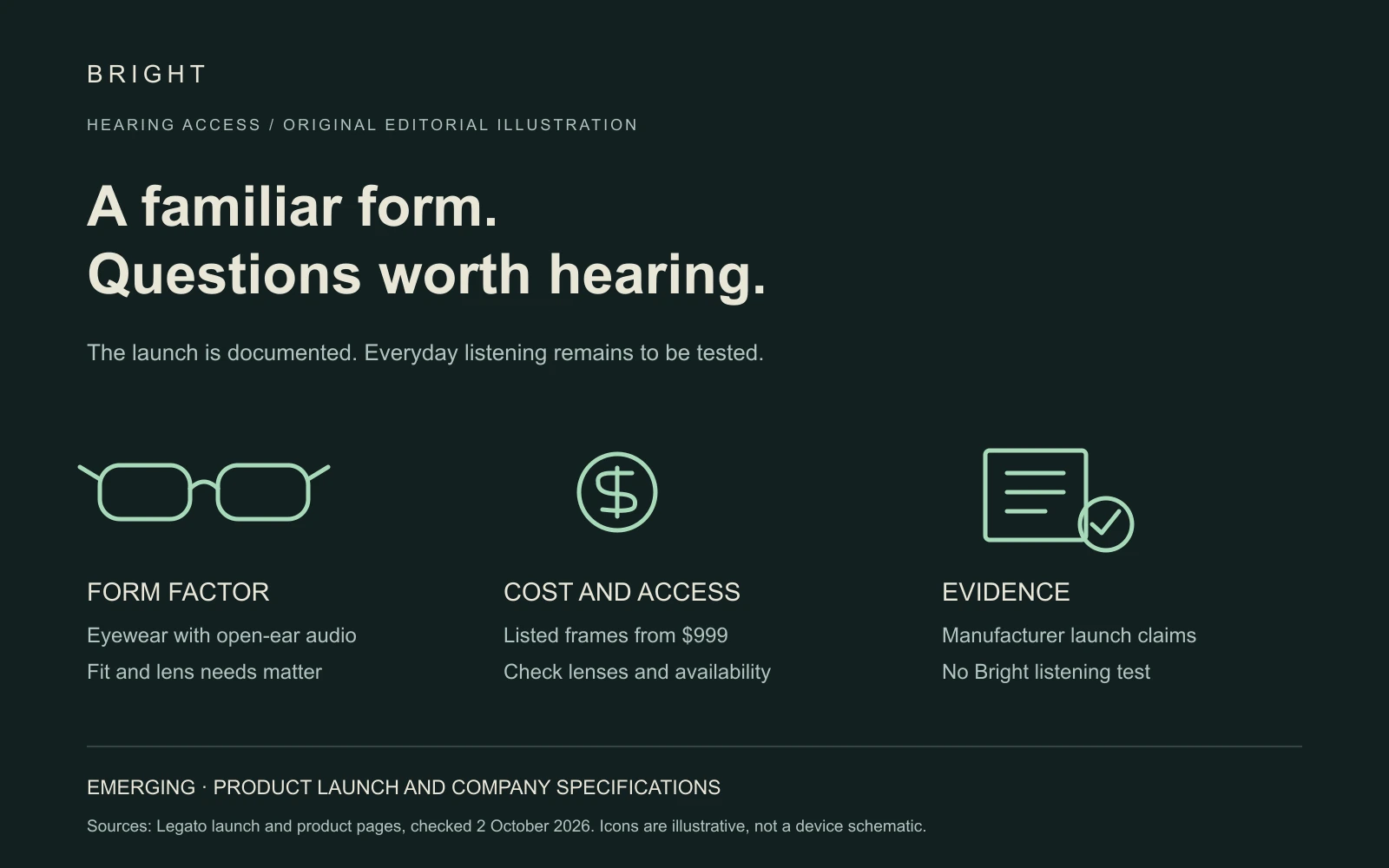
A conversation is more than audible sound. Following a colleague in a busy room can require effort, and a useful device must fit into the life of the person wearing it. Familiar eyeglass frames offer one possible route to hearing assistance without an object in the ear canal.
Choosing hearing assistance involves comfort, adjustment, cost and daily use as well as sound. Combining it with eyewear changes those choices: lens needs, frame fit and hearing support become part of the same purchase.
Legato says SpeechSense uses an on-device neural network to separate speech from background noise and enhance it in real time. Open-ear speakers deliver the sound. The company says processing happens on the frames, with no camera or audio recording. These are manufacturer descriptions, not a Bright privacy audit or measured listening result.
What was shown, and what wasn’t
Shown
Legato announced its U.S. launch on October 1 at 09:00 Eastern. Its product pages checked October 2 list Symphony and Harmony at $999 and Aria at $1,099, before any separately priced lens options. The frames support prescription lenses and Bluetooth music and calls on iOS and Android. Product pages advertise more than ten hours of power; that is a manufacturer specification. The announcement establishes a product launch, not an observed improvement in everyday conversations. On October 2, between 18:39:42 and 18:39:49 Eastern, Bright rechecked Symphony Narrow/Matte Black, Harmony Medium/Matte Black and Aria Medium/Classic Tortoise. Each default product page displayed “Select Lenses.” After choosing nonprescription lenses with the free clear basic hardcoat, each review screen displayed “Add to Cart”; no “Sold Out” or “Notify me” message was visible in those checked flows. These are interface observations, not confirmed inventory or delivery. Bright did not add an item to a cart or place an order, and the check does not cover other variants or retailers.
Not shown · limits
- Emerging evidence: the checked material establishes an announced product and manufacturer specifications. Bright has no hands-on evaluation, clinical outcome study or observed long-term user result.
- Legato cites HearAdvisor testing. Bright checked the lab’s general measurement method, but did not inspect a product-specific report supporting the advertised score or comparisons, so no score or efficacy ranking is repeated. Laboratory metrics cannot establish an individual wearer’s benefit.
- On-device processing, no recording and battery life remain company claims. Bright has not audited the device or app, measured sound leakage or battery endurance, or verified every purchase configuration, delivery estimate, lens price or insurance benefit.
Bright editorial interpretation
Bright’s analysis: the practical possibility is a familiar object that helps someone stay in a conversation. For a person who already wears glasses, one device could reduce the friction of carrying and maintaining separate equipment. For someone who does not, wearing frames may introduce a new obligation. Neither response can be inferred from a launch. The useful test is ordinary life: a quiet conversation, several people around a table, a noisy workplace and a full day of wearing the frames. Does speech become easier to follow? Is the sound comfortable, and can nearby people hear it? Fit, lens quality, battery behavior and reliable support matter alongside the processing. Bright has not performed these tests. Cost and access are part of the result. Compare the complete price for the chosen frame and lenses, the return and warranty terms, and the availability of adjustment and hearing support. A starting price does not establish affordability or insurance coverage. FDA’s OTC category is for adults 18 and older with perceived mild to moderate hearing loss; it is not the category for children or severe or profound hearing loss. Legato describes its frames as OTC hearing aids. That description is not a claim here of FDA approval or clearance. The next evidence should describe who used the frames, in what listening conditions, with what comparison and for how long. Independent listening results, sustained use and accessible support would make the possibility easier to judge.
Still open
Who benefits in everyday speech-in-noise conditions, and how do independent comparisons account for fit and hearing needs?
What are the complete lens and support costs, and which configurations can actually be delivered?
Do comfort, battery life and sustained use hold outside laboratory and company demonstrations?
How we know7 sources · checked 2026-10-02 · no corrections
Original sources
- Legato U.S. launch · October 1, 2026, 09:00 ET · manufacturer announcement ↗ · institution
- Legato mechanism and battery claims · checked October 2, 2026 ↗ · institution
- Symphony product · $999 listed frame price · checked October 2, 2026 ↗ · institution
- Harmony product and frame fit guide · $999 listed frame price · checked October 2, 2026 ↗ · institution
- Aria product · $1,099 listed frame price · checked October 2, 2026 ↗ · institution
- FDA OTC hearing aid category · adult eligibility and limits ↗ · government
- HearAdvisor measurement method · laboratory comparisons, not an individual outcome ↗ · institution
Institutions: Legato
- Maturity
- Emerging
- Event date
- 2026-10-01
- Source published
- 2026-10-01
- Captured
- 2026-10-02
- Last source review
- 2026-10-02
- Editorial method
- AI-assisted source review
- Place / relevance
- United States; announced consumer launch · unspecified
Bright compared this account with the linked original and supporting sources and kept reported, budgeted, projected, and observed claims distinct. Bright did not independently audit the underlying records.
Maturity describes the tested or operational setting. Confidence describes support for the particular claim; one does not determine the other.
Revision & correction history
2026-10-02T22:40:55.405Z · Legato puts hearing assistance in eyeglass frames. The tradeoffs matter.
No corrections recorded.