
Meta releases Muse Wonder: what is available now, and what still needs testing
Wonder is available through Meta’s API and Muse Code. The release raises useful questions about persistent memory, long-running agents and how much a benchmark tells us about work we can trust.
- Maturity
- Emerging, stage 2 of 4
- Support
- 4 sources · institution, report
- Evidence detail
- How we know ↓
What you can access today
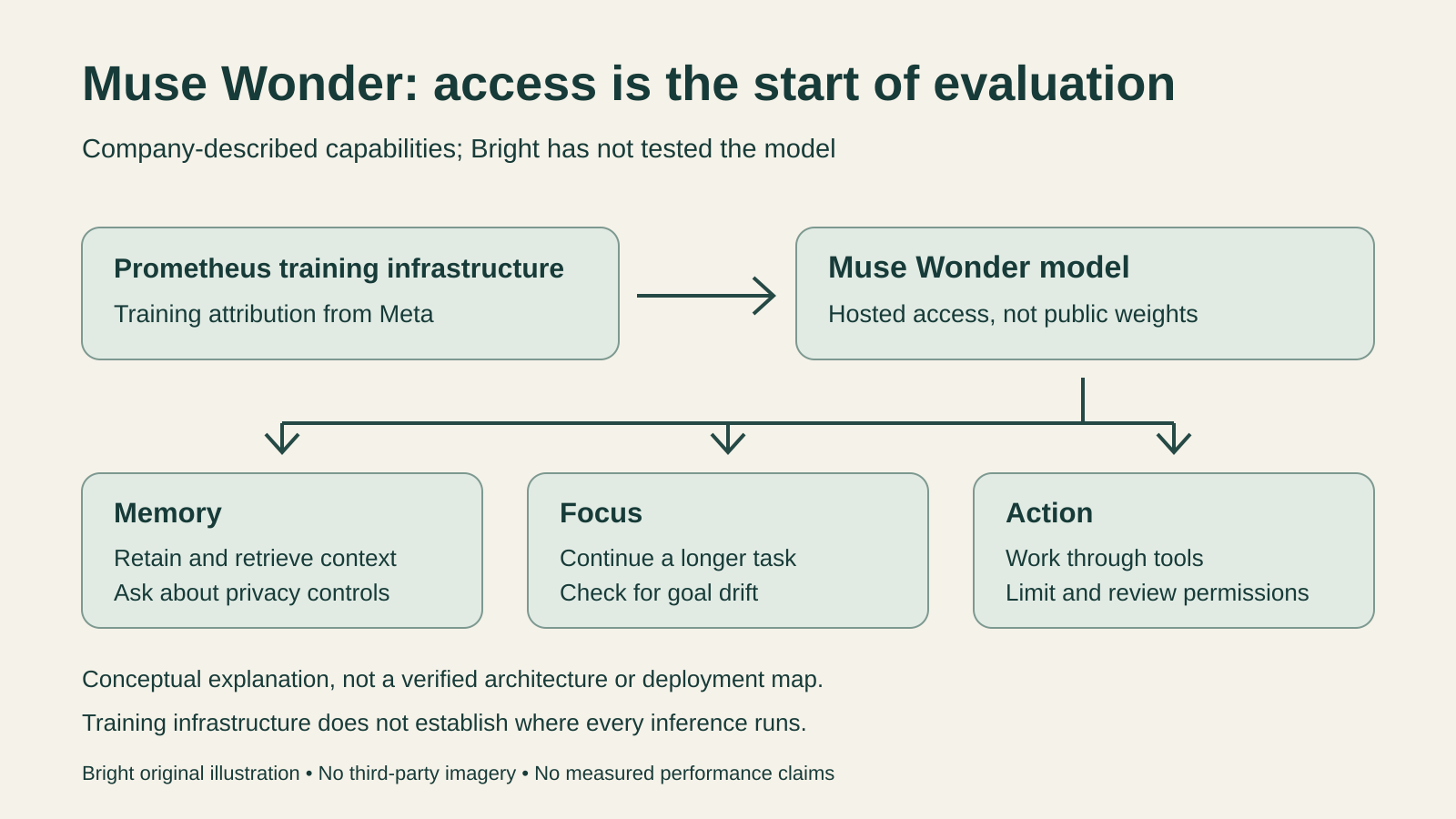
Meta announced Muse Wonder on October 12. Its Model API page lists muse-wonder-1.0 as available in the API and Muse Code. It lists muse-wonder-full-1.0 separately, available by subscription in Muse Code. Wonder Full should not be described as generally available through the API.
According to Meta’s launch announcement and model card, both models accept text, images, video and audio and produce text. They have a one-million-token inference context. Meta says integration into its consumer Muse product is coming soon. That is a plan, rather than a feature available to every consumer today.
For readers following Bright’s Open Models guide, there is another distinction: Meta has not released public weights for these models. Hosted access lets people use a model through a service. It does not provide the files or permissions needed to run and inspect that model independently. This launch is not an open-weight release, and it establishes no promise about future licensing.
Memory changes the questions to ask
Meta advertises Active Memory for persistent context and retrieval, and Active Focus for adapting through long-running tasks. Those are descriptions of intended capabilities, not Bright’s assessment of how reliably either works.
A large context window and persistent memory solve different problems. Context is information available to a particular inference. Persistent memory can carry selected information into later work. A large advertised input limit does not establish that every detail will be retrieved correctly, or that yesterday’s information remains appropriate today.
Bright’s analysis: useful memory needs control as well as recall. Before connecting a private project, ask what is retained, where it is stored, who can access it, how long it remains, and whether you can inspect, correct and delete it. Ask separately about uploaded files, conversation history and connector data. A product’s model name does not answer those questions. The access pages do not justify importing privacy promises from another model or subscription tier.
A longer task creates more chances to go wrong
An agent might read a codebase, edit several files, run checks and revise its plan. Continuing across those steps could reduce repeated instructions. It also means an early misunderstanding can affect later actions.
For a first evaluation, choose a bounded task with a result you can check. Limit access to the files and tools it needs, keep a record of its actions, and review changes before merging or publishing. A successful demonstration should identify what the agent completed, which checks passed, what failed and where a person intervened. It should not quietly count a human repair as autonomous success.
These are Bright’s proposed evaluation safeguards. We have not run Wonder, measured its task-completion rate or tested its memory controls.
Infrastructure and rankings are different kinds of evidence
Meta attributes training to its gigawatt-scale Prometheus infrastructure in the launch announcement. Training infrastructure does not identify where every API request runs. Nor does the scale of a training system establish a particular user’s reliability, response time or cost.
The model card reports a mixture of internally generated, externally supplied and provider-reported benchmark results. Artificial Analysis supplies several named rows and an independently run composite index; Vals AI supplies Finance Agent V2, and Datacurve supplies specified DeepSWE results. Those contributions matter at the level of the named evaluations. They do not independently validate the entire product, every advertised feature or every real-world workflow. The overall comparison table is assembled by Meta.
To evaluate a ranking, check the model version, task set, scoring method, tool access and testing conditions. Then ask whether those conditions resemble your intended work. A coding score cannot guarantee that an unfamiliar repository will be changed safely. A reasoning score cannot guarantee reliable legal, medical or financial advice.
A release is a starting point for evidence
Meta has published a model card; it says a separate full safety report is forthcoming. The card and its limitations should be read alongside the access announcement, rather than treating the absence of the forthcoming report as an absence of all documentation.
Meta’s card identifies limits that matter for a trial: errors in multi-step reasoning, weaknesses in visual and spatial reasoning—especially 3D tasks—and uneven evaluation across languages. Performance can also change with prompts, tools, serving configuration and the agent harness. These are documented limitations, not results of a Bright test.
For consequential uses, outputs still need qualified review, source verification and appropriate controls. Keep sensitive information out of a trial until the applicable data terms are understood. Give an agent a way to stop, and require confirmation before actions with lasting consequences.
The significance of this release is concrete: another hosted model is available for developers to evaluate. Its longer context and advertised memory and focus features offer questions worth testing. The next useful evidence will show how those capabilities behave under ordinary constraints, with failures and human intervention visible alongside successes.
What was shown, and what wasn’t
Shown
Meta’s Model API page lists muse-wonder-1.0 in the API and Muse Code, and muse-wonder-full-1.0 by subscription in Muse Code. Listed context is one million tokens. Access does not establish real-world task reliability.
Not shown · limits
- Bright has not run the model, audited its memory controls or measured task completion.
- Wonder Full is listed for Muse Code subscriptions; general API availability is not established.
- Consumer Muse integration is planned, not established as live at launch.
- No public weights are released; this is hosted access rather than an open-weight release.
- Meta’s comparison combines internal, externally supplied and provider-reported evaluations; named external results do not independently validate the whole product.
- The public model card does not guarantee reliable legal, medical or financial use; a separate full safety report is forthcoming.
- Training attributed to Prometheus does not identify every inference deployment.
- Meta identifies multi-step reasoning errors, visual/spatial and 3D weaknesses, uneven language evaluation and configuration-dependent performance.
Bright editorial interpretation
The release provides another hosted model to evaluate and makes memory control, long-task oversight and transparent failure reporting practical questions for users.
Still open
Can users inspect, correct and delete retained information under their applicable product terms?
How reliably does memory retrieve the right information across ordinary tasks?
How do long-running workflows perform with bounded access, failed steps and human intervention disclosed?
How we know4 sources · checked 2026-10-12T17:51:26.317Z · no corrections
Original sources
- Meta Muse Wonder launch, October 12, 2026 ↗ · institution
- Meta Muse Wonder model card ↗ · report
- Meta Model API access page, checked October 12, 2026 ↗ · institution
- Muse Code product page, checked October 12, 2026 ↗ · institution
Institutions: Meta
- Maturity
- Emerging
- Event date
- 2026-10-12
- Source published
- 2026-10-12
- Captured
- 2026-10-12T17:54:53.678Z
- Last source review
- 2026-10-12T17:51:26.317Z
- Editorial method
- AI-assisted source review
Bright compared this account with the linked original and supporting sources and kept reported, budgeted, projected, and observed claims distinct. Bright did not independently audit the underlying records.
Maturity describes the tested or operational setting. Confidence describes support for the particular claim; one does not determine the other.
Revision & correction history
2026-10-12T17:54:53.678Z · Initial Bright analysis of released hosted access, advertised capabilities and evidence limits, with original source review.
No corrections recorded.