
AI helped researchers decide which questions were worth asking.
A Meta research sprint produced ten manuscripts in four weeks. Its more useful lesson may be how quickly researchers could reject weak ideas, and where expert checks still mattered.
- Maturity
- Experimental, stage 1 of 4
- Support
- 3 sources · institution, report
- Evidence detail
- How we know ↓
A doctor can have a useful research question and still struggle to find time to investigate it. Turning that question into a defensible study involves choosing the right records, checking what they mean, running analyses and revising the work. Making those steps easier could widen the range of questions that get a serious hearing.
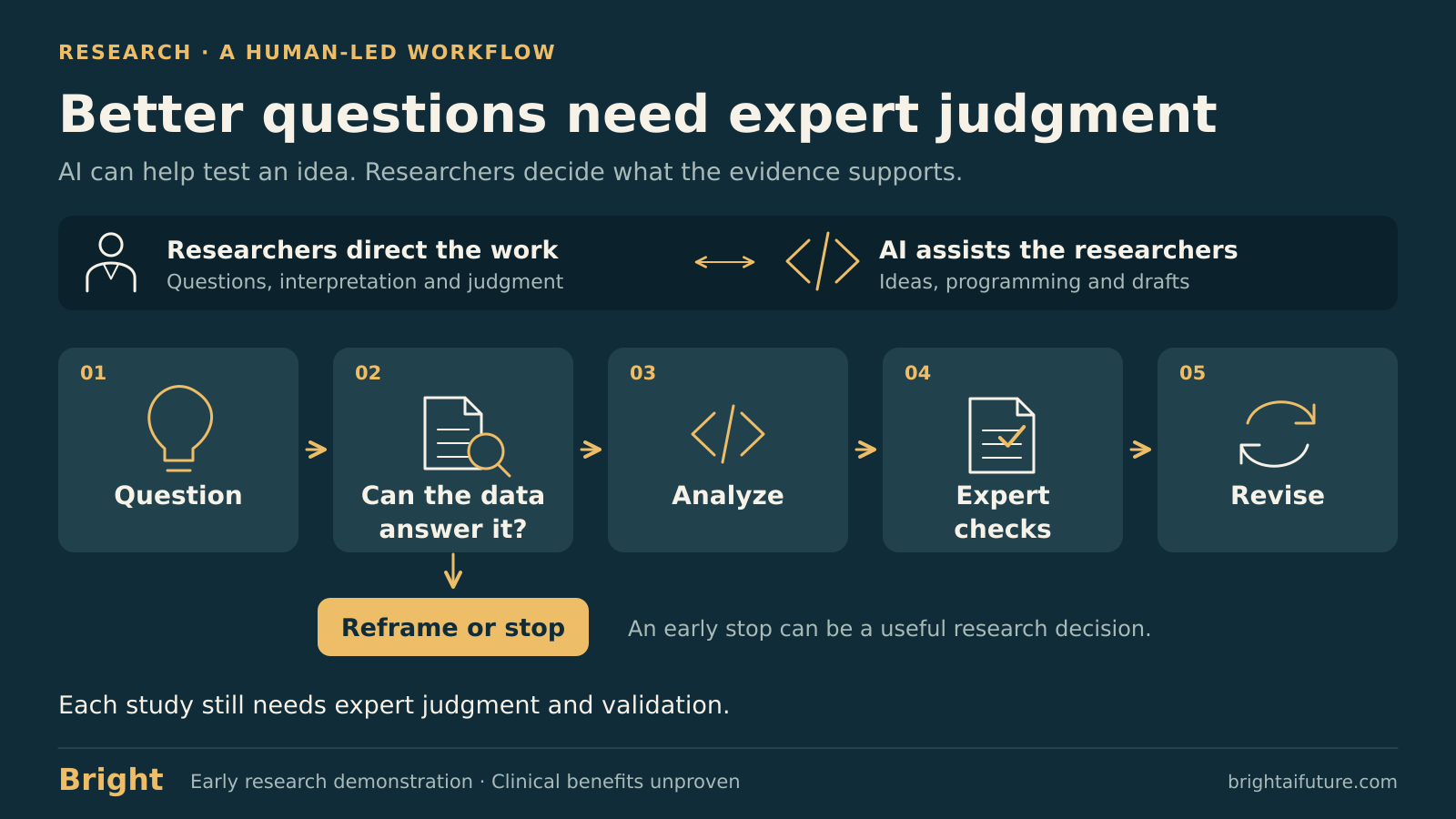
On October 14, Meta described a four-week exploration in which medical researchers used its Muse models to produce ten manuscripts. Their tools combined public datasets with access to a licensed, de-identified health-record database covering roughly five million patients. Researchers directed the work while AI helped with ideas, programming and writing. Meta’s project account
The most interesting result appears in the researchers’ accompanying report. They found that quickly checking an idea could reveal that it had already been answered, or that the available data could not answer it. Some projects were redirected or stopped before a full analysis. That is a valuable possibility: research assistance that makes it cheaper to abandon an unproductive path. Researchers’ report
For a small research team, an early stop can be progress. An attractive question is only a starting point. A tool that helps a team identify what would count as a credible answer could free attention for work with a better chance of helping people. That is the opportunity suggested by this experiment, rather than an outcome it has already measured.
The checks that mattered
The report also describes consequential mistakes. In one example, the model grouped a small dose of heparin used to keep an intravenous line open with doses used to treat a blood clot. A researcher corrected the definition using dose and route of administration. The report also records confident errors about what information the database contained. Researchers’ report
These are problems of meaning. Correctly finding a drug’s name does not establish why it was given. More generally, health records were created to support care and billing, so researchers must establish whether those records are suitable for a particular question. The FDA identifies the reliability and relevance of routine-care data, along with sound study design, as central challenges in building useful evidence. FDA background on real-world evidence
What the sprint establishes
Meta says the manuscripts received feedback within the medical cohort, a biostatistician’s review and assessments from contracted outside experts. Those steps offer scrutiny, but they should not be presented as journal peer review. Participants’ reports of productivity gains, reaching tenfold in the best cases, are self-reported experiences, not a controlled comparison proving a tenfold improvement for researchers generally. Meta’s project account
The appropriate next test is therefore larger than a manuscript count. Can another team reproduce an analysis? How much expert checking does it require? Do faster iterations improve the questions and reduce errors? And do promising findings survive further investigation? Counting papers alone would miss both useful discarded ideas and mistakes hidden inside plausible-looking results.
For ordinary readers, the potential benefit is more of the questions arising in everyday care getting investigated. It remains conditional. The experiment does not show that patients received better treatment or that its findings should change clinical practice. Faster research becomes valuable when it produces dependable knowledge that others can use.
Bright’s reading is cautiously hopeful: the useful advance here is a more responsive working process, with room to challenge assumptions and change direction. Its success should be judged by the quality of the evidence that emerges, and by the responsibility people retain for checking it.
How we know3 sources · checked 2026-10-15 · no corrections
Original sources
- Meta’s project account ↗ · institution
- Researchers’ report ↗ · report
- FDA background on real-world evidence ↗ · institution
Institutions: Meta · Participating medical researchers
- Maturity
- Experimental
- Source published
- 2026-10-14
- Captured
- 2026-10-15
- Last source review
- 2026-10-15
- Editorial method
- AI-assisted source review
Bright compared this account with the linked original and supporting sources and kept reported, budgeted, projected, and observed claims distinct. Bright did not independently audit the underlying records.
Maturity describes the tested or operational setting. Confidence describes support for the particular claim; one does not determine the other.
Revision & correction history
2026-10-15 · First prepared version of the reviewed manuscript, with primary sources and explicit evidence limits.
No corrections recorded.