
What National Compute’s research preview offers
The restricted research preview describes access to eight-GPU nodes with $100 in starter credits. Its queue, billing rules and data-sharing terms show what that access means in practice.
- Maturity
- Emerging, stage 2 of 4
- Support
- 9 sources · institution
- Evidence detail
- How we know ↓
For a researcher trying to get an experiment off the ground, National Compute’s most useful launch detail is a small, concrete offer: eligible institutional users can receive $100 in starter credits and request a whole eight-GPU node. The current documentation describes a restricted research preview, with access and hardware availability that can vary. It gives researchers enough detail to work out whether a first experiment fits, before treating a national compute grid as an established resource.
The broader ambition is to pool capacity across independent providers and research teams. AMP describes itself as the operator of National Compute, and Vultr has announced that it is joining as a founding consortium member. Pooling could help smaller teams reach hardware without negotiating their own large infrastructure commitments. The documented research route is a useful early test of that idea.
Who can get a node
According to the sign-in documentation, new users with eligible .edu, .mil or .gov addresses confirm their email to create an account and a public-research organization with $100 in credits. Other users need admission to an existing organization, an invitation or a place in the waitlist rollout. Sign-ups can pause, including for institutional addresses, so domain eligibility does not guarantee immediate access.
Public Research allocates one whole node at a time, requested through Marshall, National Compute’s infrastructure agent, and accessed through SSH. The listed options are eight AMD MI355X GPUs or eight NVIDIA B300 GPUs, each with 288 GB of memory per GPU. The offer Marshall quotes is authoritative, and availability determines which options appear. There is no multi-node training, RDMA between pool nodes or notebook server in this route. That makes the preview a bounded environment for experiments that fit on one machine.
How the clock and credits work
Requests join a first-come, first-served queue. Marshall shows a rate, the cost of a full lease and the balance required before confirmation. A request needs enough credit for its first hour, rather than the entire lease. Waiting is free; once the node is handed over, every GPU in it bills by the hour. A quiet or completed job does not stop that meter.
The current lease length is four hours, but it can continue and keep billing when nobody is queued. If another researcher is waiting after the lease length has passed, a preemption notice gives the current holder ten minutes to checkpoint. Releasing or losing the node destroys its local scratch storage. Results need to leave the node before that happens. Even the documented starter training job ends after about an hour while the node continues charging until released.
The distinction matters when reading the larger grid’s promises. Vultr describes a Grid Exchange vision built around completed work, or goodput. The current Public Research documentation specifies GPU-hour billing for capacity held. Those are different descriptions of service economics; the wider vision does not make this preview a pay-only-for-success experiment.
The research data agreement
Academic access also has a specific data-sharing condition. Organizations created from .edu addresses enter Marshall’s expanded tier: usage analytics, conversation transcripts and qualifying training artifacts, including specified checkpoints, datasets, logs and configurations copied from documented workspace and shared-storage locations. The artifact rules include filename patterns, size thresholds and credential exclusions. The stated purpose includes improving Marshall and training its underlying model.
The October 6 terms give National Compute a perpetual, irrevocable license to approved Marshall content for those purposes. Academic organizations cannot change this setting inside the service; a request to change it may require withdrawal from the research program. Organizations created with .gov or .mil addresses start at usage analytics only. Researchers therefore need to consider what they are entitled to share, alongside the hardware they can access.
The credit terms add another practical boundary: purchased credits ordinarily expire after one year and are generally non-refundable. Promotional credits follow their issuance terms; the documentation reviewed does not establish a specific expiry for the $100 starter grant. Compute stops when the balance reaches zero.
There is also a separate Public Marshall offering: up to $100 of sponsored model chat per browser visitor without sign-in. It has no shell or compute allocation. Its allowance should not be confused with research GPU credits.
The promising part is the attempt to make scarce research infrastructure easier to reach and easier to operate. A meaningful next measure of progress will be whether eligible researchers reliably obtain nodes, finish useful experiments and preserve their results at understandable costs. Today’s preview documents a concrete starting point. Its value will become clearer as access widens and completed research supplies evidence beyond the launch.
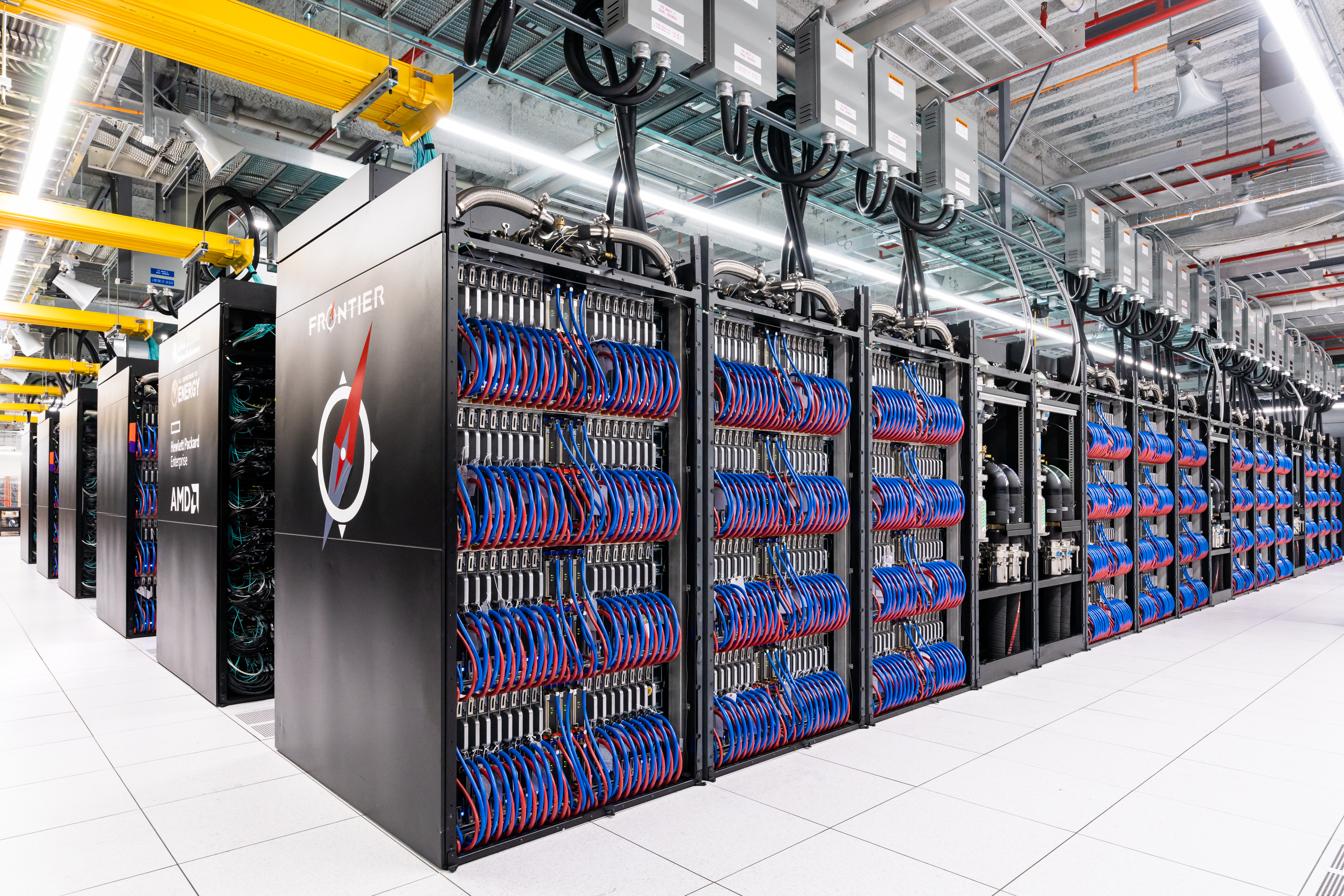
Photograph
“Frontier Supercomputer (3)” by OLCF at ORNL, photographed in June 2022 at Oak Ridge National Laboratory. Archival research-computing context; National Compute facilities are not pictured. CC BY 2.0. Original photograph, unaltered.
How we know9 sources · checked 2026-10-07 · no corrections
Original sources
- National Compute sign-in and account documentation ↗ · institution
- National Compute Public Research documentation ↗ · institution
- National Compute billing documentation ↗ · institution
- National Compute Marshall data-sharing documentation ↗ · institution
- National Compute Terms of Service updated October 6 2026 ↗ · institution
- National Compute Credit Terms updated October 6 2026 ↗ · institution
- National Compute Public Marshall documentation ↗ · institution
- Vultr joins National Compute as a founding consortium member ↗ · institution
- AMP describes its independent AI grid mission ↗ · institution
Institutions: National Compute · AMP · Vultr
- Maturity
- Emerging
- Event date
- 2026-10-07
- Source published
- 2026-10-07
- Captured
- 2026-10-07
- Last source review
- 2026-10-07
- Editorial method
- AI-assisted source review
- Place / relevance
- Research compute access · unspecified
Bright compared this account with the linked original and supporting sources and kept reported, budgeted, projected, and observed claims distinct. Bright did not independently audit the underlying records.
Maturity describes the tested or operational setting. Confidence describes support for the particular claim; one does not determine the other.
Revision & correction history
2026-10-07 · What National Compute’s research preview offers
No corrections recorded.
Keep exploring
Explore the shared question in another setting. These connections do not imply replication.