
The Future of AI Shouldn’t Require Permission
Why NVIDIA’s open-model bet matters for everyone who would rather build with intelligence than rent it forever.
- Maturity
- Demonstrated, stage 3 of 4
- Support
- 15 sources · institution, repository, paper
- Evidence detail
- How we know ↓
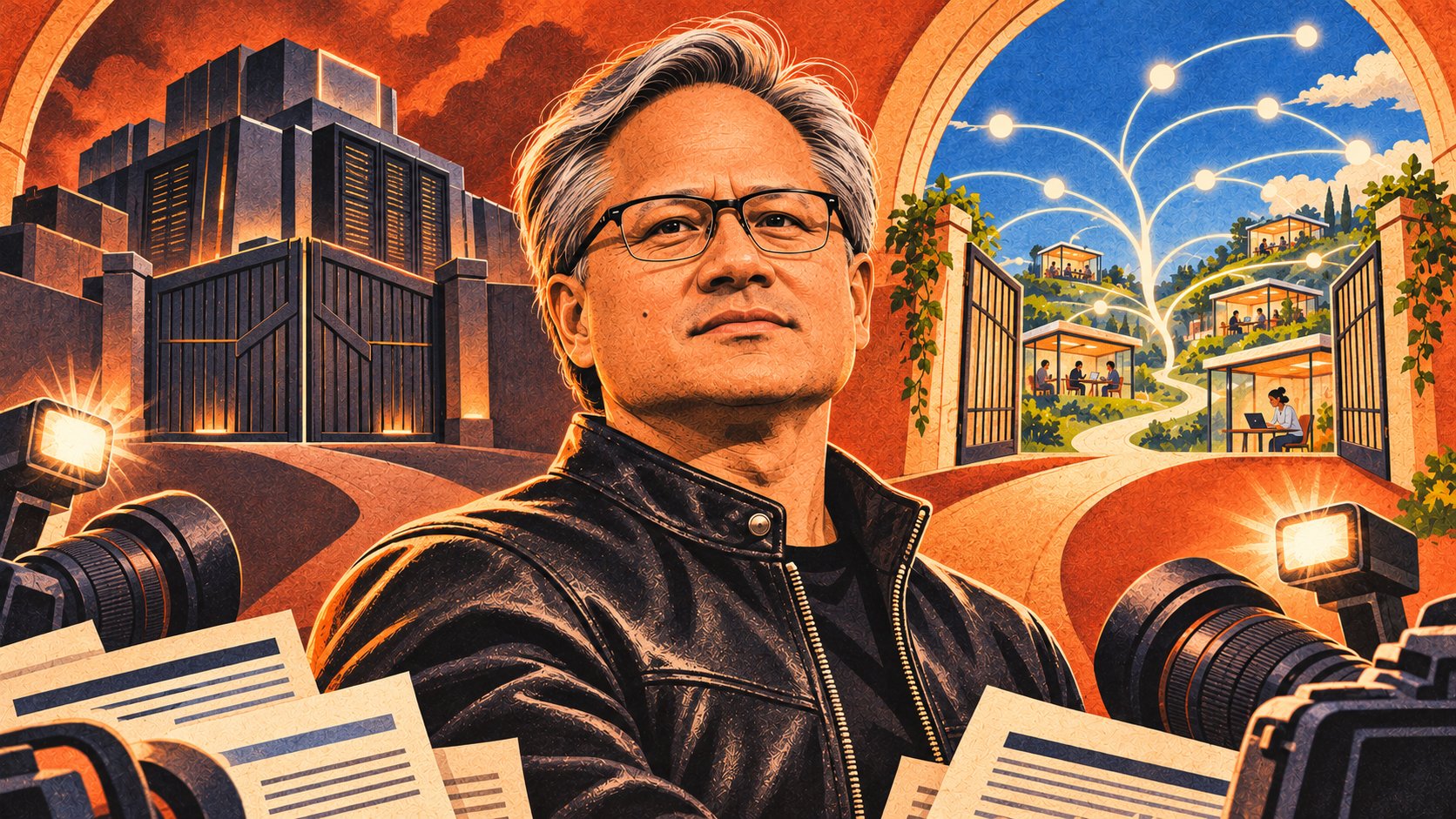
Imagine building a small business around an AI service. It helps answer customer questions, prepare estimates and make sense of the paperwork that used to eat your weekends. You invest time making it work. Your employees learn it. Your customers start depending on it.
Then the company behind the model changes the price. Or retires the version you rely on. Or changes what the system will do.
You may have alternatives. Moving to them may be easy. It may also require rebuilding the processes you just finished putting together.
Now scale that dependence beyond one business. Think about schools, research teams, local governments and entire countries building their next generation of tools on systems they can use but cannot run themselves.
That is the real question behind the fight over open AI: as this technology becomes more useful, who gets to decide what everyone else can do with it?
Jensen Huang and NVIDIA have taken a significant position in that fight. Alongside selling the chips behind the AI boom, the company is releasing models and tools that other people can download, adapt and deploy. Its work reaches beyond chatbots into robotics, biology and weather.
There is a compelling public-interest case for that approach. There is also a very good business case for NVIDIA. Both deserve to be understood.
The important thing is what becomes possible for everyone else.
The difference between access and control
Most people experience AI through an app. Open the chat window, ask a question, get an answer. A useful answer is a useful answer. Whether the model underneath it is open rarely comes up.
But the arrangement behind that window matters.
With a closed, hosted model, the provider operates the system. Customers pay for access under its terms. That can be an excellent deal: no hardware to manage, no model-serving infrastructure to maintain, and someone else responsible for much of the operational work. A powerful service available through a cheap subscription can put capabilities within reach of people who could never run it themselves.
Open-weight models offer a different option. The trained model can be downloaded and run by another operator, subject to its license and technical requirements. A business can choose a hosting company, operate its own deployment or adapt the model for a particular job.
That option changes the bargaining relationship. If a hosted service disappears, a customer may lose access. If an organization already has a properly licensed model and a working deployment, the original developer is no longer the only party capable of keeping it running.
It does not have to be every person running a server in the basement. A local software company might provide the service. A university might operate it for researchers. A group of organizations might share infrastructure. What matters is that the original model provider need not remain the sole gatekeeper.
For ordinary people, the benefit can arrive through the services they use, even if they never download a model themselves.
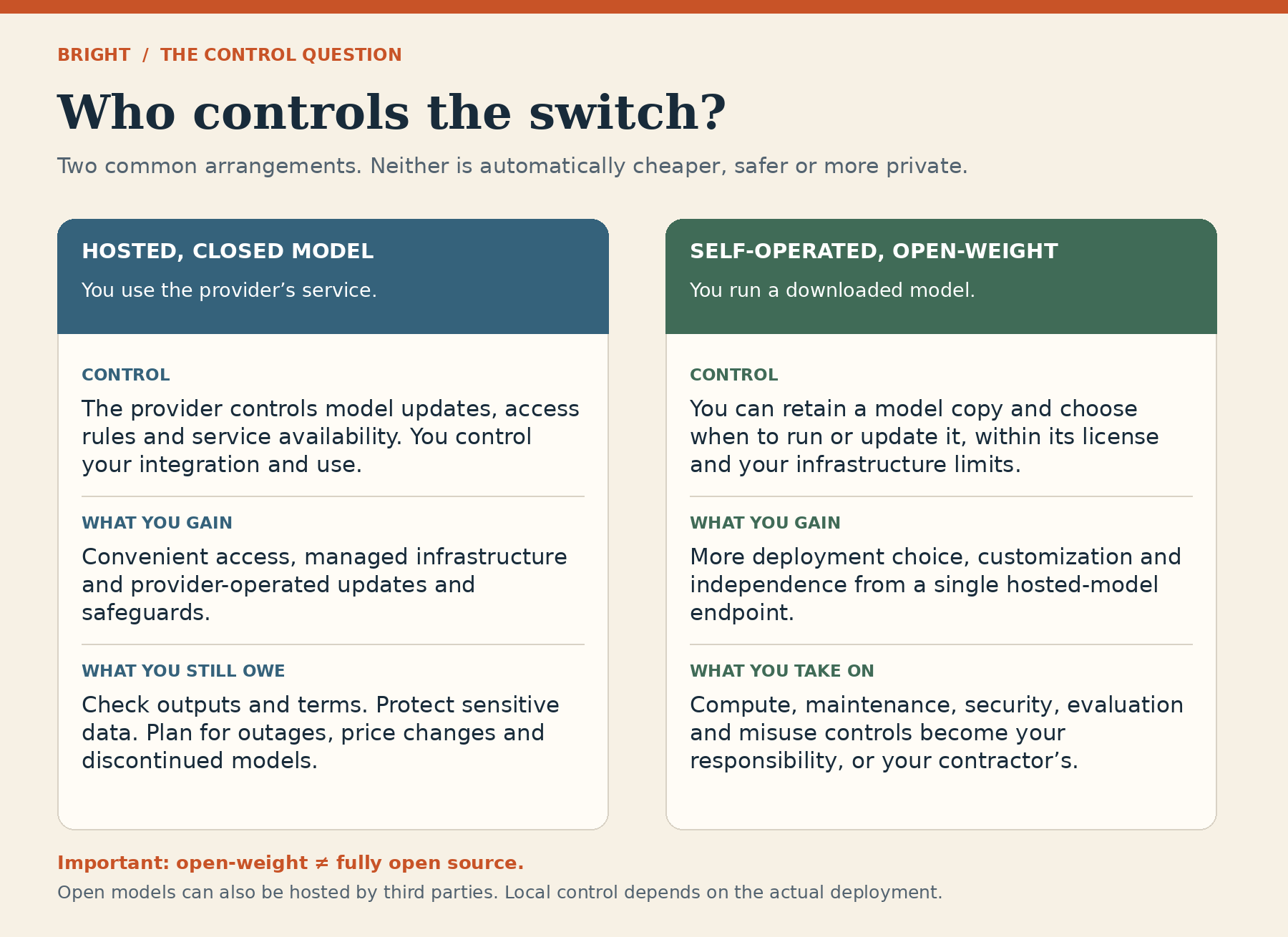
A quick guide to what “open” actually means
The terminology is messy enough to hide the stakes.
Open weights means the trained parameters are available. The license determines what people may do with them. A downloadable model is not necessarily unrestricted, and it is not necessarily possible to reproduce its training.
The Open Source Initiative sets a broader standard: rights to use, study, modify and share, with model parameters, code and sufficient information about training data to support meaningful modification and recreation. That is more demanding than publishing a model file. Source 1
Readers should ask four questions: Can somebody else run it? Can they change it? Can they share their version? Can they examine how it was made?
Different releases answer those questions differently. “Open” should begin the investigation, not end it.
What that freedom looks like outside Silicon Valley
In Sweden, a shared public-sector assistant called Svea offers a useful example. On October 15, 2025, the Gothenburg region’s innovation program reported that users could choose between Llama 3.3 70B and a newly implemented beta of OpenAI’s GPT-OSS-120B. The latter was hosted by Airon on a Swedish server, according to the regional program. Source 10
The same public-service interface could offer models from two different developers. The organization operating the assistant could make a local hosting decision rather than relying exclusively on those developers’ consumer chat products.
That is a documented implementation, not proof that Svea saves a particular number of hours or that its answers are safe for every government task. The regional account does not establish those outcomes. What it does establish is an institution exercising a choice that downloadable models made possible.
Poland offers a different example, and one directly connected to NVIDIA’s work. SpeakLeash, the computing center ACK Cyfronet AGH and NVIDIA collaborated on Bielik-Minitron-7B. Its public model card identifies a 7.35-billion-parameter model derived from a larger Bielik model and lists Apache 2.0 as its license. The Hugging Face repository requires users to review access conditions before obtaining the files. Source 11
A technical report submitted March 12, 2026 describes using NVIDIA Model Optimizer to prune the larger model and NeMo for knowledge distillation, a technique for transferring capabilities into a smaller system. The authors report reducing parameters by 33.4%, recovering about 90% of the baseline’s performance and achieving up to a 50% inference speedup in their tests. Source 12
Those are the development team’s experimental results, not an independent audit of customer savings. The tangible outcome is a released, smaller model built for European languages using tools and techniques other teams could build on.
That is a more useful picture of technological independence than a flag pasted onto a chatbot. Local developers can do substantive engineering, make trade-offs and release their own work.
There are research benefits too. Ai2’s Olmo project makes training data, code, recipes and evaluation resources available alongside model artifacts. That gives researchers ways to investigate development and training that a chat interface alone cannot provide. Source 2
The choices also reach small businesses. Imagine a manufacturer building an assistant for maintenance manuals. It might select a managed service. Or it might prefer an independently operated model so it can control where documents are processed and which version workers use. That is an illustrative scenario, not a claimed case study, and either choice would still require security, testing and expert checks on the answers.
These are different benefits: operational choice, room for specialization, and the ability to investigate. Collapsing them into “free AI” misses most of the story.
The NVIDIA bet
NVIDIA’s open-model effort deserves attention because it is building across several parts of that story at once.
Its public portfolio includes Nemotron for language and agents, Cosmos for physical-world AI, Isaac GR00T for robotics, BioNeMo for biology, and Earth-2 for weather and climate. Around the models sit tools for training, data preparation, deployment and evaluation. Those supporting pieces matter: a model that nobody can afford or figure out how to operate offers limited practical independence. Source 3
Take Nemotron 3 Ultra. Its published model card dates the release to June 4, 2026 and identifies a 550-billion-parameter model with 55 billion active parameters, meaning it uses only part of that total network for each token. NVIDIA supplies downloadable weights under OpenMDW-1.1 and links training recipes, released datasets and evaluation materials. Source 13
There is an equally important number on that card: one supported deployment requires four B200 GPUs. This is open access to a powerful model, not a promise that anyone can run it on a cheap laptop. The card also says only major portions of the pretraining and fine-tuning corpora are released, and identifies some evaluation scaffolding as still to be opened. Those qualifications belong beside the openness claim.
A smaller example is Nemotron 3.5 Lightning, whose card lists an August 11, 2026 release, 30 billion total parameters and 3 billion active. It is aimed at agents and other text applications, uses OpenMDW-1.1 and publishes evaluation recipes. Its documented deployment stack is optimized for NVIDIA GPUs. Source 14
Then there is Isaac GR00T N1, documented in a March 18, 2025 technical paper. Its model card describes taking images, instructions and robot-state information to produce actions, with post-training for particular robots or tasks. The same card explicitly says it is not tested or intended for mission-critical applications requiring functional safety. Source 15
That is a consequential contribution to robotics development. It is not a robot ready to be trusted unsupervised in every kitchen or factory. Public access gives other teams a starting point; it does not finish their engineering or discharge their safety responsibilities.
The company is also working on the legal machinery of openness. On May 28, 2026, the Linux Foundation announced that NVIDIA planned to adopt the OpenMDW-1.1 licensing framework for future releases in several model families. The framework covers models and related materials, aiming to make rights to modify, redistribute and deploy easier to understand. Source 4
That does not make every NVIDIA release equally open. Licenses and released artifacts still need checking individually. Nor does announcing a model prove that a robot works reliably in a home or that a biomedical tool improves patient care.
But it is substantial infrastructure for other people to build on. The contribution reaches further than letting developers try a chatbot.
NVIDIA did not create the open-model movement, and it does not own it. Ai2, Meta, Mistral, Hugging Face and many other organizations and communities belong in this story. So do developers outside the United States. A serious case for openness cannot quietly become an argument that only one company or one country should be allowed to provide it.
Even the supposed dividing line between open and closed companies is less tidy than the debate suggests. OpenAI released its gpt-oss open-weight models under Apache 2.0 in August 2025, alongside its proprietary offerings. The release included a smaller model designed for deployment with 16 GB of memory and described additional safety testing for public release. Source 5
The industry contains mixed strategies, not two perfectly separated camps.
Follow the money, including NVIDIA’s
There is no need to pretend NVIDIA is giving away models out of pure generosity.
In its quarterly filing for the period ended July 26, 2026, NVIDIA says demand for open-source foundation models promotes use of its products. It also acknowledges that deployment on competitors’ platforms could reduce demand for its offerings. Source 6
More people building and running AI can mean more demand for computing. Releasing capable models helps make that market larger. Tools optimized for NVIDIA hardware can make its platform more attractive within it.
That is a commercial incentive, plainly stated. It does not erase the benefits of the released work. It does mean readers should resist replacing one simplistic story with another.
An open model can weaken a model provider’s control while leaving the user dependent on expensive chips, cloud infrastructure or specialized software. A company can advance openness in one layer and benefit from concentration in another.
The public should want both the open models and more choices about how to run them.
The OECD’s 2026 analysis captures this tension. It finds that open-source development has helped lower entry costs, put pressure on prices and reduce dependence on a limited number of providers. It also warns that open ecosystems and common standards can reinforce the advantages of established firms. Competition depends on what happens across the whole supply chain, not just whether model weights are downloadable. Source 7
This is where the discussion gets more interesting than cheering for a CEO. What kind of market are we building underneath the technology?
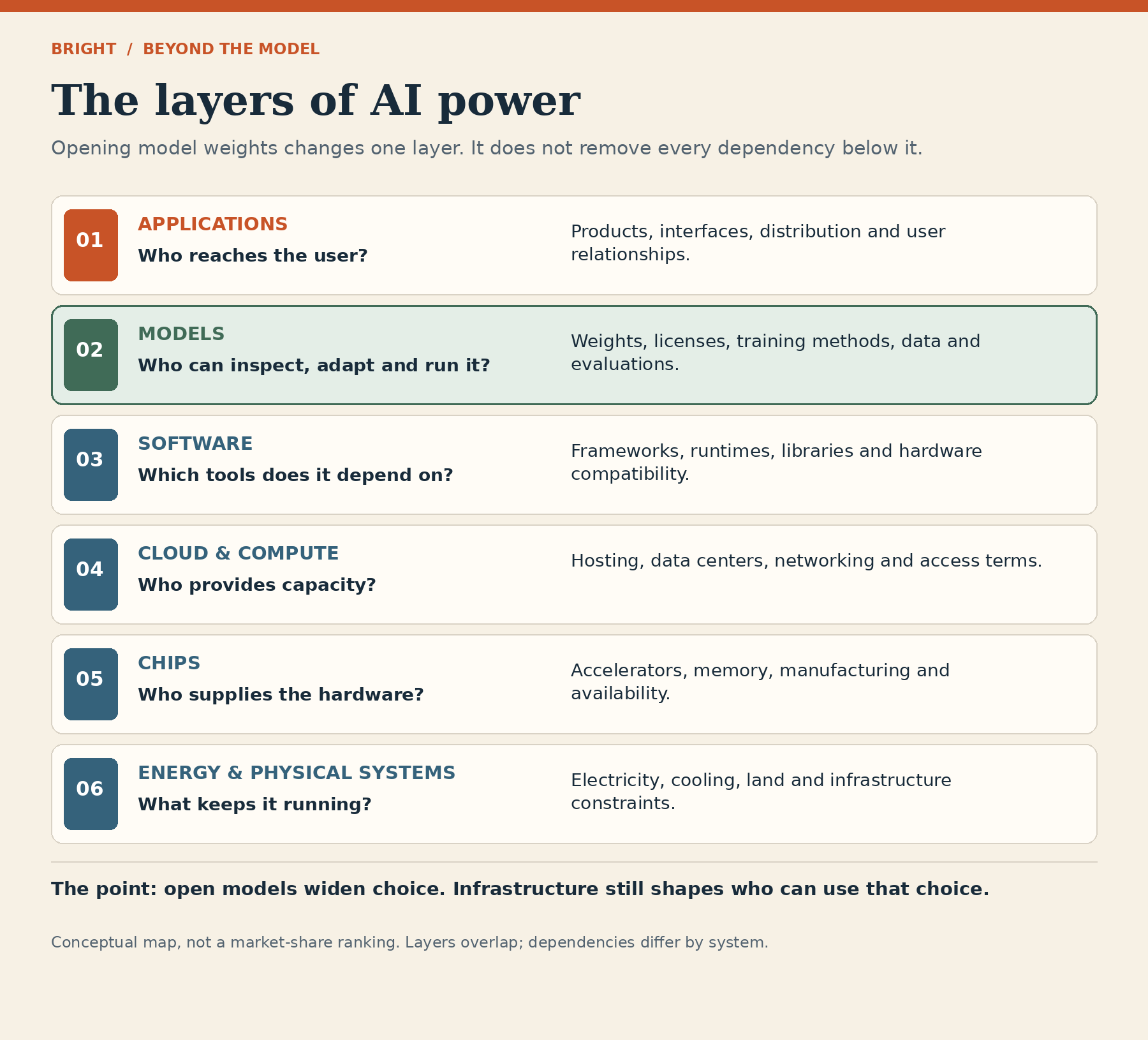
Why openness makes some people uncomfortable
There are several answers, and they should not be lumped together.
For businesses selling exclusive access, capable alternatives can create commercial pressure. Customers with another way to get a job done have more room to negotiate or leave. That is ordinary competitive logic. It is not evidence that any particular company is secretly directing a campaign against a rival.
Governments may be concerned about national security, dependence on foreign technology or the spread of dangerous capabilities. Researchers may worry that releasing weights permanently changes what can be controlled after a problem is discovered.
Those concerns deserve more than a dismissive reference to fearmongering.
A hosted provider can restrict an account, update a system or remove access to a particular model. Once weights have been widely copied, the original developer cannot reliably withdraw every copy. People can modify safeguards, and not all of them will have good intentions.
Anthropic’s stated position is important here. In July, Dario Amodei explicitly rejected a blanket ban on open-weight models and acknowledged their benefits. His argument was for testing sufficiently capable models and addressing specific security risks, including the difficulty of controlling misuse after release. Source 8
You can disagree with the proposed approach without rewriting it into “ban everything open.”
The hard questions are empirical and political: Which capabilities justify additional precautions? What evidence is enough? Who evaluates the risk? Can smaller developers meet the requirements? Will the rules reduce harm, or mostly make legitimate development more expensive?
A safety requirement that only the wealthiest companies can satisfy can have competitive consequences even when its supporters are sincere. An open release that creates serious new dangers does not become responsible simply because it challenges an incumbent.
Both deserve scrutiny. Neither should get a free pass.
The risk of a closed-only future
A world without capable, independently deployable models would still have competition among closed providers. It might have excellent products and low prices. Closed does not automatically mean monopoly, and open does not automatically mean democracy.
But a closed-only market would remove an important kind of alternative.
A business could switch providers, but could not choose to keep running the model itself. A researcher could ask for access, but could not assume access to the materials needed to study it. A country could negotiate with suppliers, but would have fewer ways to develop capabilities outside those suppliers’ continuing control.
The distinction becomes more consequential as AI moves from an optional writing assistant into the software that organizations rely on to operate.
Think of the internet as a collection of services you can leave, rebuild and host elsewhere, rather than a single service owned by somebody else. AI will not follow precisely the same path. The analogy is useful because it makes the choice visible: how much of the future can people build for themselves?
Openness creates room for answers that the original developer did not anticipate, customers it did not prioritize and research it did not choose to fund. That room is valuable even when most people continue buying managed services.
You do not have to personally run an open model to benefit from the fact that somebody else can compete with the company serving you.
The part the hype leaves out
Access to weights does not give a small organization the resources of a major AI lab. Training can require enormous computing budgets. Running a model requires hardware or a hosting bill. Reliable deployment takes expertise. Security, evaluation, maintenance and legal compliance remain real work.
For a lightly used application, paying an API provider may cost less than maintaining an underused server. For another workload, running an open model may offer better economics or more control. There is no honest universal answer without looking at the task, quality requirements and total operating cost.
Openness also does not guarantee quality. Stanford’s 2025 AI Index documented a narrowing gap between leading open- and closed-weight models on one prominent benchmark during 2024 and early 2025. That was evidence of competitive progress, not proof that all models became interchangeable or that an old leaderboard can settle today’s deployment decision. Source 9
The practical question is whether a model works well enough for the job, under conditions the user can afford and accept.
Open ai should be bigger than Jensen
NVIDIA’s role matters. Huang has helped put corporate resources behind the argument that more people should be able to build with advanced AI. The resulting models and tools deserve close attention, serious evaluation and, where the evidence supports it, credit.
But a durable case for open AI cannot depend on treating any executive as indispensable or beyond criticism. It should survive changes in leadership, commercial strategy and political fashion.
The strongest argument is about the public’s options.
Can a school choose where its information goes? Can a researcher examine the system? Can a small company build something the largest vendors would never prioritize? Can customers leave without abandoning everything they have built? Can communities adapt the technology instead of waiting to be included?
Those freedoms will not appear just because the models get smarter. They have to be built into the tools, the licenses, the infrastructure and the rules around them.
NVIDIA is helping make some of that possible. It is also benefiting from the expansion of AI. We can recognize both and still make a clear choice about the future we want.
Powerful AI should be available as a service. It should also remain something people can build with, investigate and operate beyond the continuing permission of a handful of providers.
The future needs customers. It needs owners, builders and independent institutions too.
What was shown, and what wasn’t
Shown
NVIDIA and other developers have released models and tools that others can run and adapt, subject to licenses and hardware requirements.
Not shown · limits
- Open weights are not automatically fully open source; licenses and released artifacts vary.
- Open models do not eliminate compute costs, infrastructure dependence or safety responsibilities.
- Deployment and benchmark examples have different evidence strengths; this is document-based analysis, not original interviews or independent testing.
Bright editorial interpretation
Deployable alternatives can support competition, local development and independent research.
Still open
How can broad access and proportionate safety precautions coexist without entrenching incumbents?
Keep the evidence together · share a card
BRIGHT / EVIDENCE TO KEEP
The Future of AI Shouldn’t Require Permission
Possible benefit · Bright interpretation
Deployable alternatives can support competition, local development and independent research.
Documented result · source-backed
NVIDIA and other developers have released models and tools that others can run and adapt, subject to licenses and hardware requirements.
Limits & unknowns
Open weights are not automatically fully open source; licenses and released artifacts vary.
Open models do not eliminate compute costs, infrastructure dependence or safety responsibilities.
Deployment and benchmark examples have different evidence strengths; this is document-based analysis, not original interviews or independent testing.
How can broad access and proportionate safety precautions coexist without entrenching incumbents?
Evidence state: Demonstrated. Source check: 2026-11-12T13:06:07.842Z. A source check is not independent replication.
OSI Open Source AI Definition: https://opensource.org/ai/open-source-ai-definition
Ai2 Olmo: https://allenai.org/olmo
NVIDIA open-source portfolio: https://opensource.nvidia.com/en-us/
Linux Foundation OpenMDW announcement: https://www.linuxfoundation.org/press/linux-foundation-releases-openmdw-1.1-nvidia-adopts-openmdw-for-cosmos-isaac-gr00t-ising-and-nemotron-ai-model-families
OpenAI gpt-oss release: https://openai.com/index/introducing-gpt-oss/
NVIDIA FY2027 Q2 filing: https://investor.nvidia.com/files/doc_financials/2027/NVDA-2027-Q2-10Q-Final-including-exhibits.pdf
OECD AI markets report: https://www.oecd.org/en/publications/artificial-intelligence-markets_d531d73f-en/full-report.html
Anthropic open-weights position: https://www.anthropic.com/news/position-open-weights-models
Stanford AI Index 2025: https://hai.stanford.edu/ai-index/2025-ai-index-report/technical-performance
Gothenburg region: Svea: https://innovationsarena.goteborgsregionen.se/ny-sprakmodell-i-ai-assistenten-svea/
Bielik-Minitron model card: https://huggingface.co/speakleash/Bielik-Minitron-7B-v3.0-Instruct
Bielik-Minitron technical report: https://arxiv.org/abs/2603.11881
Nemotron 3 Ultra model card: https://huggingface.co/nvidia/NVIDIA-Nemotron-3-Ultra-550B-A55B-NVFP4
Nemotron Lightning model card: https://huggingface.co/nvidia/NVIDIA-Nemotron-3.5-Lightning-30B-A3B-NVFP4
GR00T N1 model card: https://huggingface.co/nvidia/GR00T-N1-2B
https://brightaifuture.com/discoveries/open-ai-nvidia-control
How we know15 sources · checked 2026-11-12T13:06:07.842Z · no corrections
Original sources
- OSI Open Source AI Definition ↗ · institution
- Ai2 Olmo ↗ · institution
- NVIDIA open-source portfolio ↗ · institution
- Linux Foundation OpenMDW announcement ↗ · institution
- OpenAI gpt-oss release ↗ · institution
- NVIDIA FY2027 Q2 filing ↗ · institution
- OECD AI markets report ↗ · institution
- Anthropic open-weights position ↗ · institution
- Stanford AI Index 2025 ↗ · institution
- Gothenburg region: Svea ↗ · institution
- Bielik-Minitron model card ↗ · repository
- Bielik-Minitron technical report ↗ · paper
- Nemotron 3 Ultra model card ↗ · repository
- Nemotron Lightning model card ↗ · repository
- GR00T N1 model card ↗ · repository
Institutions: NVIDIA · Ai2 · OpenAI · SpeakLeash
- Maturity
- Demonstrated
- Source published
- 2026-11-12
- Captured
- 2026-11-12T13:06:07.842Z
- Last source review
- 2026-11-12T13:06:07.842Z
- Editorial method
- AI-assisted source review
- Place / relevance
- Global · global-study
Bright compared this account with the linked original and supporting sources and kept reported, budgeted, projected, and observed claims distinct. Bright did not independently audit the underlying records.
Maturity describes the tested or operational setting. Confidence describes support for the particular claim; one does not determine the other.
Revision & correction history
2026-11-12T13:06:07.842Z · Initial source-linked analysis of open-model access, NVIDIA’s contributions, commercial incentives and safety tradeoffs.
No corrections recorded.
Keep exploring
Explore the shared question in another setting. These connections do not imply replication.