
AI is helping small businesses get more of their own ideas off the ground
New Census figures show the scale of America's nonemployer economy. Individual business accounts offer a closer look at how AI can expand what an owner is able to do.
- Maturity
- Demonstrated, stage 3 of 4
- Support
- 15 sources · institution, dataset, government
- Evidence detail
- How we know ↓
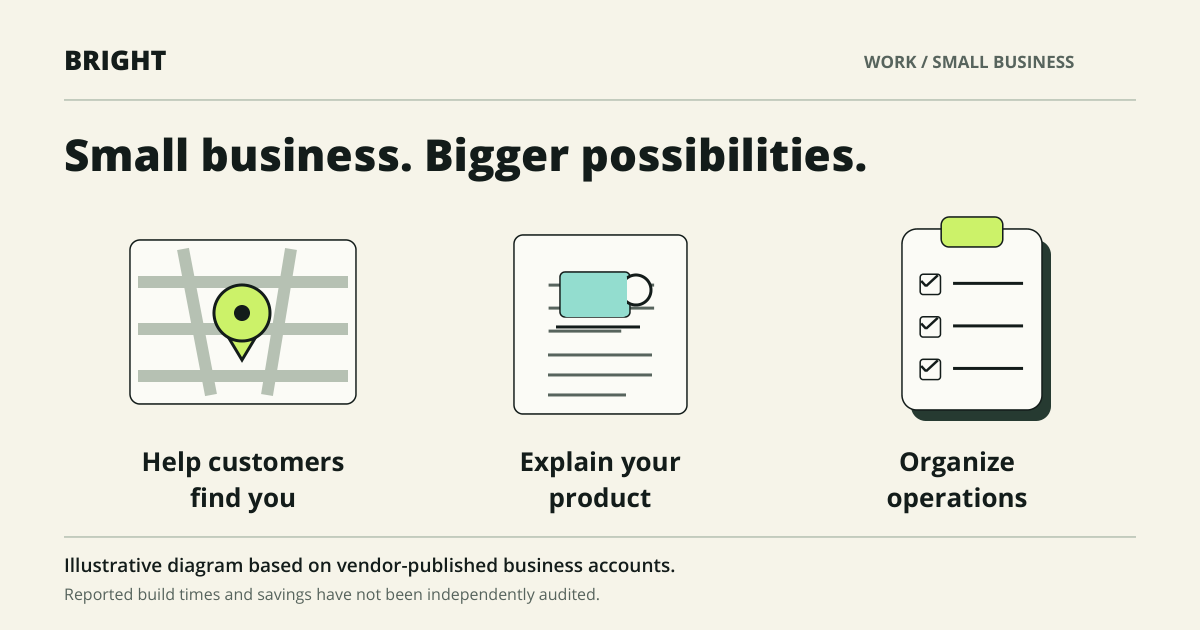
Christian Ortega wanted customers to find his family's tamales at nearby farmers markets. According to an OpenAI profile, he used ChatGPT to build and publish a searchable locator in one afternoon, despite having no previous coding experience. OpenAI's account
It is a small project with an easy-to-understand purpose: help someone who wants your product figure out where to buy it. The Original Tamale Co.'s website currently displays a farmers market finder with an address-search field. That visible page supports the existence of the tool; the account of how it was made comes from the company profile. The company's market finder
This is one of the most promising ways to think about AI in small business. An owner can have a clear idea of what customers need and still lack the time, skills or budget to act on it. Tools that make a useful project more manageable can widen the range of work a small business can take on.
The scale behind the opportunity
The Census Bureau's latest Nonemployer Statistics, released September 29, 2026, count 31,985,874 U.S. businesses with no paid employees in 2024. That is nearly 32 million establishments across the industries the program covers. 2024 Census data
These are business establishments, and the count includes different legal structures and income levels. It should not be read as 32 million people earning a full-time living alone, or as the number of new businesses created that year. The program covers tax-filing businesses that meet its receipts thresholds. Census definitions and scope
The everyday economy is well represented. Census counts more than 1.1 million individual proprietorships in janitorial services and more than half a million in landscaping in 2024. These figures describe the business landscape; they do not measure AI adoption or show that AI caused businesses to form. Census industry snapshot
More business ideas are entering the pipeline
There is a more recent signal of people taking a step toward running a business. Census recorded 4.35 million U.S. business applications from January through August 2026, up 13.5% from the same months in 2025. Bright calculated that comparison from the bureau's monthly data, using unadjusted counts for both periods. These are applications for federal employer identification numbers, filtered for business activity. They are recorded by Census using IRS information, rather than applications to the SBA. Census monthly data
The latest month shows why the longer view matters. August's seasonally adjusted total was 531,728, down 7.8% from July. August is the latest available monthly release as of October 7; September's figures are scheduled for October 14. August release Release schedule
Applications show business activity getting started on paper. They do not establish that a business opened, found customers or became someone's main income. The hiring signals are also mixed: over January through August, applications Census classifies as more likely to become employers rose 2.3% from a year earlier, while applications supplying a first wages-paid date fell 18.4%. Both comparisons use unadjusted counts. Census data What the series measure
That distinction leaves room for a meaningful opportunity. A business can earn revenue and serve customers without immediately employing anyone else. But a stronger application pipeline still needs to be followed through to operating businesses, income and survival. Applications alone cannot tell us how many lasting opportunities have been created, how many businesses have closed, or what role AI played.
What the jobs headlines can miss
Small-business activity reaches beyond what a payroll headline can show. The Bureau of Labor Statistics' payroll survey excludes unincorporated self-employed workers. Its separate household survey, which produces the unemployment rate, includes people working in their own businesses. Self-employment is therefore part of the official employment picture. BLS survey comparison BLS employment definitions
There is still an important measurement gap between having work and seeing what someone can do with it. The household survey counts an employed person once, even if they have several jobs. Someone who already has a job and develops a useful side business does not become a second employed person. An owner who can now build a customer tool or take on a new kind of project may also remain in the same employment category. The headline employment count alone will not describe those changes. BLS definitions
The established small-business economy is substantial, too. The SBA Office of Advocacy's February 2026 compilation reports 36.2 million small businesses and 62.3 million small-business employees, representing 45.9% of private-sector employment. Those figures draw on 2022 Census data. They provide a picture of the sector's scale, while the newer applications series shows more recent activity. The SBA total already includes nonemployer businesses, so it should not be added to the nearly 32 million count above. SBA small-business facts and source years
This is why it is worth looking closely at what owners actually build and what happens afterward. Better tools could make a first experiment more affordable or help an existing business offer something it previously could not. Whether that turns into dependable income is a question for evidence about costs, customers and business survival. The national counts set the scale of the opportunity; the individual projects let us examine how AI might help.
Useful work in familiar businesses
At Henry's House of Coffee in San Francisco, owner Hrag Kalebjian describes using Gemini to help write code for a daily sales forecaster, develop his newsletter and refresh instructions for an Armenian coffee kit. In Google's account, the instruction-card project took about 20 minutes of uploading and working with the tool. Those are specific activities an owner can describe and inspect, even though the time claim has not been independently audited. Google's business profile
ATV Big Air Tour offers another example. OpenAI describes a two-person leadership team using AI to review event information and organize merchandise work. Its profile reports that inventory and reordering work fell from three days to three hours. That is a company-reported result published by the vendor, rather than a controlled measurement of what another business should expect. The tour also has a crew; a two-person leadership team does not mean only two people do all the work. OpenAI's profile The tour's own account
These examples concern established small businesses, including family employers. They illustrate possible uses of AI, rather than providing a representative sample of the nonemployer businesses in the Census count.
A wider range of things an owner can attempt
Taken together, the accounts suggest something more interesting than a longer to-do list completed faster. They point to owners being able to attempt work in another discipline: a customer-facing tool, a clearer set of instructions or a more organized way to handle operational information.
That possibility matters because a small improvement can have a very direct beneficiary. A customer finds the right location. Someone opening a coffee kit has better guidance. A family looking for a live event gets the correct details. These are useful outcomes to look for when judging an AI project.
The value still depends on the underlying business. Customers need a product or service they want, at a price that works. Owners remain responsible for checking accuracy, protecting customer information and maintaining whatever they build. A working first version is the start of that responsibility.
For Bright, the encouraging possibility is that more people can turn practical knowledge into something customers can use, including through a small business of their own. The next evidence worth following is whether AI-assisted projects keep working, earn revenue after their costs and help businesses endure. That is how a wider range of things an owner can attempt becomes an economic benefit we can measure.
Follow Bright for evidence-led stories about AI in everyday work. Get Bright Weekly.
Updates
Updated October 7, 2026: Economic context expanded with January–August 2026 business applications, mixed employer signals, BLS survey definitions and SBA figures based on 2022 data. National counts do not establish that AI drove business growth.
How we know15 sources · checked 2026-10-07 · no corrections
Original sources
- OpenAI's small-business accounts ↗ · institution
- The Original Tamale Co. market finder ↗ · institution
- 2024 Census Nonemployer Statistics ↗ · dataset
- Census release and definitions ↗ · government
- Census industry snapshot ↗ · government
- Google's business profile ↗ · institution
- OpenAI's ATV Big Air Tour profile ↗ · institution
- The tour's own account ↗ · institution
- Census monthly Business Formation Statistics ↗ · dataset
- Census August 2026 Business Formation Statistics release ↗ · government
- Census Business Formation Statistics release schedule ↗ · government
- Census Business Formation Statistics definitions ↗ · government
- BLS household and payroll survey comparison ↗ · government
- BLS household survey employment definitions ↗ · government
- SBA February 2026 small-business facts and source years ↗ · government
Institutions: U.S. Census Bureau · The Original Tamale Co. · Henry's House of Coffee · ATV Big Air Tour
- Maturity
- Demonstrated
- Source published
- 2026-10-07
- Last source review
- 2026-10-07
- Editorial method
- AI-assisted source review
- Place / relevance
- United States · unspecified
Bright compared this account with the linked original and supporting sources and kept reported, budgeted, projected, and observed claims distinct. Bright did not independently audit the underlying records.
Maturity describes the tested or operational setting. Confidence describes support for the particular claim; one does not determine the other.
Revision & correction history
2026-10-07 · AI is helping small businesses get more of their own ideas off the ground
2026-10-07T14:21:57.591Z · Economic context expanded with January–August 2026 business applications, mixed employer signals, BLS survey definitions and SBA figures based on 2022 data. National counts do not establish that AI drove business growth.
2026-10-07T15:20:57.570Z · Evidence review note updated: Census figures describe business establishments and applications, not AI-caused growth. The business examples are vendor-published accounts; reported build times and savings have not been independently audited. The SBA figures draw on 2022 Census data.
2026-10-07T20:21:00.965Z · Image-only revision: replaced the portrait hero and share illustration with the approved original Bright 1200×630 landscape diagram. Article prose, dates, evidence and source claims are unchanged.
No corrections recorded.