
What space data centers could do for people
The hardware already in orbit and the engineering still needed
- Maturity
- Emerging, stage 2 of 4
- Support
- 62 sources · institution, report, government, paper
- Evidence detail
- How we know ↓
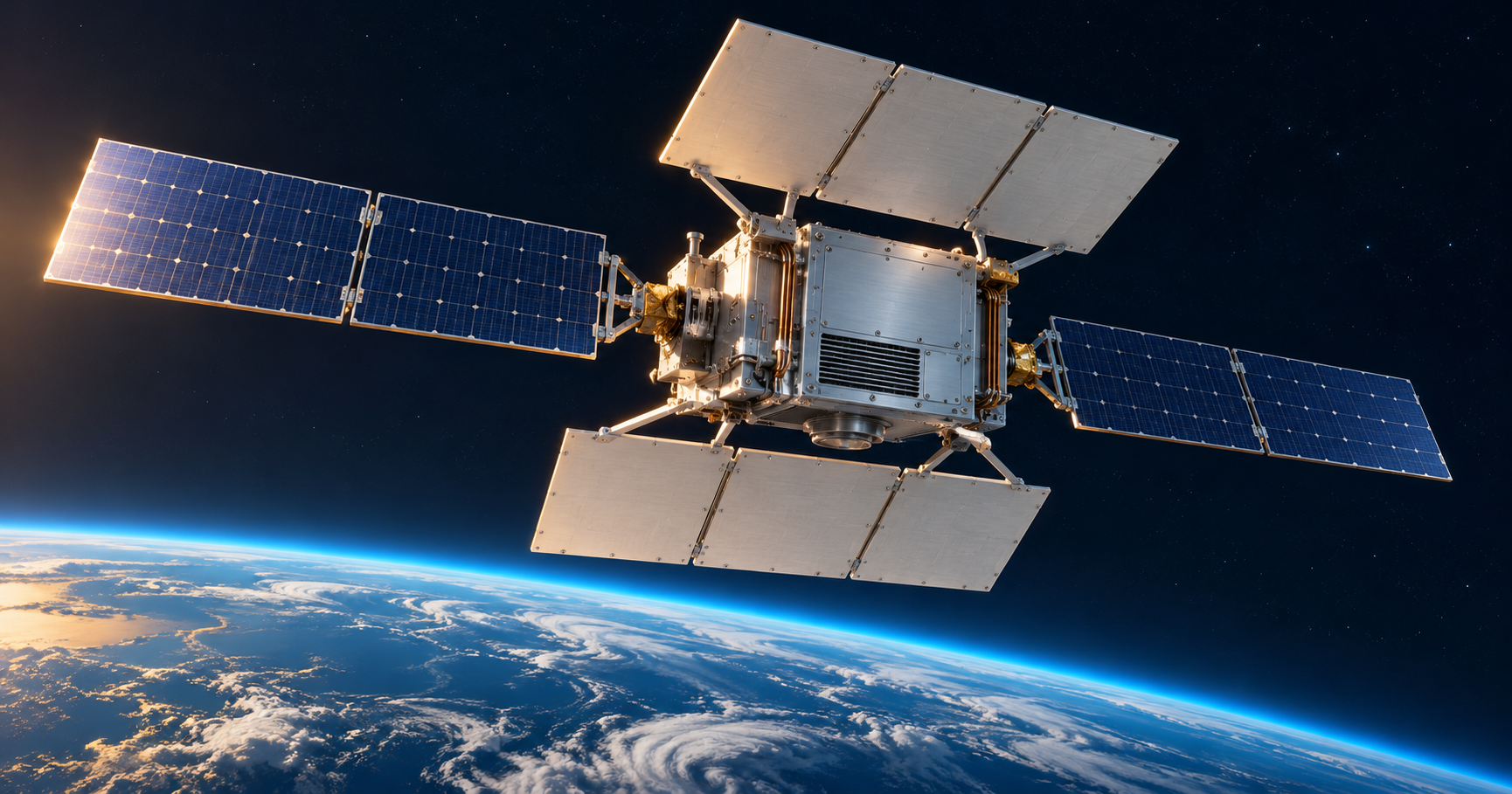
A computer in orbit can now answer a question sent from Earth. On 30 October, Google reported that its first Project Suncatcher prototype had run Gemma 4 onboard and returned a response during a pass over Svalbard. The experiment followed an October launch. Thermal and radiation testing continues, and a pair of interconnected satellites remains a planned 2027 milestone. Google has not disclosed the sustained throughput, availability or full cost needed to judge it as a commercial service. Google’s flight update
That is a useful place to begin a discussion that often jumps straight from a chip in a satellite to enormous AI factories above the atmosphere. A real experiment has happened. The larger proposition still has to earn its way through several different tests.
For people on the ground, the attraction is understandable. Computing supports scientific work, weather and environmental monitoring, education, business and an increasing number of everyday services. Its infrastructure also occupies land, consumes electricity and can put pressure on local water supplies. If some future computing could use sunlight in orbit and radiate its heat into space, could people get more of the benefits with fewer of the local burdens?
The answer deserves more care than either a sweeping promise or a physics-based dismissal. Spacecraft already run computers and reject heat. Selected tasks performed near satellite sensors already have evidence of practical value. A general-purpose orbital cloud has a much harder assignment: it must deliver useful work reliably, move data where it is needed, survive long enough to repay its construction and launch, and compete with improving facilities on Earth.
Our assessment is that the strongest early case is computing close to data already being collected in space. Large orbital systems serving terrestrial users remain a conditional prospect. Their most ambitious public benefits depend on engineering and economic improvements that have not yet been demonstrated together.
The answer lies in following the whole journey: sunlight becomes electricity, electricity becomes useful work and heat, and information reaches someone who can use it. Every step matters to the price and the benefit.
Why the idea is receiving serious attention
The pressure behind orbital computing is partly a question of timing. It can be easier to order more processors than to secure a suitable site, a grid connection and dependable electricity for them. The International Energy Agency estimates that data centers used 485 terawatt-hours of electricity in 2025 and projects about 950 TWh in 2030, roughly 3% of world electricity. These figures cover all data centers, not just AI. Its assessment describes constraints in grids, equipment, chips and financing, alongside rapid improvements in efficiency. IEA’s 2026 assessment
The global percentage can obscure the local issue. A load that is modest relative to world electricity production can be difficult to accommodate in a particular place. An additional facility may need a new substation, transmission capacity or generation that cannot arrive on its preferred schedule. These are site-specific questions. An aggregate demand forecast cannot tell us which town will face a shortage or who will pay for an upgrade.
Orbit offers a different arrangement. A solar-powered computer could consume energy where it is collected, then send information rather than electrical power back to Earth. That avoids the separate challenge of transmitting bulk space-generated electricity to terrestrial grids. The question becomes whether the complete system for producing and delivering that information is worth launching.
The attraction should not be reduced to the size of the Sun. Solar energy also reaches Earth. The relevant advantages would have to come from the particular orbit’s illumination, freedom from clouds, site availability, or access to space-generated data. They must outweigh the burdens of a spacecraft, launch and a communications network.
There is also a practical distinction between an additional source of compute and relief for an existing community. If orbital capacity simply serves additional demand, it may expand the industry without reducing any present ground load. It could still avoid a future facility, but that is a counterfactual to establish rather than a benefit to assume.
Four different things called a space data center
The phrase covers projects with very different requirements.
Onboard processing helps a satellite perform its own mission. It might identify clouds, select useful images, flag a possible fire or decide where to point an instrument. The data starts in space, and the result sent to Earth may be much smaller than the raw observation.
An orbital computing service accepts work from other satellites or from Earth. It adds questions about scheduling, customer access, security, sustained communications and reliable service. A useful small service need not resemble a terrestrial hyperscale facility.
A distributed AI cluster spreads a single computing job across many processors, potentially on separate spacecraft. Its computers must exchange intermediate information fast enough to stay productive. This can be much more demanding than sending a final answer to Earth.
A megawatt or gigawatt installation is an infrastructure proposition. At this scale, power generation, thermal transport, launch cadence, replacement, orbital operations and environmental effects have to work as one system.
Progress at each level can help the next. It does not certify it. Running an AI model in orbit establishes something important about hardware and operations. It does not establish the price, availability or environmental advantage of a future industrial-scale service.
Starcloud provides another useful example. Its operator reports that Starcloud-1 launched with an NVIDIA H100 in November 2025 and subsequently performed AI inference and nanoGPT training. NVIDIA described the demonstration spacecraft as approximately 60 kg. Much larger installations are plans. These are operator and supplier reports, not an independent demonstration of megawatt-scale economics. Starcloud-1, NVIDIA’s account
The sensible response to such milestones is to ask what uncertainty each one removes, then identify the next uncertainty. A demonstration can be impressive without answering every question at once.
What the Musk and Maguire exchange gets us to ask
The recent exchange involving Elon Musk, venture investor Shaun Maguire and critic Jan Broersen distilled the debate into cooling. Broersen emphasized that a spacecraft cannot reject heat to an atmosphere through convection. Musk argued that cooling in space is easier. Maguire emphasized passive thermal transport and the importance of launch mass and cost. Maguire’s original explanation
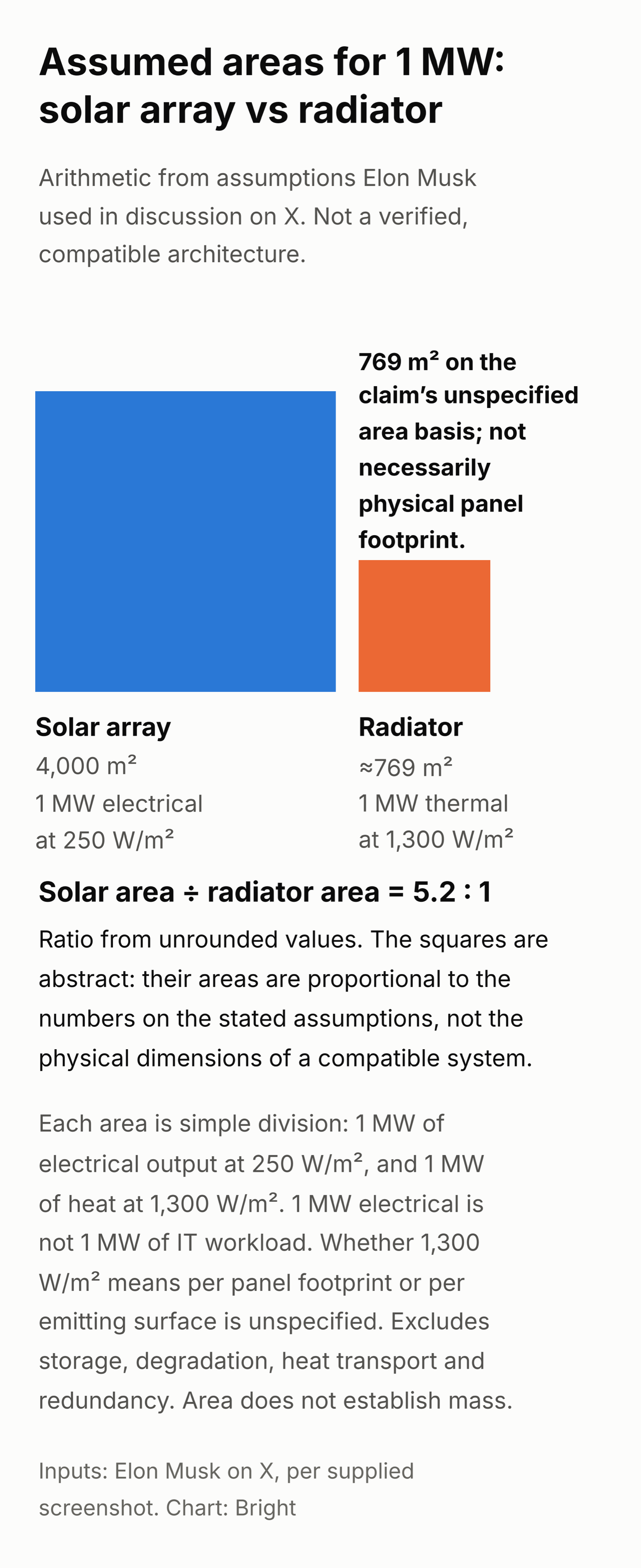
In the numerical reply preserved in the supplied screenshots, Musk used approximately 1,300 watts per square metre for heat rejection and 250 watts per square metre for solar electrical generation. Those figures imply a solar array about five times the radiator area, provided the areas are defined consistently and the other assumptions hold. They are assertions about a possible design, not a disclosed test result for a complete orbital data center. Musk’s numerical reply
The debate is more informative when separated into three questions. Can heat be removed from a chip in space? How much radiator and supporting equipment does a given computing load require? How does that complete system compare with a ground installation?
The first question is settled by existing spacecraft. The other two require a design, operating conditions and a cost comparison. Neither the existence of vacuum nor the existence of a working heat pipe resolves them.
Maguire’s investment context also belongs in the account: his Sequoia profile lists SpaceX among his portfolio relationships. That does not decide whether his engineering claims are correct. It helps readers understand the perspective from which the case is being made. Sequoia profile
Source note on the discussion: this article draws on the screenshots and accessible public posts. The discussion was reviewed qualitatively across public and signed-in views, including nested replies. It was not an exhaustive or representative survey, so the examples below describe specific contributions rather than claiming to represent every response.
The practical questions readers are asking
A related thread by David Aronchick makes the cooling objection vivid through comparisons with tennis courts, football fields and server racks. Replies challenge those comparisons and offer their own mass, power and radiator assumptions. The accessible discussion is useful because it exposes questions a serious proposal needs to answer, even where the participants’ numerical conclusions remain unverified. Aronchick’s thread
Moving heat through a solid could reduce plumbing, but geometry matters. Jonathan Blow asks why a short pumped path could not be followed by solid conduction across the radiator. That is a legitimate architecture to investigate. Heat spreading depends on material, thickness, distance and the permitted temperature difference. A very thin panel can offer a large radiating surface but a small cross-sectional path for heat traveling across it. More thickness or additional transport paths may be needed to keep distant areas useful, adding mass. A short fluid loop and solid spreading can also work together. The answer needs a component design rather than a general preference for pipes or metal. Blow’s question, NASA thermal-engineering guidebook
Rack counts need a power specification. Aronchick’s initial post associates two megawatts with about two racks, but a subsequent reply uses 250 kW for two NVIDIA GB200 racks. The latter is close to NVIDIA’s approximately 120 kW per GB200 rack; its GB300 reference reaches up to 142 kW per rack. The fair lesson from the inconsistency is to compare systems in watts of computing and heat, with rack type stated. Two megawatts would mean roughly 14–17 of those published rack examples, before spacecraft overhead. A sports-field analogy can otherwise change dramatically without any change in the cooling physics. Aronchick’s follow-up, NVIDIA GB200 guide, NVIDIA GB300 reference architecture
A percentage needs a defined comparison. The thread characterizes radiative cooling as 90–99% worse. Before such a percentage is meaningful, we need to know what is being measured: heat removed per square metre, per kilogram, per dollar, or per watt spent on cooling. We also need temperatures and an environmental boundary. A liquid-cooled chip and a radiator can be parts of the same system. Comparing one stage of a terrestrial cooling loop with the final stage of an orbital system can miss much of both.
Mass shares need a component budget. In a visible reply, Maguire proposes that cooling accounts for roughly a third of satellite mass and emphasizes the economics of Starship. That is a design claim to test, rather than a universal satellite ratio. It raises the right bookkeeping questions: does “cooling” include fluid, transport, structure, deployment hardware and spare capacity? Does the total include processors, shielding and propulsion? A smaller radiator footprint can still represent substantial mass. Maguire’s reply
Shared surfaces need compatible functions. Phil Metzger’s reply discusses a large solar installation with radiator area on the backs of the arrays. The appeal is clear: make one deployed structure do more than one job. The engineering question is whether the relevant surfaces can simultaneously receive useful sunlight, transport the computer’s heat and radiate it effectively at acceptable temperatures. That requires an actual layout and thermal path, not just the observation that every panel has a back. Metzger’s reply
Overhead and design margin belong in the numbers. Another visible reply, from @kushkoirala, works outward from a 100 kW computing load and adds losses, margin, absorbed radiation and a pumped loop. It is an illustrative proposal, not demonstrated hardware. Its useful contribution is the structure of the question: how much heat must the whole spacecraft reject, at what temperature, after accounting for what it absorbs? Worked example in the replies
Damage tolerance needs a failure model. Aronchick’s follow-up asks what happens when a radiator is punctured, whether a shared loop can lose its fluid, and how many independent devices or replacement flights would be needed. Those are legitimate engineering questions. The outcome depends on impact exposure, segmentation, valves, fluid inventory and redundancy. It cannot be inferred from a blanket assumption that every system loses all coolant immediately after any impact. Orientation deserves the same care: the relevant quantity is the net radiation balance over the mission, not a universal rule that one panel angle always provides cooling and another provides none. Aronchick’s follow-up concerns
A further reply from @bitcoinbosu asks for a numerical, whole-system engineering and cost comparison between ground and orbit. That is the most useful request in the discussion: follow the same workload through both complete systems. The sections below take that approach while identifying where public data is still too incomplete for a trustworthy final price. Request for a full comparison
These are questions and concerns drawn from identifiable posts, rather than a survey of public opinion. A claimed advantage becomes testable when its units, boundary and assumptions are visible.
How a hot computer loses heat in space
A chip’s heat must travel through the package and an interface into a heat-transport system, then reach a surface that can emit infrared radiation. A radiator does not make the earlier steps disappear. Each part has a temperature difference, a throughput limit and a possible failure mode.
Vacuum removes atmospheric convection from the external heat balance. Radiation remains available. A spacecraft also absorbs energy from sunlight, sunlight reflected by Earth and Earth’s own infrared emission. NASA’s thermal-control guidance treats these inputs alongside internally generated heat and outgoing radiation. A surface’s view of Earth, the Sun and nearby hardware therefore matters. Pointing toward a cold sky is a useful design condition, not a complete description of every surface in low Earth orbit. NASA thermal-control guidance
One published equation shows why the incoming heat deserves attention. Starcloud’s September 2024 white paper applies its low solar absorptivity to both reflected sunlight and Earth’s thermal infrared. Those are different spectral ranges. In an illustrative partial recalculation using the paper’s infrared emissivity for absorption of Earth infrared, while holding its other inputs fixed, net rejection falls from about 633 to 585 W/m². The area needed for the same heat rises by about 8%. This does not validate a replacement model or establish feasibility; it identifies a specific assumption to clarify before reusing the headline value. Starcloud white paper, page 9, NASA’s treatment of optical properties
For a deliberately simplified calculation, take a uniform radiator with infrared emissivity 0.9 facing a 3 kelvin background and absorbing no other heat. Emissivity describes how effectively the surface radiates relative to an ideal emitter. The Stefan–Boltzmann law says that emission rises with the fourth power of absolute temperature. The temperature must be expressed in kelvin. NIST value of the Stefan–Boltzmann constant
Under those assumptions, a radiator at 40°C emits about 491 W per square metre of actual emitting surface. At 60°C it emits about 629 W/m². At 100°C it emits about 989 W/m². Rejecting one megawatt would require approximately 2,038, 1,591 or 1,011 square metres respectively. These are Bright’s elementary calculations, not measured spacecraft specifications.
The higher-temperature result helps explain the appeal of running a radiator hot. It also creates a constraint upstream. The chip, cold plate, transport loop and radiator have different temperatures. A chip’s maximum permitted temperature cannot simply be assigned to the entire radiator. Heat must move through the system, and hotter operating conditions may affect other components and lifetime.
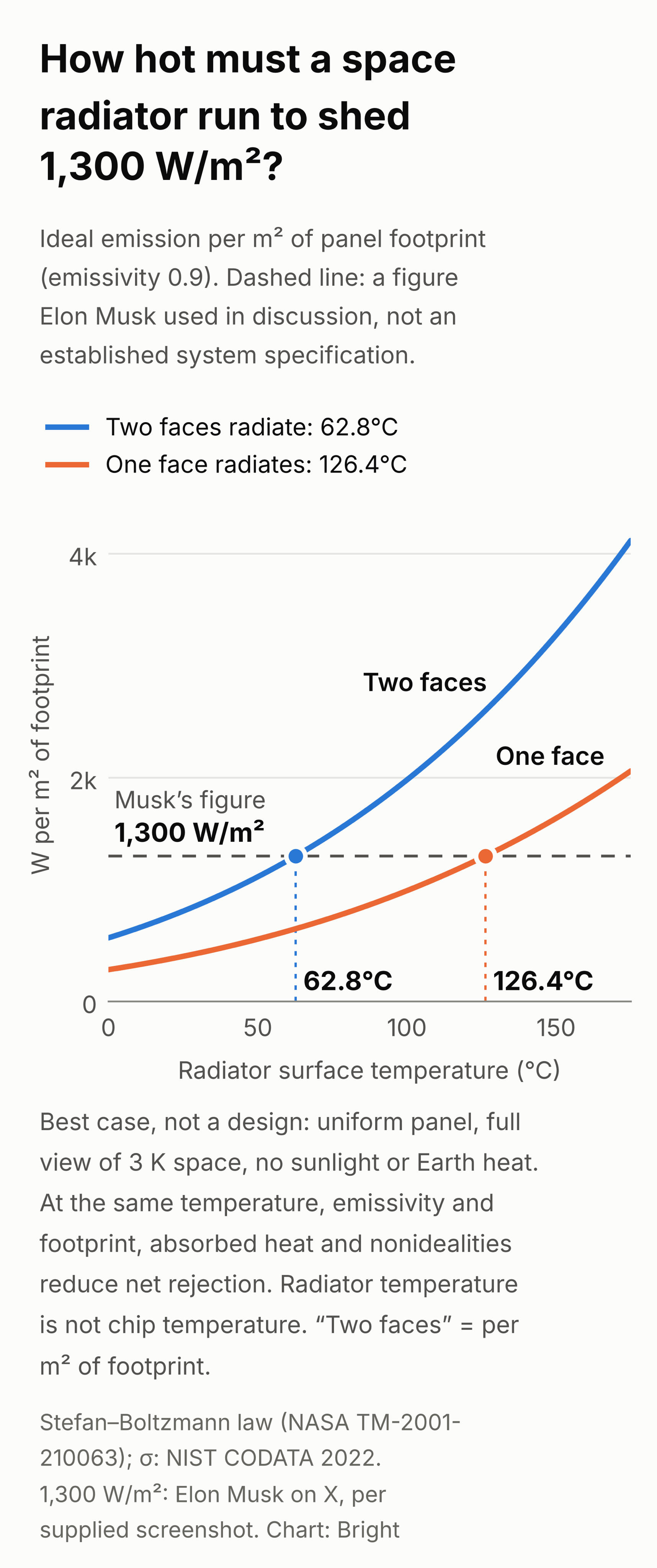
There is a particularly important ambiguity in the 1,300 W/m² claim. With the assumptions above, one emitting face must be about 126°C to radiate that amount per square metre. A panel with two equally effective emitting faces can radiate 1,300 W per square metre of panel footprint at about 63°C, because it has twice the emitting area.
That difference is large enough to change the apparent verdict on a social-media calculation. It does not show that either temperature is the chosen or achievable operating point of a proposed satellite. Both faces would need suitable temperature, coatings and environmental views. A shadowed or Earth-facing side cannot automatically be counted as an equally effective second radiator.
The numerical lesson is useful well beyond this dispute: every area claim needs a definition. Physical footprint, deployed panel area and total emitting surface are not interchangeable. A chart that ignores the distinction can make a plausible calculation look impossible, or make an incomplete design look solved.
Hotter radiators and recovered heat bring their own tradeoffs
Several readers propose an intuitive improvement: increase the operating temperature and let the fourth-power radiation law shrink the required area. Mark George asks whether newer semiconductor processes could support hotter, reliable operation. That is a component-specific question. A proposed system needs permitted temperatures and lifetime evidence for its processors, memory, packaging and other electronics. The radiation curve alone cannot tell us which operating point they can sustain. George’s question
A heat pump offers a different route: keep the electronics cooler while lifting their waste heat to a hotter radiator. A reader explicitly asks about this option, and it has a real spacecraft research history. An ESA program built and tested a heat-pump breadboard intended to raise radiator temperature. That is evidence for the mechanism, not a demonstration of a megawatt computing system. Reader’s heat-pump question, ESA heat-pump study
The energy balance is important. The radiator must reject both the heat collected from the equipment and the work supplied to the heat pump. As an idealized example, moving 1 MW of heat from 40°C to 100°C requires at least about 192 kW of additional work even for a reversible machine. The hot side then has to reject about 1.192 MW. A real machine would require more input. These are Bright’s calculations from the Carnot limit, not a proposed device’s performance. MIT thermodynamics notes
The hotter radiator can nevertheless be smaller. Using the earlier ideal radiation assumptions, the reversible example would need about 1,204 m² of emitting area at 100°C, compared with about 2,038 m² for direct rejection of 1 MW at 40°C. The possible area saving has to pay for extra electricity, power hardware, heat-pump mass and complexity. Environmental heat inputs, real efficiency and temperature drops still need to be included. This is an optimization problem with a plausible benefit, not free cooling.
Another reader asks whether thermoelectrics or thermophotovoltaics could recover electricity from waste heat. Heat-to-electricity conversion is possible, but it needs a temperature difference and must still reject heat. For an illustrative device receiving heat at 60°C and rejecting it at 20°C, the ideal heat-engine efficiency cannot exceed about 12%; real performance would be lower. The relevant temperatures are those of the working system. The 3 K background cannot simply be treated as a cold terminal available without a radiator and its own finite temperature. Reader’s recovery question, MIT explanation of the Carnot limit
Recovered electricity could offset some external supply or perform additional work, but it cannot make the whole system recycle all its heat indefinitely. A serious recovery proposal needs a net system benefit after converter mass, temperature differences, reduced radiator temperature if applicable and remaining heat rejection are included.
Passive cooling still needs an engineered system
Maguire’s emphasis on passive devices has a real basis. His later mass-budget reply also mentions pumps, qualifying the earlier broadly passive description. Maguire’s later reply NASA’s established heat-pipe practice includes aluminum pipes containing ammonia. In a conventional wicked heat pipe, capillary action helps return condensed liquid without a mechanical pump. Describing the circulation only through density differences is incomplete in microgravity, where ordinary buoyancy cannot be assumed. NASA heat-pipe practice
But ammonia does not imply a passive architecture. The International Space Station uses mechanically pumped external ammonia loops to transport heat to radiators. That is a deployed example of an alternative, not a prescription that an uncrewed computing satellite must copy the station. NASA overview of the ISS thermal-control system
Working fluids also have to be discussed accurately. Ammonia’s critical temperature is about 132°C. That is not the same thing as the useful boiling temperature in an operating loop, which depends on pressure. Choosing a fluid means matching its operating behavior to the device, materials and thermal requirements. NIST ammonia data
For a reader evaluating a proposed system, the important questions are concrete. How far must heat travel? What happens if a section is punctured? Can a failed loop be isolated? How much usable heat transfer is available at the intended temperatures? What mass is required for pipes, pumps if any, fluid, supports and redundancy?
Actual operating experience helps put the puncture debate in perspective. NASA documented an ISS ammonia leak that increased over time and was stopped by remotely isolating radiator hardware. That report does not establish a debris-impact cause, but it shows why a leak need not mean immediate loss of an entire cooling system. NASA has also studied radiators with independent heat-pipe segments to limit the consequence of a puncture. Neither source demonstrates economical gigawatt reliability; both identify engineering options that a blanket failure claim overlooks. NASA ISS leak investigation, NASA segmented-radiator study
A passive component may reduce moving parts and power consumption. It still has a finite capacity and needs qualification for the mission. Calling a system passive should tell us something about its mechanism, not end the reliability discussion.
Sunlight becomes useful power only after several losses
Musk’s area comparison can be checked without endorsing a spacecraft design. At an assumed electrical output of 250 W/m², one megawatt requires 4,000 m² of solar array. At an assumed rejection of 1,300 W/m², one megawatt of heat requires about 769 m² on the stated radiator-area basis. The ratio is 5.2.
That is sound arithmetic. The quantities are simplified: one megawatt of generated electricity and one megawatt of heat to reject. A real installation must also power communications, control, distribution and thermal transport. It may need storage. The relevant comparison is usable computing power after all these requirements, rather than peak panel output.
NASA’s power-system survey distinguishes solar-cell performance from array-level specific power and the electricity actually available to a payload. Qualified arrays include wiring, support and deployment hardware, and their output changes with temperature, radiation damage and mission life. A cheap or efficient cell is only part of a working spacecraft power system. NASA power-system guidance
Orbit selection matters too. A design seeking nearly continuous illumination must specify its geometry and seasonal behavior. The label “sun-synchronous” alone is not a guarantee of uninterrupted solar power. If a design enters eclipse, it needs storage, a lower duty cycle or another way to maintain service. Batteries affect mass, lifetime and heat, so this decision reaches far beyond the electrical diagram.
The back-of-the-array idea has a second interaction. A reader asks whether a radiator behind solar cells would heat them and reduce electrical output. Solar performance is temperature-dependent, so the combined design needs to show both useful electrical generation and net heat rejection at the same operating point. Mounting two functions together does not make their temperature requirements independent. Kübler’s question, NASA power-system guidance
Area also does not establish mass. A square metre of solar array and a square metre of radiator need not weigh the same. The claim that solar panels dominate a satellite’s mass therefore requires a component budget. Array area divided by radiator area cannot supply one.
The economic problem starts with what has to be launched
An orbital facility needs computing hardware, but also the equipment that lets that hardware function and survive. A comparison that prices bare processors, bare solar cells and a launch slot can omit much of the project it is trying to evaluate.
Slava Turyshev’s 2026 preprint offers a useful system-level example. Its modeled installation with one megawatt of information-technology (IT) power has a base case of roughly 5,640 m² of photovoltaic array and 2,500 m² of effective radiator emitting area. Power and radiator hardware contribute 29.4 tonnes. An illustrative allowance for other spacecraft mass raises the total to roughly 34–59 tonnes. This high-sunlight example assumes no eclipse-storage battery. It is a model, not a flight-qualified design or a NASA institutional verdict. Turyshev’s model, Table 10
The point is not that every future installation must match those numbers. It is that modest changes in component assumptions compound. More absorbed heat can require more radiator area. More radiator area adds mass and structure. A lower usable-power fraction requires more solar capacity. Additional shielding or redundancy changes the launch requirement again.
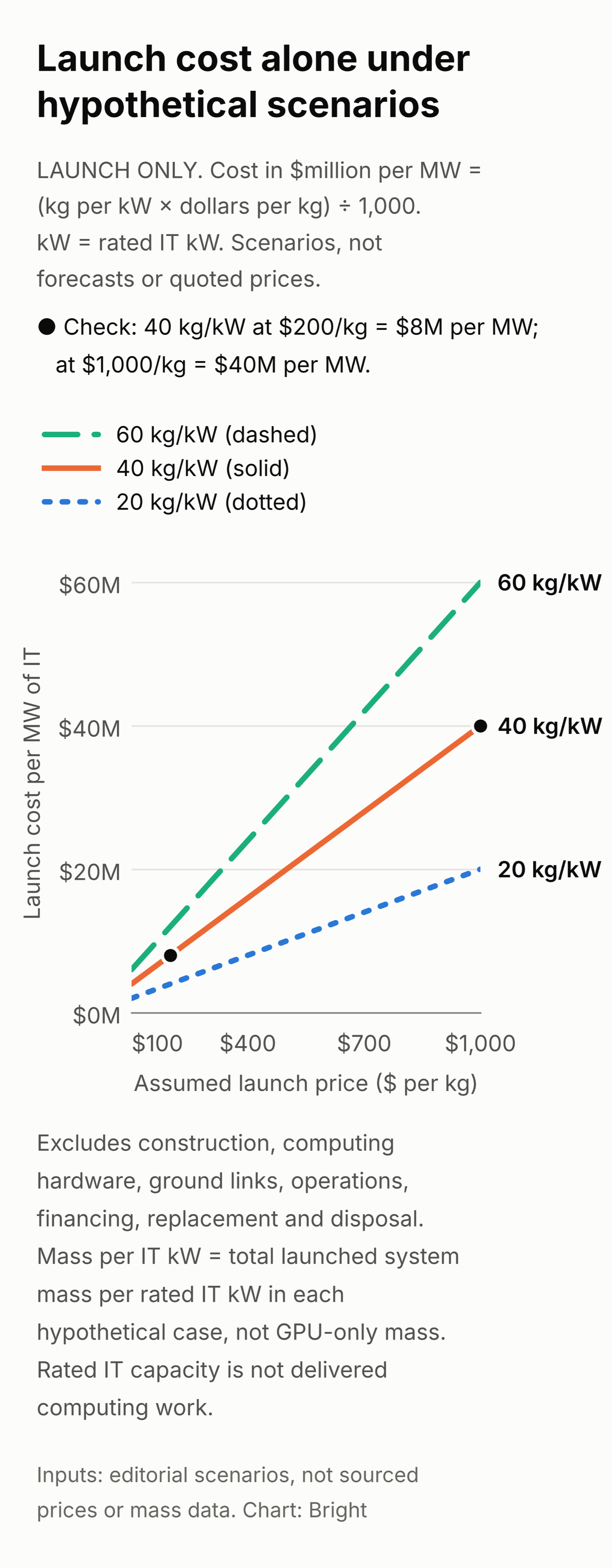
A simple sensitivity calculation makes the cost issue tangible. Suppose a design requires 40 kilograms of complete launched system per kilowatt of IT capacity. At a launch price of $200/kg, the launch bill alone is $8,000 per IT kilowatt, or $8 million per megawatt. At $1,000/kg it becomes $40 million per megawatt. These are arithmetic scenarios, not quotations or complete project costs. They exclude construction, ground infrastructure, financing, operations and replacement.
The same assumed mass ratio would put a one-gigawatt system at 40,000 tonnes. If a hypothetical transport delivered 100 tonnes of that useful system mass per flight to the required orbit, initial deployment would require 400 flights. That calculation does not predict a launch vehicle’s actual payload, cadence or price. It illustrates why an apparently small change in kilograms per kilowatt matters when the ambition becomes gigawatts.
The thread’s scaling discussion also benefits from a simple unit check: 1 GW is 1,000 MW, so it would take 500 nodes of 2 MW each, or 4,000 nodes of 250 kW each, before any distinction between computing power and total spacecraft power. These are capacity identities. Converting them into a launch count additionally requires each node’s complete mass, volume and deployment architecture. Reader discussion of scale
Current launch products must be quoted on their own terms. SpaceX’s public rideshare offer lists $350,000 for 50 kg to sun-synchronous orbit and $7,000/kg for additional mass. That small-payload service is neither a future Starship price nor a sensible universal rate for a large dedicated payload. Conversely, a projected low price should not be presented as a customer quotation available today. SpaceX rideshare pricing
Launch cost is important because every kilogram carries an access cost. It is not the only cost simply because it is easy to express in dollars per kilogram.
Cheap energy is only one part of cheap computing
A widely discussed Starcloud concept paper estimated orbital energy at roughly $0.002/kWh in a 40 MW, ten-year scenario. Its assumptions included a $5 million launch and a $2 million solar array. This is a company scenario whose result depends on lifetime, component costs and the treatment of common hardware. It is not a measured price for reliable computing delivered to a customer. Starcloud white paper, September 2024
The distinction matters because electricity and computing are different products. A customer buys a completed job, a response within a certain time, storage with specified durability, or some other service. An inexpensive power source does little for the price per result if costly hardware spends too much time unavailable, waiting for data or repeating work after a fault.
Consider a purely illustrative machine costing the same amount in two locations and producing the same quality of result when active. If one installation delivers only half as many useful operating hours during its life, its fixed cost per productive hour doubles before any difference in energy price is considered. That is arithmetic, not a forecast of orbital utilization. It explains why duty cycle and lifetime are decisive inputs.
Refresh complicates the calculation. A long-lived spacecraft may be mechanically healthy while newer processors on Earth can do the same work more efficiently. Alternatively, a stable workload may make older hardware productive for longer. A fair model must state which case it assumes and how replacements are paid for. Giving orbital hardware a long economic life while charging the terrestrial comparison for frequent upgrades, without crediting those upgrades’ benefits, would bias the answer.
The right unit is usually cost per correctly completed task at an agreed quality and service level. Cost per watt, per launched kilogram and per advertised processor are intermediate measures. Each is useful, but none by itself tells a hospital, researcher, small business or public agency what service it can afford.
This is also where competition and access enter the public-benefit argument. Even a genuine reduction in operator costs does not automatically become lower prices for everyone. That outcome depends on the market, contracts and who can use the service. An engineering saving creates an opportunity; distribution determines how widely it helps.
There are two separate communications problems
The first is getting data between orbit and Earth. High-rate optical communications already have flight evidence. NASA’s TBIRD demonstration achieved a 200 Gbps downlink and delivered up to 4.8 terabytes error-free during a five-minute pass. Those numbers describe an impressive pass, not an always-available connection. Using decimal units, the transferred data corresponds to a pass-average rate of 128 Gbps. NASA’s TBIRD mission results
A commercial service must additionally account for station visibility, cloud cover at optical ground terminals, routing, handovers, uplink, queueing and availability. A batch job that can wait for the next contact has different requirements from an interactive application expected to respond continuously.
Distance alone is not a reason to rule out interaction. At 650 km altitude, an idealized straight-up-and-down light path takes about 4.34 milliseconds. That is a geometric lower bound calculated from distance and the speed of light, not a promised internet latency. Real slant paths, terrestrial routing and processing add time.
The second communications problem is inside the computer cluster. Distributed AI work can require processors to exchange intermediate results repeatedly. Fast communication between a satellite and Earth does not establish that thousands of processors on many spacecraft can cooperate efficiently.
Google’s revised technical study models an 81-satellite cluster and reports a short-path laboratory optical link at 800 Gbps one-way, or 1.6 Tbps bidirectionally. Approximately 10 Tbps links are proposed. A separate preprint by Kees van Berkel examines how network topology constrains a hypothetical large orbital cluster. Its baseline uses 100 Gbps links, a very different assumption. Neither analysis is a measured orbital training service. Google’s revised technical study, van Berkel’s network analysis
The general lesson is that a link’s headline speed does not tell us how much traffic an entire network can move between distant groups of processors. The arrangement of links, synchronization requirements and workload all matter. A task that runs on one satellite may avoid much of this internal traffic. A large training run spread across spacecraft may not.
One reply describes the intended application as inference rather than training. That may fit a particular service, but it cannot define the whole field: Google’s technical study discusses machine-learning clusters, and Starcloud’s white paper explicitly proposes training. The project and workload must be identified before assigning their network requirements. Davies’s comment
This is one reason the phrase “AI in space” is too broad for an economic verdict. Inference, tightly coupled training, image filtering and independent batch simulations can place very different demands on the same network.
Training across islands is a real experiment on Earth
The illustration Elie Bakouch shared on 2 November shows satellite groups with fast internal links and intermittent connections between groups and Earth. It comes from Rohan Anil’s Core Automation article and depicts a concept, not deployed hardware. Bakouch’s post, Core Automation’s orbital proposal
Core Automation reports using 160 B300 GPUs in the US and 160 GB300 GPUs in Asia, roughly 9,000 miles apart, over a bidirectional 25 Gbps link. A roughly 32-billion-parameter sparse mixture-of-experts model exchanged compressed updates on a 50-step schedule. At equal compute, the reported general-coding evaluation was 0.2525 bits per byte, versus 0.2549 for standard training; lower is better on that measure. A separate eight-learner experiment ran at one physical site. These are company-reported results, not an independent orbital benchmark. Core Automation’s experiment
The approach lets groups do more local work between exchanges. Anil proposes testing small-model pretraining across a few satellites against a ground baseline. That orbital test remains a next step.
This changes the question worth asking about a slow link. How much useful learning can continue while it is unavailable, and how much progress survives when delayed updates arrive? Raw bandwidth remains important, but the algorithm, schedule and final model quality belong in the comparison too.
Orbit would add conditions that the terrestrial result does not reproduce: changing link visibility, pointing and reacquisition, radiation errors, thermal restrictions and failures that cannot be fixed by reaching into a rack. A model trained across such interruptions would need to reach the same quality target with acceptable wall-clock time, energy use and cost. Recovering a connection is only part of that test; the recovered training run must still be useful.
An operational demonstration should therefore report the duration and frequency of interruptions, transfer completion times, stale or discarded updates, checkpoint recovery, corrupted-state detection and final evaluation results. It should also distinguish a simulated outage from an actual orbital loss of contact. Those records would reveal whether asynchronous methods relax an important constraint or merely move its cost elsewhere.
There is a terrestrial benefit to investigate as well. If distributed methods make otherwise fragmented computing capacity productive, that could help users before any large orbital cluster exists. Space should be compared with that improved ground alternative, rather than receiving exclusive credit for software that works in both places.
Reliability has to include correct answers
Surviving launch and turning on are necessary milestones. A computing service must also detect faults, recover from them and continue producing correct results.
Radiation can cause transient errors as well as permanent damage. Google’s revised study reports testing Trillium hardware, including silent corruption in processor or memory state. The authors characterize this behavior rather than treating survival as proof of error-free operation; training-related questions remain open. The June 2026 revision should be used instead of relying on the earlier version’s account. Google’s radiation-testing results
The practical response may include shielding, error correction, repeated computation, checkpointing, spare capacity and software recovery. Each has a cost in mass, electricity, time or usable performance. These costs should be included when comparing the number of useful results delivered by the orbital and terrestrial systems.
Reliability is also a system property. A processor, a radiator and an optical terminal may each pass a test while a failure in their shared power supply stops the whole service. A fleet can add redundancy, but it must be designed around failures that affect multiple nodes together rather than assuming every failure is independent.
Repair and replacement change the economics too. On Earth, operators can often reach faulty equipment and change a component. In orbit, recovery may depend on software, preinstalled redundancy, robotic servicing or replacement launches. The appropriate mix remains design-specific. A business case should say what happens after a failure instead of silently treating the spacecraft’s planned lifetime as guaranteed productive life.
The most useful evidence would therefore be operating records: workload, power draw, thermal conditions, detected and silent errors, recovery time, availability and degradation over a meaningful period. A successful response is a start. A credible service needs the denominator showing how often it succeeds.
The clearest benefits begin with data already in space
The most immediate reason to compute in orbit may have little to do with replacing a ground data center. A sensor already in space can use local computing to decide what information is worth sending and what to observe next.
This has a longer history than today’s generative-AI demonstrations. The EO-1 mission used autonomous science software in the 2000s. Its researchers described a volcanic event in which an alert reached the ground in about two hours and follow-up imaging occurred in about six hours, compared with earlier workflows taking days. The result was specific to that mission and operational setting. EO-1 research paper
In 2025, NASA reported a Dynamic Targeting flight test that completed look-ahead imaging, onboard AI analysis and instrument pointing in under 90 seconds without human intervention. ESA’s Φsat-2, meanwhile, entered its science phase with onboard applications for selecting and processing Earth imagery. These are concrete improvements in an observation workflow. They do not yet measure lives saved or financial losses avoided. NASA Dynamic Targeting, ESA Φsat-2 science phase
Wildfire detection offers a particularly useful example. A 2026 OroraTech research preprint describes a deployed nine-satellite thermal-imaging system using Jetson Xavier NX hardware in a 10 W mode. The paper reports compact models and an under-ten-minute overpass-to-alert pipeline target. That is not a guarantee of detecting every fire within ten minutes of ignition: the satellite must first observe it, and detection quality matters. OroraTech research preprint
The human benefit would come from the complete chain. A satellite observes a developing event. Its software identifies a credible signal. The alert reaches the appropriate responder. The responder trusts it enough to act, has resources available and can do something useful sooner. Improving one link helps only if the rest of the chain works.
That suggests better success measures than processor size: time from observation to a trusted alert, false-alarm rate, missed events, coverage, delivery reliability and changes in response decisions. A small onboard computer might produce a substantial benefit if it removes a bottleneck. Additional megawatts would not automatically improve that outcome.
There is an important design principle here. Put computing where it improves a particular service, and use the amount that service needs. A successful small system is valuable in its own right. It should not be treated merely as a promotional stepping stone toward the largest imaginable installation.
What larger orbital facilities could change on Earth
Readers also ask the most basic question: what problem does this solve for people? The broader promise is to shift some future computing away from constrained terrestrial resources. O’Hogan’s question Several mechanisms are plausible, but each needs a matched comparison.
Electricity and grid capacity. A workload supplied by orbital solar power would not draw its main computing electricity from a local terrestrial grid. As an arithmetic illustration, a continuous 1 GW load consumes 8.76 TWh in a non-leap year. If that exact ground load were genuinely avoided, the electricity would be a substantial avoided demand. This is a hypothetical substitution, not a claim that an announced orbital project has freed grid capacity. Ground stations and other support would still use electricity.
Whether households benefit depends on the situation. Avoiding a difficult new load might ease an upgrade requirement or reduce competition for scarce capacity. In another setting, a data-center customer might fund infrastructure that benefits other users. Electricity tariffs, investment plans and who pays for upgrades determine the result. A global capacity announcement cannot establish a change in a local bill.
Water. A radiator in space does not need a terrestrial evaporative cooling tower to reject its operating heat. For a workload that would otherwise use evaporative cooling in a water-stressed basin, relocation could reduce that particular demand. But the avoided amount depends on the actual ground design, climate and operating pattern. Manufacturing, electricity supply, launch operations and the ground segment still have water footprints.
Land and local disturbance. Moving part of a facility’s physical infrastructure could avoid some terrestrial siting conflicts. The benefit would be specific to the site and the alternative being avoided. It would need to be weighed against launch, manufacturing and ground-station activity elsewhere, rather than treated as the disappearance of infrastructure.
Access to useful computing. If an orbital service eventually lowers the delivered cost of a useful task, it could broaden what researchers, public agencies or smaller businesses can afford. That is a conditional economic pathway. It should be tested with actual service prices and access terms, not inferred from a low estimate for solar energy.

Figure 4 sources: ESA on onboard cloud filtering, NASA JPL’s cloud-avoidance test, NASA FIRMS ground-processed alerts, and HPE’s 24 ISS experiments.
These distinctions do not diminish the ambition. They make it possible to evaluate it. Public benefit becomes more credible when a proposal names the affected place, workload and people, then explains what changes relative to a realistic alternative.
Ground data centers are improving too
An orbital system should compete against the terrestrial facility that could be built for the same workload and time period. Comparing a future spacecraft with an inefficient legacy building would answer the wrong question.
The National Laboratory of the Rockies’ high-performance computing facility reports an annualized power usage effectiveness of 1.036, using warm-water cooling and heat reuse without compressor cooling. PUE measures total facility electricity divided by IT electricity, so this figure describes low facility overhead, not zero computing electricity or zero water use. Laboratory facility description
Microsoft has described a next-generation closed-loop design that eliminates evaporative water consumption for cooling, while acknowledging an increase in PUE relative to evaporative designs. Its projected water savings are design-specific. The example demonstrates a tradeoff: conserving local water can require more electricity. It does not support a claim that every future terrestrial facility must consume large amounts of cooling water. Microsoft’s cooling design
Some workloads can also become more flexible. Google reports reducing machine-learning-related demand during three Omaha Public Power District grid events in 2024. That provides field evidence for shifting or deferring suitable work. It does not show that every job can be interrupted, or establish a universal amount of spare grid capacity. Google’s demand-response account
Other options belong in a fair comparison: better software and processors, improved utilization, appropriate siting, additional generation, transmission upgrades, storage, heat reuse and different cooling designs. Their suitability depends on the place and workload. A latency-sensitive service and a deferrable training run may need different answers.
The comparison should also consider time. A promising orbital design expected years from now cannot relieve a bottleneck next winter. Conversely, a technology need not solve the next winter’s problem to merit research. Near-term deployment decisions and long-term exploration can proceed on different schedules, provided the claims are clear about which one they address.
The most productive question is where an orbital system would have a durable advantage after those ground options are considered. Proximity to space-generated data is already a distinctive feature. Lower all-in cost for Earth-origin workloads would require additional evidence.
Moving infrastructure into orbit changes its footprint
Operational sunlight and the absence of an evaporative cooling tower are only part of an environmental assessment. Hardware must be manufactured, launched, maintained or replaced, and ultimately disposed of. A service may also need a network of terrestrial terminals.
Europe’s ASCEND feasibility study is instructive precisely because its favorable carbon case was conditional. Thales Alenia Space said substantial CO2 reductions would require a launch system with full-lifecycle emissions ten times lower; consortium partner Carbone 4 specifies the comparison in terms of emissions per kilogram of payload. The study therefore does not establish that current launches already make orbital cloud computing greener. Thales Alenia Space’s findings, Carbone 4’s explanation
Carbon is not the entire atmospheric question. Two 2026 Earth’s Future studies examine launch and re-entry chemistry and show that results depend on inventories, particle chemistry and modeling choices. Rocket soot, re-entry materials and emissions at altitude need treatment beyond a conventional electricity-emissions calculation. These papers model scenarios; they do not provide a measured damage coefficient for a proposed orbital data center. Barker and colleagues, Vliex and colleagues
Orbit is also a shared operating environment. ESA’s 2026 space-environment report says active debris removal is needed to halt collision-driven growth. That is a sector-wide finding, not a risk estimate for a particular computing design. A project with large arrays or radiators still needs its own analysis of collisions, debris avoidance, damage tolerance and disposal. ESA Space Environment Report 2026
A complete assessment should examine effects on other spacecraft and astronomy as well as the terrestrial effects it hopes to avoid. It should specify the orbit, physical dimensions, optical and radio behavior, expected lifetime, replacement rate and end-of-life plan. “Space” is too broad a location for an environmental claim.
The appropriate conclusion is neither impact-free computing nor a presumption of unacceptable harm. It is that an environmental advantage must be demonstrated for a defined system against a defined alternative, with uncertainties visible. A lower burden in one place should not conceal a higher burden elsewhere.
What a credible deployment path would look like
A reply from @ieatfishburitos raises the practical challenge of deploying enormous areas of reliable hardware on a useful timescale. That concern is best answered with demonstrated steps and explicit requirements, rather than a date inferred from a concept drawing. Reader’s deployment question
A sensible progression begins with sustained operation of a single node. It would measure thermal behavior, energy use, computing performance and error recovery across relevant conditions. The goal is to understand how much useful work survives the full mission environment, rather than only whether a model can run once.
The next stage depends on the intended service. An observation satellite might need to demonstrate that onboard processing improves its mission. A commercial node serving Earth might need reliable customer connectivity. A distributed cluster would need sustained inter-satellite communication and workload tests across multiple spacecraft.
Larger deployment then adds different questions. Can manufacturing repeat the demonstrated design at the intended rate? Can arrays and radiators be packaged and deployed reliably? Is there sufficient launch capacity to the chosen orbit? Can operators control the formation, replace failed nodes and safely retire them? Does the complete service still beat its terrestrial comparison after reserves and failures are included?
Even optimistic participants acknowledge the development gap. In a nested reply, Metzger says he does not expect the technology to be ready in less than ten years, while believing its economics could become favorable around that horizon. This is his forecast, not a verified readiness schedule, and it should not be converted into an industry consensus. Metzger’s qualified timeline
These stages do not require a universal timetable. They provide a way to interpret announcements. A laboratory link advances communications evidence. A launched accelerator advances hardware evidence. A customer paying for repeated work advances commercial evidence. They should be recorded as the milestones they are.
The most persuasive companies and research groups will make those distinctions themselves. Publishing limitations alongside results lets others improve designs and prevents an early success from being burdened with claims it cannot yet support.
The evidence that would change the answer
The case for large orbital computing would become materially stronger with six kinds of evidence.
Sustained useful output. Publish operating records for a defined workload, including quality, throughput, availability, energy use and errors. Report downtime and repeated work, not just the best demonstration.
A complete mass and thermal budget. Show the full deployed system, with power available at the end of life, radiator emitting-area conventions, environmental heat inputs, transport equipment, shielding, structure and reserves. The components must work at the same operating point.
A credible communications service. Demonstrate the external network’s availability and the internal cluster’s performance where required. Include weather, handovers, routing and realistic workloads. A fast individual link should not stand in for a fleet-wide result.
Delivered economics. Provide a cost per useful task under matched service requirements, with construction, launch, operations, ground connectivity, financing, replacement and disposal. Separate contracted prices from learning-curve forecasts and distinguish economic life from mere survival.
A matched environmental assessment. Compare the orbital design with a plausible new ground facility at the relevant time and place. Include water, manufacturing, launch and re-entry, replacement and orbital effects. Show how conclusions change under uncertain inputs.
Observed benefit for people. For an Earth-observation service, measure whether credible information reaches people sooner and changes decisions. For a computing service, show who receives lower prices or improved access. For grid or water claims, identify the local demand actually avoided.
Some evidence could weaken the case just as clearly: low utilization, frequent silent errors, thermal operation limited to short bursts, rapidly obsolete hardware, expensive replacement, or a ground alternative improving faster than expected. A useful investigation should be willing to update in either direction.
The uncertainty is not a reason to stop building prototypes. It is a reason to design prototypes that answer the most consequential questions.
A practical reason to be interested
There is a serious idea inside the spectacle of data centers in space. Computing is useful, its physical infrastructure has costs, and different locations can change those costs. Engineers now have real orbital demonstrations with which to test assumptions that once lived mainly in proposals.
The strongest evidence today supports a focused proposition: computing near space-generated data can improve how satellites observe and respond. The wider proposition, that large orbital facilities can deliver cheaper or environmentally preferable computing to Earth, remains a systems question with several unresolved conditions.
Musk’s radiator arithmetic and Maguire’s emphasis on launch costs each point to part of that system. Neither settles it. The fair test runs from the solar array through the processor, thermal system and communications network to the completed task and the person who uses it.
If those links can be made to work together, the result could expand what people can do while relieving particular constraints on Earth. The evidence needed is demanding but understandable. That is a better basis for optimism than assuming that moving a machine above the atmosphere also moves its problems out of view.
About the evidence
This article separates flight results, laboratory experiments, company reports, technical models and our own illustrative calculations. Public posts supply the questions being examined; they do not independently validate engineering claims. The discussion sample was qualitative, not a survey. All four figures are original explanatory graphics, with assumptions and limitations shown. No interview quotation or outside endorsement is implied.
How we know62 sources · checked 2026-11-03 · no corrections
Original sources
- Google’s flight update ↗ · institution
- IEA’s 2026 assessment ↗ · institution
- Starcloud-1 ↗ · institution
- NVIDIA’s account ↗ · institution
- Maguire’s original explanation ↗ · report
- Musk’s numerical reply ↗ · report
- Sequoia profile ↗ · institution
- Aronchick’s thread ↗ · report
- Blow’s question ↗ · report
- NASA thermal-engineering guidebook ↗ · government
- Aronchick’s follow-up ↗ · report
- NVIDIA GB200 guide ↗ · institution
- NVIDIA GB300 reference architecture ↗ · institution
- Maguire’s reply ↗ · report
- Metzger’s reply ↗ · report
- Worked example in the replies ↗ · report
- Request for a full comparison ↗ · report
- NASA thermal-control guidance ↗ · government
- Starcloud white paper, page 9 ↗ · institution
- NIST value of the Stefan–Boltzmann constant ↗ · government
- George’s question ↗ · report
- Reader’s heat-pump question ↗ · report
- ESA heat-pump study ↗ · institution
- MIT thermodynamics notes ↗ · institution
- Reader’s recovery question ↗ · report
- MIT explanation of the Carnot limit ↗ · institution
- NASA heat-pipe practice ↗ · government
- NASA overview of the ISS thermal-control system ↗ · government
- NIST ammonia data ↗ · government
- NASA ISS leak investigation ↗ · government
- NASA segmented-radiator study ↗ · government
- NASA power-system guidance ↗ · government
- Kübler’s question ↗ · report
- Turyshev’s model, Table 10 ↗ · paper
- Reader discussion of scale ↗ · report
- SpaceX rideshare pricing ↗ · report
- NASA’s TBIRD mission results ↗ · government
- Google’s revised technical study ↗ · paper
- van Berkel’s network analysis ↗ · paper
- Davies’s comment ↗ · report
- Bakouch’s post ↗ · report
- Core Automation’s orbital proposal ↗ · institution
- Core Automation’s experiment ↗ · institution
- EO-1 research paper ↗ · paper
- NASA Dynamic Targeting ↗ · government
- ESA Φsat-2 science phase ↗ · institution
- OroraTech research preprint ↗ · paper
- O’Hogan’s question ↗ · report
- ESA on onboard cloud filtering ↗ · institution
- NASA JPL’s cloud-avoidance test ↗ · government
- NASA FIRMS ground-processed alerts ↗ · government
- HPE’s 24 ISS experiments ↗ · institution
- Laboratory facility description ↗ · institution
- Microsoft’s cooling design ↗ · institution
- Google’s demand-response account ↗ · institution
- Thales Alenia Space’s findings ↗ · institution
- Carbone 4’s explanation ↗ · institution
- Barker and colleagues ↗ · paper
- Vliex and colleagues ↗ · paper
- ESA Space Environment Report 2026 ↗ · institution
- Reader’s deployment question ↗ · report
- Metzger’s qualified timeline ↗ · report
Institutions: Google Research · NASA · ESA · Core Automation · Starcloud
- Maturity
- Emerging
- Captured
- 2026-11-03
- Last source review
- 2026-11-03
- Editorial method
- AI-assisted source review
Bright compared this account with the linked original and supporting sources and kept reported, budgeted, projected, and observed claims distinct. Bright did not independently audit the underlying records.
Maturity describes the tested or operational setting. Confidence describes support for the particular claim; one does not determine the other.
Revision & correction history
2026-11-03T14:09:14.915Z · Initial complete source-linked deep dive with 62 distinct source URLs, four original explanatory figures, a labeled conceptual cover and distinctions among flight results, company reports, models, illustrative arithmetic and conditional human benefits.
No corrections recorded.
Keep exploring
Explore the shared question in another setting. These connections do not imply replication.