
A better forecast can start by learning its own mistakes.
New research shows how machine learning can improve the odds in three- and four-week weather outlooks by correcting forecasts that already exist.
- Maturity
- Demonstrated, stage 3 of 4
- Support
- 4 sources · paper, dataset, institution
- Evidence detail
- How we know ↓
Some weather decisions need a longer runway than tomorrow’s forecast. A grower might be weighing when to plant; a water manager might be planning for a wetter period. An uncertain outlook can still be useful if its probabilities are dependable enough to help people prepare. Improving those probabilities is the subject of a new weather study.
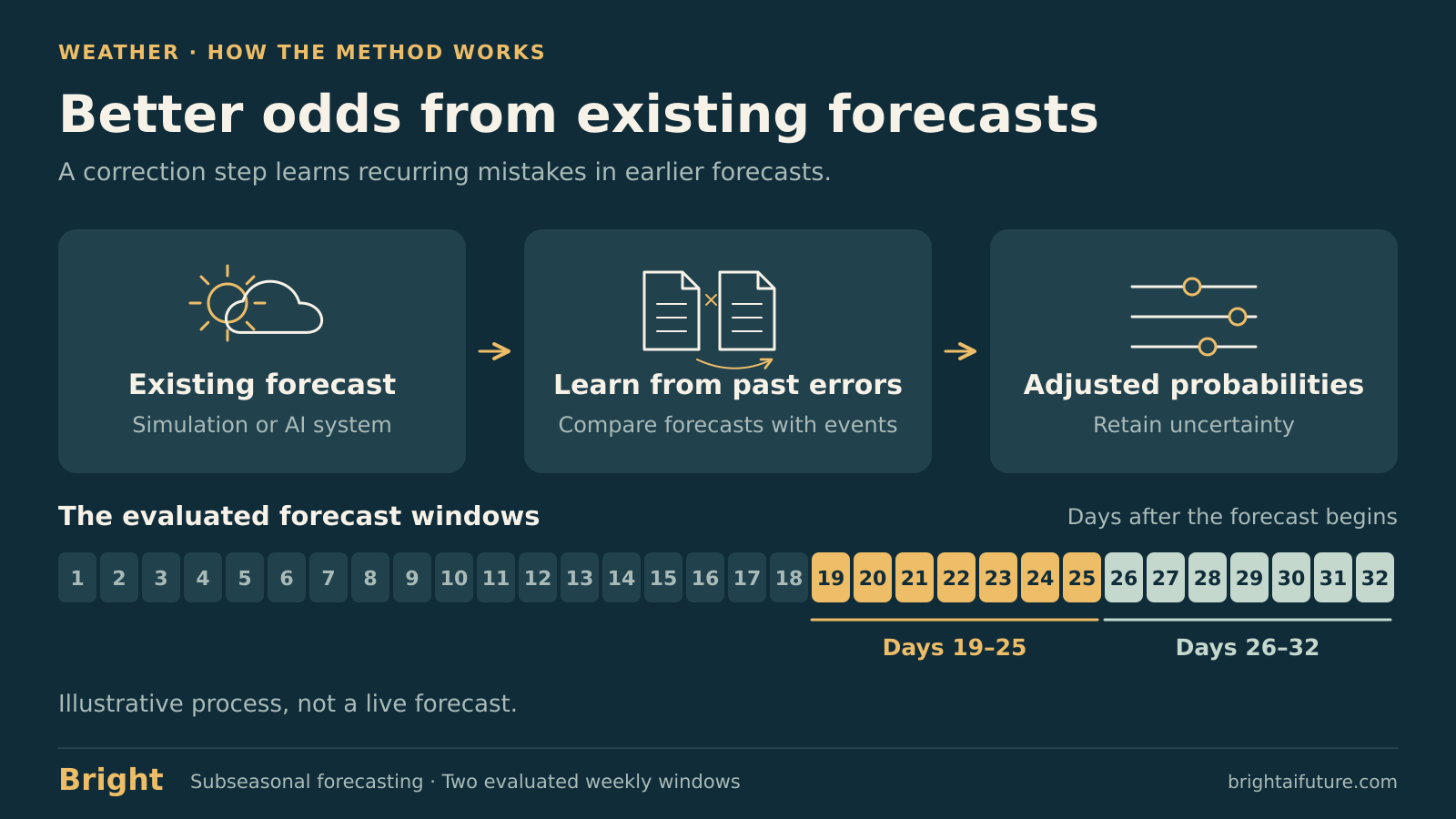
Published in Nature on October 14, the research describes probabilistic bias correction, or PBC. It learns recurring errors in existing forecasts and adjusts their predicted probabilities. The approach works with forecasts generated by conventional atmospheric simulations as well as AI systems. Nature paper
The central tests concern two week-long windows: days 19–25 and days 26–32 after a forecast begins. Those are the same windows used by the European Centre for Medium-Range Weather Forecasts’ AI Weather Quest. Its original challenge assessed weekly temperature, rainfall and sea-level pressure across a global grid. ECMWF dataset description
Improving the forecast’s odds
Imagine a forecasting system that repeatedly puts too much confidence in a particular outcome. Simply running it again will not necessarily remove that habit. A correction trained on earlier forecasts and what subsequently happened can learn where its probabilities need adjusting. This is an illustration of the idea, not a result for a particular town or weather event.
Microsoft’s research team developed MicroDuet by combining PBC with POET, a system that uses a transformer model to improve forecast ensembles. An ensemble is a set of possible weather outcomes. Their work builds on a longer effort to combine machine learning with established forecasting systems, rather than requiring every improvement to begin with a wholly new weather model. Microsoft Research project
In the Nature study’s 2025 test, PBC doubled the average ranked probability skill score of ECMWF’s subseasonal AI system across the tested variables and lead times. The starting average was modest: 0.03. This is a gain in a particular measure of forecasting skill, not a claim that the system gets the weather right twice as often. Nature paper
The score measures improvement against a baseline built from historical climate patterns. A positive score means beating that baseline; a negative score means doing worse. That makes the choice of benchmark important when interpreting a large percentage improvement. Readers should ask what improved, over which period and compared with what. ECMWF’s explanation of the evaluation
Evidence beyond looking backward
The approach also faced weather that had not yet happened. ECMWF’s account of the competition’s first two seasons reports that MicroDuet led at both forecast horizons and significantly outperformed its dynamical benchmark across the three variables. The organizer also emphasized a remaining challenge: turning better scores into guidance national weather services can use. ECMWF competition analysis, March 13, 2026
Bright previously covered the competition’s open forecast data. This paper adds a closer explanation of a successful correction method. It gives researchers something specific to examine, test and improve within that shared framework.
For people whose work depends on weather, the next questions are practical. Does an improvement hold in their region and season? Does it arrive early enough to change a decision? Can a local service explain the uncertainty clearly? Those answers determine whether an encouraging global result becomes useful preparation.
The study establishes better forecast performance within its evaluations. It does not measure avoided flood damage, improved harvests or lives saved. The hopeful part is the route it opens: improving information already flowing through weather systems, then testing whether people can make better use of it.
How we know4 sources · checked 2026-10-15 · no corrections
Original sources
- Nature paper ↗ · paper
- ECMWF dataset description ↗ · dataset
- Microsoft Research project ↗ · institution
- ECMWF’s explanation of the evaluation ↗ · institution
Institutions: Microsoft Research · European Centre for Medium-Range Weather Forecasts
- Maturity
- Demonstrated
- Source published
- 2026-10-14
- Captured
- 2026-10-15
- Last source review
- 2026-10-15
- Editorial method
- AI-assisted source review
Bright compared this account with the linked original and supporting sources and kept reported, budgeted, projected, and observed claims distinct. Bright did not independently audit the underlying records.
Maturity describes the tested or operational setting. Confidence describes support for the particular claim; one does not determine the other.
Revision & correction history
2026-10-15 · First prepared version of the reviewed manuscript, with primary sources and explicit evidence limits.
No corrections recorded.
Keep exploring
Explore the shared question in another setting. These connections do not imply replication.