
Your AI doesn’t have to live on someone else’s computer
Downloadable models can handle some everyday tasks on a device you own. That gives people a new choice about their prompts. Artists’ consent, land-use decisions and electric bills raise different questions.
- Maturity
- Emerging, stage 2 of 4
- Support
- 18 sources · institution
- Evidence detail
- How we know ↓
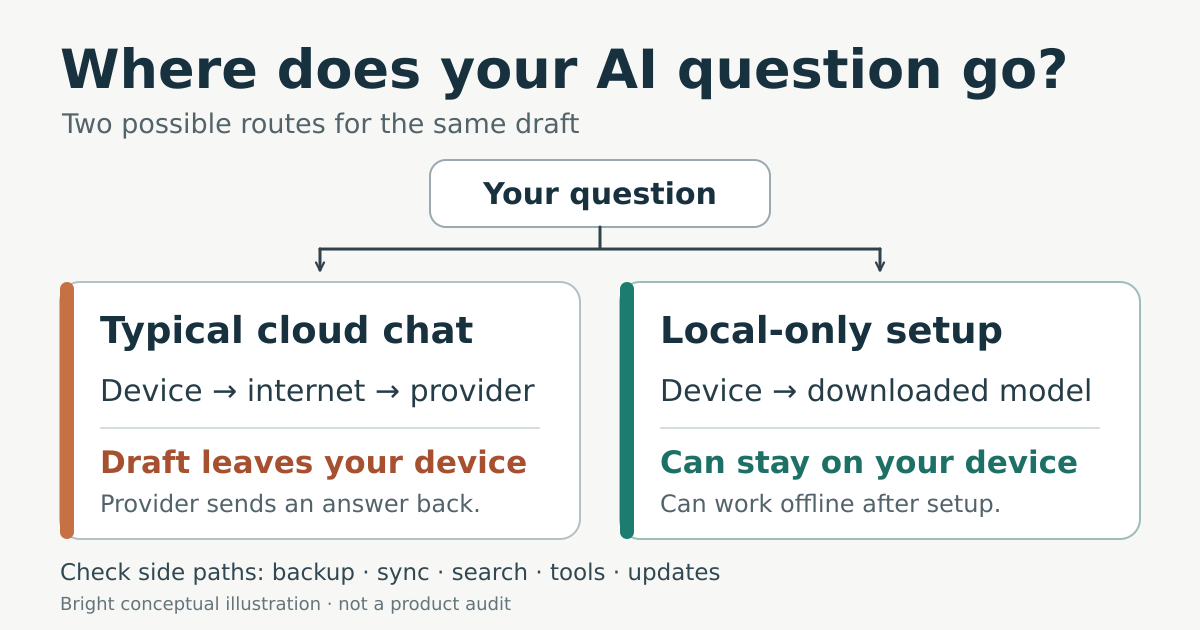
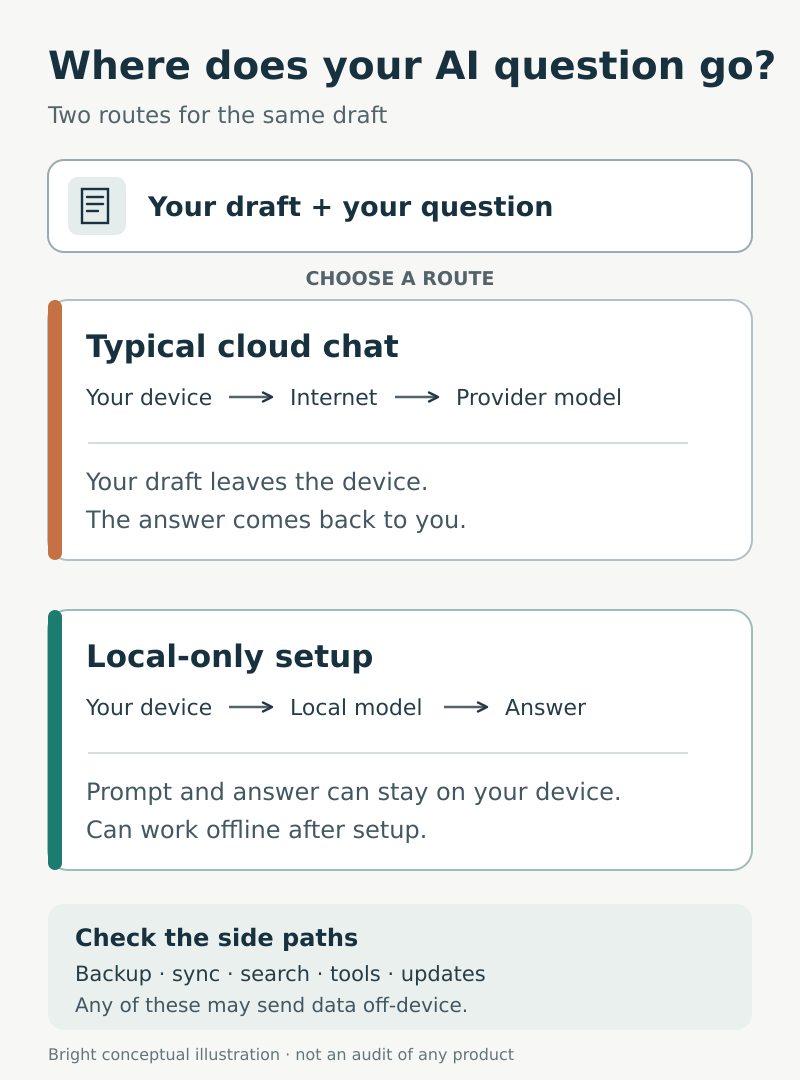
Suppose you want help rewriting an awkward email. It contains a customer’s name, or something private about your family. With a typical cloud chatbot, your draft travels over the internet to a company’s computers, where the model generates an answer. But you can now download some models and ask certain questions on a computer you already own. After setup, some will work even when the connection is off.
That changes a basic question: who receives what you type? It does not mean every AI problem has a setting you can fix at home.
What “on your computer” can mean
In a Pew survey published June 17, 2026, 49% of U.S. adults said they had used a chatbot. Yet 71% thought greater AI use would make personal information less secure. The latter figure is a prediction people made, not a measured leak. It captures a familiar tension: the tool may be useful, but what happens to the material fed into it?
In a local-only setup, the answer-generating step takes place on your device. LM Studio’s documentation says its downloaded models can chat with documents without an internet connection. Someone could, for example, ask for a first draft of a letter or a summary of a locally stored meeting transcript. That is a documented capability, not a hands-on test by Bright.
The conditions matter. The app and model must already be installed. The chosen feature must actually use the downloaded model. A cloud backup might copy the document, while web search, email tools and optional cloud models can send data out. A malicious document might even try to make a connected tool disclose information. The Electronic Frontier Foundation’s August 2026 guide urges people to inspect the whole path their information takes. The clearest test is simple to understand: after setup, disconnect the computer and see whether that specific task still works. Bright has not run that test yet.
A real choice on more than one kind of computer
NVIDIA is helping make local AI more capable. Its graphics chips can speed up the work; in January 2026 it described improvements to software for running models on RTX computers. It also publishes a downloadable Nemotron 3 Nano 4B model. These are concrete contributions. They do not make an RTX card a requirement for everyone.
The open-source llama.cpp project supports ordinary processors, Apple Silicon and AMD graphics hardware, as well as NVIDIA’s. Google offers smaller Gemma 4 models that can be downloaded. What runs well depends on the computer, model and task. Start by asking what an existing machine can do before treating new hardware as the price of entry.
There is a tradeoff. A small model may take longer or miss something a large cloud model catches. It may answer with old information while offline. Google’s own model card warns that Gemma 4 can make factual errors. Cloud services can provide stronger models, current search and managed updates. Privacy there is not necessarily an all-or-nothing proposition: LM Studio’s June 2026 policy says prompts and responses sent to its optional cloud services are not retained after a request completes, although those requests still leave the device for processing. Those are the company’s stated terms, not a substitute for checking the service you use.
A downloaded copy has a second advantage: it may keep doing familiar work if a provider raises prices, changes a feature or goes offline. That does not bring free updates, new facts or perfect security. Someone still needs to maintain the computer and software.
What a local model cannot decide
At a March 19, 2026 public hearing in Genesee County, New York, residents and workers weighed a proposed data-center project near Tonawanda Seneca land and wetlands. Chief Scott Logan spoke about his community’s ability to “continue governing ourselves as we do today.” A carpenters-union representative said, “We need projects like this,” describing construction jobs and benefits. The hearing’s professionally prepared transcript records both views. A person running AI on a laptop cannot settle who controls that land or whether promised work materializes.
In Homer City, Pennsylvania, residents’ published questions from March 2026 ask who would pay for grid upgrades, how air and water would be measured and whether local people would get permanent jobs. Questions do not prove that predicted harms have happened. The benefits also cannot be waved away. In July 2026 reporting from Jay, Maine, some residents saw a proposed center as a chance to replace part of the economic loss from a closed paper mill. Both the benefits and the costs need evidence a town can hold a developer to.
Control over creative work is another matter. In Madison, Wisconsin, artist Noah Peterson argued that artists should give clear consent before their work from a museum collection feeds an AI exhibition, Wisconsin Public Radio reported September 25, 2026. The museum says it obtained rights-holder permission where required. It says the collection images entered the exhibition’s system but were not added to the underlying model’s training data. Legal permission for this exhibition, an artist’s ethical consent, and consent to a model’s earlier training are separate questions. Downloading a model resolves none of them.
Four questions, four kinds of power
Running a model locally moves some electricity use to a device at home. It does not erase the computers used to train models or the cloud systems used by other services. Nor is it automatically greener: the answer depends on hardware, use and what it replaces. The International Energy Agency’s 2026 analysis treats data-center demand and its costs as fast-changing public questions. In a September 22, 2026 Pew survey, 60% of U.S. adults said they would be uncomfortable with a new data center nearby. That survey covers data centers broadly, not just AI, and says nothing about the impact of any one project.
So ask four separate questions. Can I choose where my prompts and files are processed? Can creators decide how their work is used? Can I keep using or move away from a provider’s product? Can neighbors shape the land and grid decisions around them?
Local AI offers a practical choice on the first question and a measure of continuity on the third. The others require consent and public decisions with enforceable terms. The point is to make each choice visible, so people can decide what control is worth to them and demand answers where a download is not enough.
**Reader’s note: “open” has layers.** A model’s *weights* are the learned numbers that let compatible software run it. NVIDIA’s Nemotron 3 Nano 4B is downloadable under NVIDIA’s Nemotron Open Model License. Google’s Gemma 4 model card, updated July 30, 2026, lists an Apache 2.0 license. The MIT-licensed llama.cpp software is another layer. The Open Source Initiative distinguishes access to model weights from fully open-source AI. None of those labels alone tells you where an app sends your prompts.
What was shown, and what wasn’t
Shown
LM Studio documents offline chat and document processing with downloaded models. Bright has not performed a hands-on offline test for this package.
Not shown · limits
- Source-based reporting; no hands-on test performed.
- Local processing depends on the app, model, setup, backups and connected services. It is not a guarantee of complete privacy.
- Model quality, hardware fit and maintenance vary.
- Local processing does not resolve creator consent, land use or grid decisions; it is not automatically greener.
Bright editorial interpretation
Local processing can offer a practical choice over where prompts are processed and some continuity when a provider changes its service.
Still open
Can users inspect where each feature processes data?
Which connected services send information off-device?
How we know18 sources · checked 2026-10-09 · no corrections
Original sources
- Pew survey published June 17, 2026 ↗ · institution
- LM Studio’s documentation ↗ · institution
- Electronic Frontier Foundation’s August 2026 guide ↗ · institution
- January 2026 it described improvements ↗ · institution
- publishes a downloadable Nemotron 3 Nano 4B model ↗ · institution
- open-source llama.cpp project ↗ · institution
- offers smaller Gemma 4 models ↗ · institution
- LM Studio’s June 2026 policy ↗ · institution
- March 19, 2026 public hearing in Genesee County, New York ↗ · institution
- carpenters-union representative ↗ · institution
- Homer City, Pennsylvania, residents’ published questions from March 2026 ↗ · institution
- July 2026 reporting from Jay, Maine ↗ · institution
- Wisconsin Public Radio reported September 25, 2026 ↗ · institution
- museum says ↗ · institution
- International Energy Agency’s 2026 analysis ↗ · institution
- September 22, 2026 Pew survey ↗ · institution
- MIT-licensed llama.cpp software ↗ · institution
- Open Source Initiative ↗ · institution
Institutions: LM Studio · NVIDIA · Google · Open Source Initiative
- Maturity
- Emerging
- Source published
- 2026-10-09
- Captured
- 2026-10-08
- Last source review
- 2026-10-09
- Editorial method
- AI-assisted source review
- Place / relevance
- Local AI and public decisions in the United States · unspecified
Bright compared this account with the linked original and supporting sources and kept reported, budgeted, projected, and observed claims distinct. Bright did not independently audit the underlying records.
Maturity describes the tested or operational setting. Confidence describes support for the particular claim; one does not determine the other.
Revision & correction history
2026-10-08T23:18:03.791Z · Your AI doesn’t have to live on someone else’s computer
No corrections recorded.
Keep exploring
Explore the shared question in another setting. These connections do not imply replication.