
Meta’s Muse update takes aim at an everyday AI frustration: repeating yourself
Meta is rolling out specialized models to Muse and Meta AI. Its memory results are promising, but the everyday test is whether people spend less time correcting the assistant.
- Maturity
- Emerging, stage 2 of 4
- Support
- 4 sources · institution
- Evidence detail
- How we know ↓
An assistant becomes useful when you can leave a task with it and return without starting over. The budget is still the budget. The appointment you moved is no longer on Tuesday. A change of plan should replace an old instruction, rather than sit beside it waiting to cause trouble.
Meta’s November 6 announcement targets that problem. The company says specialized versions of its existing models, trained using Muse Wonder, are rolling out to Muse and Meta AI. It describes improvements in retaining relevant information, recognizing stale information and continuing through unexpected obstacles.
That is a useful direction for personal AI. The evidence available so far is a provider announcement and provider-reported evaluations. Bright has not tested these specialized models or found independent tests of this rollout.
What the memory number actually means
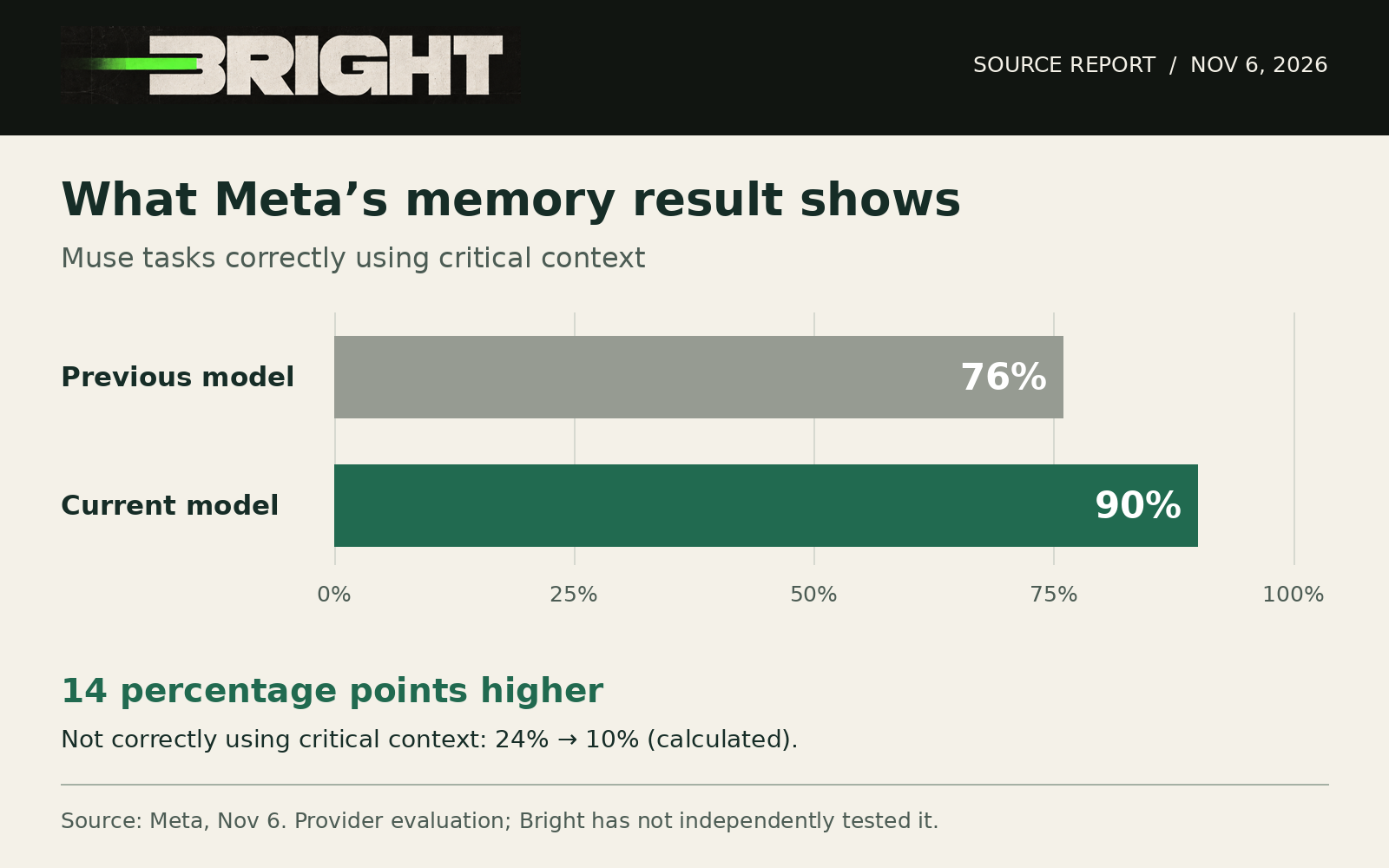
Meta’s Active Memory evaluation reports that Muse correctly used critical context on 90% of tasks, up from 76%. That is a 14-percentage-point improvement. Turn those figures around and the share not correctly using critical context falls from 24% to 10%. This explains the company’s “2.4x reduction” in forgetting: 24 divided by 10 is 2.4. It does not mean the assistant has 2.4 times as much memory.
The distinction matters because a remembered detail is only useful if it belongs in the current task. A practical assistant needs to keep a continuing preference, replace an outdated plan and avoid importing unrelated details. The user should not have to reconstruct which version of their life the software is following.
The remaining 10% also matters. Even in the reported evaluation, the new model did not use critical context correctly every time. Whether an error means a slightly irrelevant suggestion or a missed commitment depends on the task and the safeguards around it.
Better scores leave an everyday question open
Meta also reports a 67% improvement in completing Muse tasks involving unexpected problems, without publishing the starting and ending success rates. Its Personal Superintelligence Index rises from 38% to 47%. These figures concern Muse; they are not separate measurements of Meta AI.
The announcement does not supply sample sizes, reproducible task sets or enough methods to establish how those improvements translate into ordinary use. A task-completion score does not tell a reader how many reminders, corrections or approvals they will still need to provide.
That is the result worth measuring next: how much work comes back to the person. A helpful evaluation would count completed tasks, missed constraints, human repairs and time spent supervising, including the attempts that failed. It would also test what happens after a person changes their mind.
What is rolling out, and what remains unclear
In Bright’s October coverage, Wonder was available through developer services while consumer integration was still planned. This announcement describes a distinct step: specialized product models trained using Wonder. Results for Wonder or Wonder Full should not be treated as validation of these unnamed versions.
The research post does not specify rollout regions, subscription tiers or a completion date. Meta separately announced spaces inside Muse, where people can build tools such as planners and trackers. That post says spaces are available wherever Muse is available. It does not establish the same availability schedule for the model update.
A small test before a bigger commitment
Here is a Bright exercise, not a test we have run. Use a fictional weekend plan with three clear constraints: a budget, a travel limit and a preferred activity. Ask the assistant to organize the options. In a later conversation, change one constraint and ask it to continue without restating everything.
Check whether it kept the unchanged details, replaced the old instruction and explained any conflicts. Add a harmless obstacle, such as an option no longer being available. Does it find an alternative within the same limits, or quietly relax them to finish?
Keep the trial away from purchases, real appointments and sensitive information. Before sharing personal details, check the product’s controls for retained information and connected apps. Meta’s Muse launch description says users can disconnect services and ask it to forget specific information. Bright has not audited those controls, and those Muse controls should not be assumed to apply to Meta AI.
The potential benefit is easy to recognize: less explaining, less chasing and more continuity. The next evidence needs to show that improvement in people’s actual work, with the corrections counted too.
What was shown, and what wasn’t
Shown
Meta announced the rollout on November 6. Its Muse Active Memory evaluation reports 90% of tasks correctly using critical context, compared with 76% previously. These are provider-reported evaluation results, not an independent measure of user outcomes.
Not shown · limits
- Bright has not tested these specialized models or found independent tests of this rollout.
- The announcement does not supply sample sizes, reproducible task sets or enough methods to establish how those improvements translate into ordinary use.
- The research post does not specify rollout regions, subscription tiers or a completion date.
- These figures concern Muse; they are not separate measurements of Meta AI.
Bright editorial interpretation
The useful test is whether people spend less time repeating instructions, correcting stale assumptions and supervising unfinished work.
Still open
How many ordinary tasks are completed without human repairs or missed constraints?
Which accounts, regions and tiers receive the specialized models, and when?
How reliably do the models replace outdated instructions without losing continuing preferences?
Keep the evidence together · share a card
BRIGHT / EVIDENCE TO KEEP
Meta’s Muse update takes aim at an everyday AI frustration: repeating yourself
Possible benefit · Bright interpretation
The useful test is whether people spend less time repeating instructions, correcting stale assumptions and supervising unfinished work.
Documented result · source-backed
Meta announced the rollout on November 6. Its Muse Active Memory evaluation reports 90% of tasks correctly using critical context, compared with 76% previously. These are provider-reported evaluation results, not an independent measure of user outcomes.
Limits & unknowns
Bright has not tested these specialized models or found independent tests of this rollout.
The announcement does not supply sample sizes, reproducible task sets or enough methods to establish how those improvements translate into ordinary use.
The research post does not specify rollout regions, subscription tiers or a completion date.
These figures concern Muse; they are not separate measurements of Meta AI.
How many ordinary tasks are completed without human repairs or missed constraints?
Which accounts, regions and tiers receive the specialized models, and when?
How reliably do the models replace outdated instructions without losing continuing preferences?
Evidence state: Emerging. Source check: 2026-11-06T19:47:33.127Z. A source check is not independent replication.
Meta research announcement · November 6, 2026 · provider-reported rollout and evaluations: https://research.meta.ai/blog/specialized-models-for-muse-and-metaai
Meta newsroom spaces announcement · November 6, 2026 · separate availability statement: https://about.fb.com/news/2026/11/introducing-spaces-customize-muse-app/
Meta Muse Wonder announcement · October 12, 2026 · preceding model release and access: https://research.meta.ai/blog/muse-wonder
Meta Muse launch · September 8, 2026 · described user controls, not independently audited: https://about.fb.com/news/2026/09/introducing-muse-personal-ai-agent/
https://brightaifuture.com/discoveries/meta-muse-specialized-models-memory-focus
How we know4 sources · checked 2026-11-06T19:47:33.127Z · no corrections
Original sources
- Meta research announcement · November 6, 2026 · provider-reported rollout and evaluations ↗ · institution
- Meta newsroom spaces announcement · November 6, 2026 · separate availability statement ↗ · institution
- Meta Muse Wonder announcement · October 12, 2026 · preceding model release and access ↗ · institution
- Meta Muse launch · September 8, 2026 · described user controls, not independently audited ↗ · institution
Institutions: Meta
- Maturity
- Emerging
- Event date
- 2026-11-06
- Source published
- 2026-11-06
- Captured
- 2026-11-06T19:38:59Z
- Last source review
- 2026-11-06T19:47:33.127Z
- Editorial method
- AI-assisted source review
Bright compared this account with the linked original and supporting sources and kept reported, budgeted, projected, and observed claims distinct. Bright did not independently audit the underlying records.
Maturity describes the tested or operational setting. Confidence describes support for the particular claim; one does not determine the other.
Revision & correction history
2026-11-06T19:47:33.127Z · Initial source report separating the announced product rollout from provider-reported evaluations and unmeasured user outcomes.
No corrections recorded.