
NVIDIA’s $1 Billion Science Commitment Is a Bet on What Researchers Can Discover Next
A five-year pledge could give U.S. researchers stronger tools to test ideas in medicine, energy, materials, and quantum computing. Access and experimental results will determine its impact.
- Maturity
- Emerging, stage 2 of 4
- Support
- 6 sources · institution
- Evidence detail
- How we know ↓
NVIDIA has committed resources valued at $1 billion over five years to advance U.S. science. The headline number is striking. The more important question is what happens when powerful computing reaches the people working on hard problems in medicine, energy, and materials—and helps them test more good ideas. NVIDIA’s announcement points to research universities, quantum computing, cloud providers serving government missions, and collaborations connected to the Department of Energy’s Genesis Mission.
This is a commitment to research capacity, not a report of cures, commercial fusion power, or finished quantum computers. NVIDIA has not published a project-by-project breakdown or specified how much of the $1 billion is cash rather than computing and other resources. But the direction is clear: give scientists more powerful tools and see what they can prove.
From computing power to a better experiment
The promise of AI in science becomes tangible at a lab bench. A researcher might have thousands of possible materials, molecular structures, or experimental conditions to investigate. Computing can help model those possibilities and identify a smaller, more promising set to test. The scientist still decides what question matters, checks the model’s assumptions, and measures what actually happens. A prediction is a starting point; an experiment is evidence.
There is already a glimpse of that workflow at Argonne National Laboratory. In work reported this August, researchers demonstrated AI agents that coordinate atom-by-atom simulations of materials. A human can request a property to study; the system sets up the calculations, runs them, and analyzes the results. The team tested the approach on elements and alloys and compared its outputs with expert-run simulations. It is one example of a broader scientific shift, not a result of NVIDIA’s newly announced commitment: scientists can spend less time stitching tools together and more time deciding which discoveries are worth pursuing.
That difference matters. Faster computation alone can produce more guesses. Better-connected computation, instruments, and human judgment can produce more useful tests of those guesses.
Why the human stakes are so large
In health research, the near-term opportunity is to help scientists understand biology and choose stronger candidates for investigation. NVIDIA’s separate, existing BioNeMo platform supports work such as processing biological data, building models, and studying molecules. That does not make a proposed drug safe or effective. It could help a research team decide what to make and test next. For patients, progress ultimately depends on results that survive laboratory work, clinical studies, and real-world scrutiny.
In energy, better models can help researchers investigate difficult designs before committing to costly physical tests. The federal Genesis Mission’s newly announced projects include a digital-twin effort to simulate a fusion demonstration device and another to map deep geothermal reservoirs. These are Department of Energy awards, separate from NVIDIA’s $1 billion commitment; they show what the wider AI-for-science effort is trying to make possible. The human payoff would be cleaner or more reliable energy if the research works and can eventually be engineered at scale. That is a path to pursue, not an outcome to declare today.
Materials research may sound further from everyday life, yet it sits inside batteries, electronics, medical equipment, buildings, and the grid. Finding a material with the right properties can take years of modeling, fabrication, and testing. The Argonne simulation work shows how AI can reduce some of that search burden. What counts is whether a promising digital candidate performs in the physical world and can be made reliably enough to matter.
Quantum computing is a longer-horizon part of the story. The same federal award announcement includes a Harvard-led effort on error correction, a core obstacle to making quantum machines scientifically useful. NVIDIA says its five-year commitment will support quantum research, but neither company nor government has claimed that this award is funded by that pledge. The near-term milestone is better research capability; possible benefits for chemistry and other fields remain to be demonstrated.
An existing foundation, and a new step
NVIDIA is building on work with U.S. national laboratories rather than starting from zero. Last year, the company and Oracle announced plans for major AI supercomputers at Argonne, including a 100,000-GPU system called Solstice. NVIDIA’s new release also points to systems across Argonne and Los Alamos and to phase-two Genesis projects in fusion, accelerator design, microelectronics, and quantum computing. Those earlier projects are context for the new pledge; their costs or outcomes should not be added to its $1 billion figure without further disclosure.
The real test now is access and follow-through. Which universities and public researchers will receive resources? What will be available to them, and when? Will AI predictions lead to reproducible experiments, shared knowledge, and practical advances beyond the best-resourced labs? Those details will tell us more about the commitment’s impact than the headline alone.
The Bright view
At Bright, we follow this kind of investment because scientific progress expands the number of futures people can realistically build. A better medicine begins as a question someone can test. A better battery begins with a material someone can find and verify. A more dependable energy system begins with designs that engineers can examine before they build. NVIDIA’s strength in computing gives it an unusually powerful role in making those early steps faster and more accessible to researchers.
There is reason for excitement here, and reason to measure the results. The most encouraging outcome would be more scientists making discoveries that hold up in the lab, move into the world, and improve ordinary lives. That is the progress worth watching over the next five years.
Update, October 8, 2026
Expanded October 8, 2026 at 15:48 UTC with sourced examples in health, energy, materials and quantum research, plus context on separate earlier lab projects. The original publication remains dated October 8.
Follow the evidence
See what AI is making possible for people. Bright Weekly brings five source-checked stories and one useful thing to try. Sign up with the form below, or join Bright Weekly.
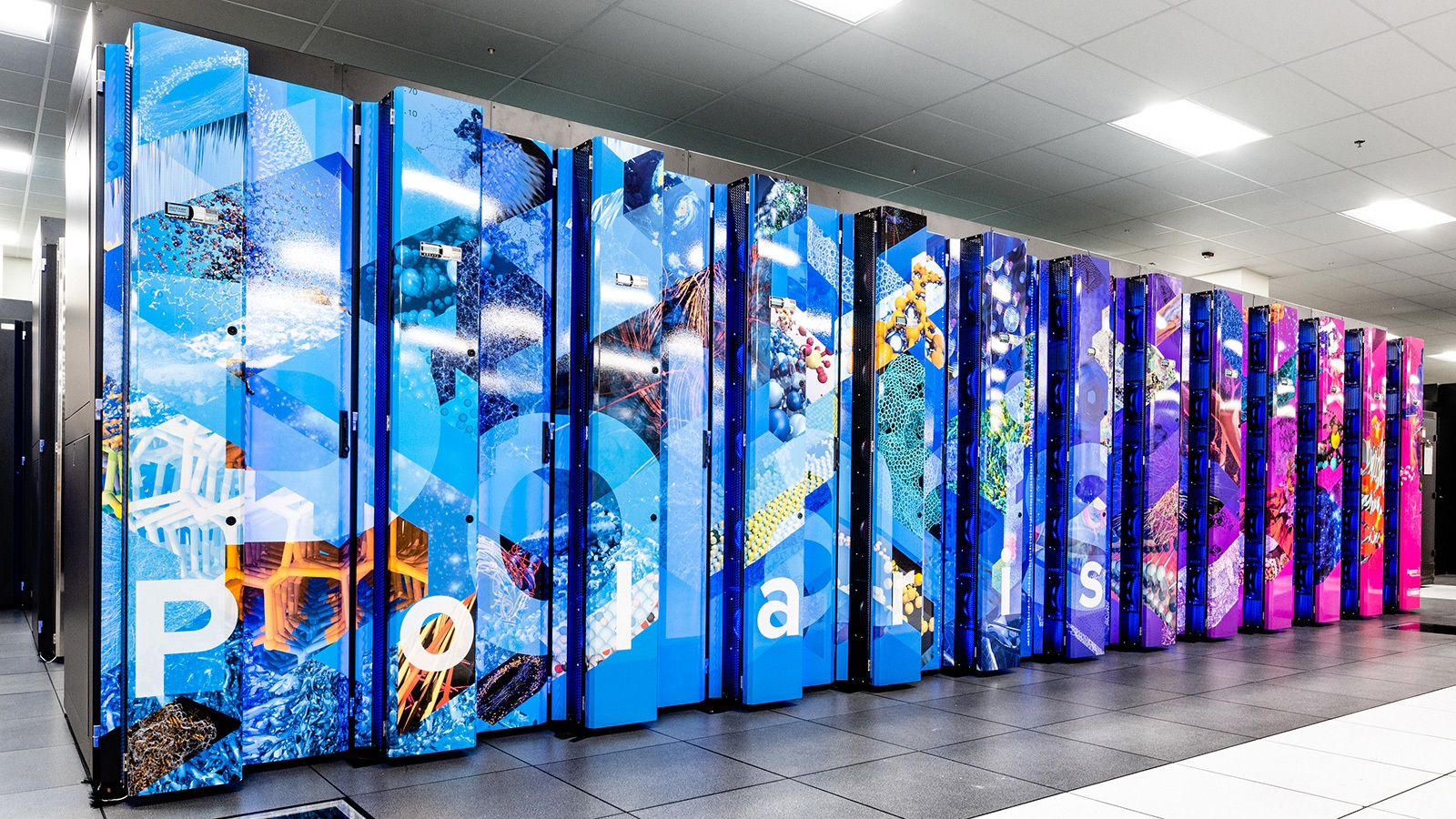
Photograph
Argonne National Laboratory’s Polaris supercomputer, photographed for the U.S. Department of Energy. Archival research-computing context; the pictured system is not hardware newly funded by this commitment. Flickr labels the photo a United States government work.
How we know6 sources · checked 2026-10-08 · no corrections
Original sources
- NVIDIA commits $1 billion to advance U.S. science over five years · October 8, 2026 ↗ · institution
- Argonne Polaris supercomputer photograph · U.S. Department of Energy ↗ · institution
- Scientists deploy AI agents to accelerate discovery of new materials · Argonne National Laboratory ↗ · institution
- NVIDIA BioNeMo platform adopted by life sciences leaders · NVIDIA Newsroom ↗ · institution
- Energy Department announces new Genesis Mission awards · U.S. Department of Energy ↗ · institution
- NVIDIA and Oracle announce DOE AI supercomputers · NVIDIA Newsroom ↗ · institution
Institutions: NVIDIA
- Maturity
- Emerging
- Event date
- 2026-10-08
- Source published
- 2026-10-08
- Captured
- 2026-10-08
- Last source review
- 2026-10-08
- Editorial method
- AI-assisted source review
- Place / relevance
- United States · unspecified
Bright compared this account with the linked original and supporting sources and kept reported, budgeted, projected, and observed claims distinct. Bright did not independently audit the underlying records.
Maturity describes the tested or operational setting. Confidence describes support for the particular claim; one does not determine the other.
Revision & correction history
2026-10-08T15:00:05.259Z · First publication of source-attributed report on NVIDIA’s announced five-year U.S. science commitment, its possible human value, access questions and limits; includes archival DOE photograph.
2026-10-08T15:48:28.330Z · Expanded the original article with sourced health, energy, materials and quantum research examples, clear separation of earlier projects and DOE awards from the new NVIDIA pledge, and a stronger Bright perspective. Canonical story and first publication preserved.
No corrections recorded.
Keep exploring
Explore the shared question in another setting. These connections do not imply replication.