
NVIDIA’s local AI push brings more work onto your own computer. Here’s what changes.
At GTC Berlin, NVIDIA laid out a range of computers and software for running AI closer to the people using it, from Windows laptops to team-scale workstations. The appealing idea is more control over where data goes and how AI tools work. The test is whether local AI becomes useful and manageable beyond a premium-hardware demo.
- Maturity
- Emerging, stage 2 of 4
- Support
- 9 sources · institution
- Evidence detail
- How we know ↓
By Bright | October 21, 2026
A personal AI assistant that can search your files, help write code or work inside a design application is attractive partly because it can see so much. That is also the reason to care where it runs. Sending each request to a remote service is convenient, but it can leave individuals and organizations depending on a provider’s connectivity, pricing, policies and data handling. Running a model on a computer you control offers another option.
That is the story behind NVIDIA’s GTC Berlin local-AI announcements. The company is connecting three different kinds of machine: RTX Spark Windows PCs for individuals, DGX Spark Linux systems for developers, and DGX Station workstations for larger teams. Alongside them are model updates, agent software and tools intended to make several machines work together. NVIDIA’s vision is broad, but these are not all products that arrived today, and they are not interchangeable. The practical question is which piece solves a real problem now.
What is actually available today?
RTX Spark laptops are the most familiar entry point. They went on sale on October 16, before the Berlin event, from ASUS, Dell, HP, Lenovo, Microsoft and MSI. The RTX Spark product page describes premium Windows PCs combining RTX graphics and up to 128GB of unified memory. “Up to” matters: a given laptop may have less memory, and model size alone does not tell you how fast or useful it will feel.
Today’s addition is Underdog Desktop Agent, which NVIDIA says is available to download for RTX Spark. If the app works as presented, a person could ask an assistant to work with local material without routinely sending that material to a model hosted elsewhere. That is a meaningful design choice, not proof that every action is offline or private. An agent with a browser, cloud account or network-enabled tool can still send information out. Readers should check an app’s permissions, connected tools and telemetry, rather than assuming the word “local” answers every privacy question.
DGX Spark is a different product: a compact Linux development system, not an RTX Spark laptop. Existing DGX Spark systems are available, while a new 64GB version starts rolling out from partners on Friday, October 23. NVIDIA says developers can now configure clusters of up to eight DGX Spark units manually. A cluster promises more capacity for larger models or simultaneous work, but it requires multiple devices, a network and the skill to operate them. NVIDIA Sync Model Launcher, meant to simplify downloading and connecting an appropriate model, is promised later in October. It should not be described as a convenience buyers can already use today.
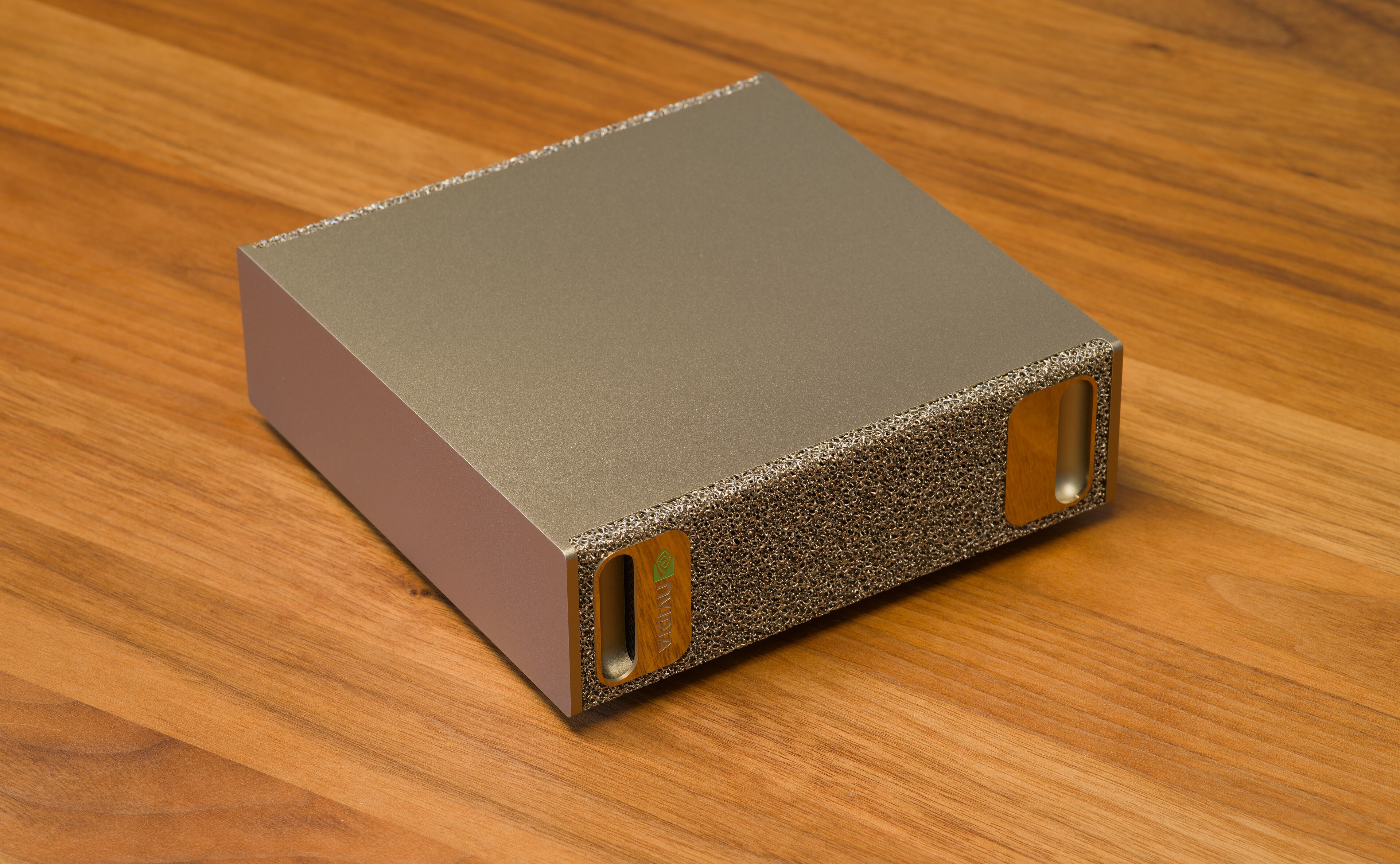
At the upper end, DGX Station is a Linux workstation for teams running demanding models. Its product specifications list up to 748GB of coherent memory and offer partner ordering. A Windows version is still marked “coming in Q4.” A deskside system like this could let a team share computing capacity, but an organization would still need to decide who can use it, what may run on it and how to maintain it.
Why bringing AI closer could matter
“Local AI” can sound like a hardware specification, but its value is often organizational. An engineer iterating on a proprietary design, a developer examining an internal codebase, or a researcher working with confidential notes might prefer to keep the model and its inputs inside a controlled environment. A creative worker may want to continue using a tool when a connection is unreliable. A small team may want predictable capacity rather than waiting on an outside service’s rate limits or changing product terms.
There is also a question of access. Cloud AI can be easier to start using because the provider supplies the machines. Local tools can give technically capable people more choices about models, workflows and retention. An open-weight model can sometimes be adapted and run on infrastructure its user chooses. But “open” is not a single promise: model licenses, available weights, training data and permitted uses vary. For example, the Kumo Relational model card identifies its weights as licensed under OpenMDW 1.1. It would be a mistake to assume every model in a portfolio has the same terms. Nor is every newly announced model made for a laptop. NVIDIA’s Nemotron 3.5 Super VL, for example, is available through multiple model and hosted-service channels, but availability of a model does not imply it will run comfortably on a typical personal computer.
The most constructive result would be a genuine choice among local, organizational and cloud processing, not pressure to pick one forever. A small model on a laptop might handle routine document work while a larger remote model tackles a harder analysis with the user’s permission. Microsoft, in NVIDIA’s earlier RTX Spark launch release, described a similar hybrid approach: local when it makes sense, cloud when needed. The difficult part is making the boundary visible so that people know when data leaves a device, which model is answering and what an agent has been allowed to do.
The software may matter as much as the machines
Inference is the work a trained model does when answering a prompt. It matters because owning a powerful chip is only part of running AI: someone must still choose a suitable model, make it work with that chip, give it enough memory for both the model and the conversation, and connect it responsibly to useful tools. A model fitting in memory on paper is not sufficient if there is no space left for its context or other running applications. This helps explain why the software around local AI may matter as much as the machines. Work such as DeepSeek’s open inference engine shows another part of the picture: publishing an engine and making it straightforward for ordinary people to run are different steps.
That gap is where a lot of today’s practical work remains. People need clear instructions, reliable updates, understandable permissions and simple ways to compare how models perform on their actual tasks. Developers may be comfortable choosing a model and tuning its runtime. A small organization needs to know who will maintain it after that developer moves on. A person buying a laptop wants to know whether the assistant they care about works well, not just how many parameters a demonstration managed to load.
Meanwhile, NVIDIA’s wider open-model announcements reach beyond chatbots. They include retrieval models for finding information, Kumo tools for structured business data, Cosmos tools for robotics simulation and BioNeMo work in protein design. Those applications are a reminder that “AI on your own infrastructure” is not just about a conversational assistant. It could help people build specialized systems around their own documents, factories or research processes. The availability dates differ: NVIDIA says Nemotron 3.5 Super VL and Kumo models are available now, its smaller Nemotron Bolt E4B model is expected October 23, and Alpamayo 2 Edge for autonomous vehicles is due later this month. Claims about real-world benefit in such sensitive settings should be judged through independent evaluation, not a launch-day description.
The trade-offs should stay in view
The first trade-off is cost. RTX Spark laptops are premium purchases, not an inexpensive route to AI for everyone. Even NVIDIA’s launch materials differ: its October 16 release said $2,599, while its October 17 blog said $2,399. Buyers should check the current price of the particular model and configuration. A multi-machine DGX Spark cluster or a DGX Station has a different purchasing and maintenance burden. Cloud services charge for use, while local systems bring upfront hardware, electricity, IT support and eventual replacement. Neither is automatically cheaper. The fair comparison depends on how often the model runs, the level of performance needed, and what it costs to safeguard the data either way. Cloud systems also have power-grid and infrastructure constraints; running AI locally changes where electricity is used, rather than eliminating energy demand.
The second is capability. Large cloud systems can pool far more compute than a laptop. Local models may be sufficient for many bounded tasks and may respond quickly without a round trip to a data center, but speed and quality need testing on the work that actually matters. NVIDIA’s specifications and demos show technical potential; they do not settle whether a local agent is accurate on a particular company’s code, accessible to a particular user, or reliable enough to trust with a workflow. As our look at AI for legacy software explores, task-specific evaluation matters more than a general coding promise.
The third is accountability. Keeping a model nearby does not make its answer correct. Giving an agent local file access can create new risks even if no document is uploaded to a remote server: it can read the wrong folder, modify a file, follow malicious instructions inside a document, or act with permissions that are too broad. Teams need the same basics they would require for a cloud agent: limited access, clear logs, human review for consequential actions and a way to undo mistakes. Local deployment changes the control surface; it does not remove the need for control.
There is a positive possibility here. Better on-device hardware and openly available tools could let more people shape AI around their own needs instead of accepting only a provider’s default product. The most meaningful progress would not be the largest model squeezed onto a desk. It would be a tool a person understands well enough to use safely, at a price and level of effort that make sense. NVIDIA has supplied more of the pieces. The next measure is what people can actually build with them, and how much control those people retain.
Sources and further reading
What was shown, and what wasn’t
Shown
NVIDIA’s GTC Berlin announcements describe available RTX Spark laptops and local tools alongside upcoming DGX Spark 64GB rollout, Model Launcher and Windows DGX Station releases. Product specifications and vendor demonstrations do not establish independent performance or privacy outcomes.
Not shown · limits
- RTX Spark PCs, DGX Spark and DGX Station are distinct products. Available systems and promised future releases must be separated.
- Local processing does not prove every tool, connection or telemetry flow is offline or private, nor does it guarantee correct or safe agent actions.
- NVIDIA’s October 16 release quoted $2,599 and its October 17 blog quoted $2,399. Configuration-specific current prices require checking.
- Upfront hardware, electricity, IT support, model quality and maintenance affect whether local AI is suitable or economical.
- Open-model licenses and hardware requirements vary; vendor specifications and launch-day descriptions require task-specific independent evaluation.
Bright editorial interpretation
More local hardware and software choices could let people shape AI workflows around their own needs and control where processing happens.
Still open
Will these tools make local AI useful, manageable and affordable on the tasks people actually need, while retaining understandable data and permission boundaries?
How we know9 sources · checked 2026-10-21 · no corrections
Original sources
- NVIDIA’s GTC Berlin local-AI announcements ↗ · institution
- They went on sale on October 16 ↗ · institution
- RTX Spark product page ↗ · institution
- product specifications ↗ · institution
- Windows version ↗ · institution
- open-weight model ↗ · institution
- Kumo Relational model card ↗ · institution
- October 17 blog ↗ · institution
- NVIDIA’s GTC Berlin press kit ↗ · institution
Institutions: NVIDIA
- Maturity
- Emerging
- Event date
- 2026-10-21
- Source published
- 2026-10-21
- Captured
- 2026-10-21
- Last source review
- 2026-10-21
- Editorial method
- AI-assisted source review
- Place / relevance
- GTC Berlin, Germany · unspecified
Bright compared this account with the linked original and supporting sources and kept reported, budgeted, projected, and observed claims distinct. Bright did not independently audit the underlying records.
Maturity describes the tested or operational setting. Confidence describes support for the particular claim; one does not determine the other.
Revision & correction history
2026-10-21T11:52:30.851Z · Initial detailed feature on NVIDIA’s GTC Berlin local-AI announcements, availability, privacy boundaries, costs, software and human control.
No corrections recorded.
Keep exploring
Explore the shared question in another setting. These connections do not imply replication.