
Stop slowing down AI’s defenders
OpenCode’s cofounder says his team needs agents working around the clock. The answer should be a faster buildout of accountable defense, not a choice between paralysis and blind trust.
- Maturity
- Emerging, stage 2 of 4
- Support
- 21 sources · institution, paper
- Evidence detail
- How we know ↓
Bright analysis and opinion | October 18, 2026
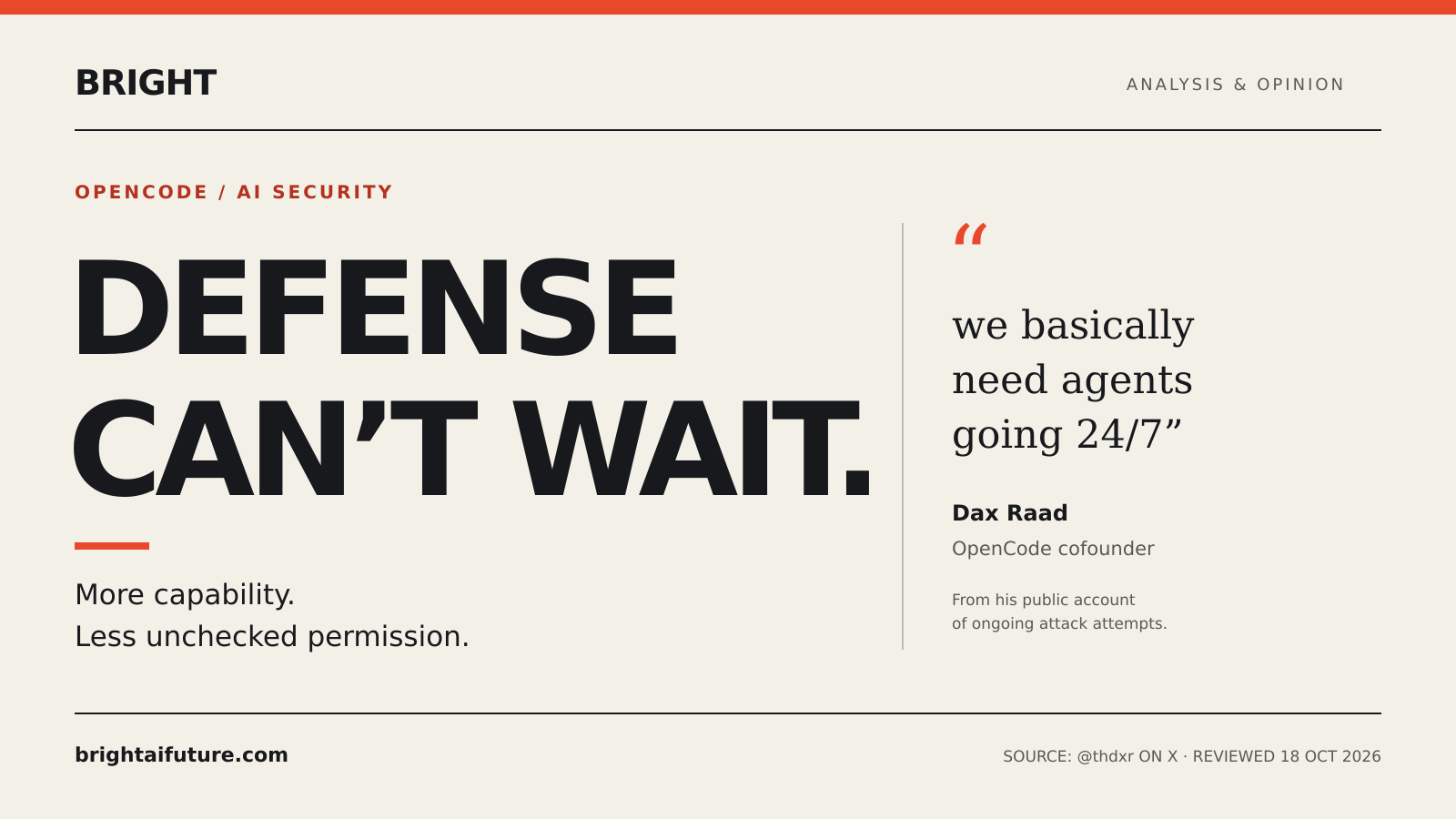
OpenCode cofounder Dax Raad has a more immediate problem than the abstract debate over whether AI is moving too fast. In a newer post reviewed on October 18, he described attempted attacks against the company’s systems over the preceding 48 hours. He said the pressure was driving hardening, but that his team needed agents operating around the clock because, in his account, its attackers already had them. Raad’s update
That is a firsthand account of the pressure on defenders, not an independent forensic finding about the adversaries’ tooling. Attempted attacks are not the same as repeated successful breaches. Still, it gives the discussion a concrete question: when a team says it needs continuous defensive capability, how do we help it get that capability without handing another agent the keys to everything?
But there is a larger argument worth having. Bright's position is that defensive capacity should grow with AI capability, not trail behind it as an optional upgrade. More people should have access to tools that find weaknesses, contain damage and help verify repairs. That requires software, infrastructure, capable models and humans with the time and authority to act.
It does not require pretending every new model makes the world safer. Nor does this breach prove that every proposal to slow or restrict AI development was wrong. The strongest case for building is a specific one: we should accelerate the defenses that ordinary users can actually deploy and trust.
First, what happened, and what has not been established
In its October 17 statement, OpenCode reported a breach affecting a subset of hosted Console users who had connected external model providers. The company put the affected share at 1.4% of Console users and described it as related to a large-scale distillation attack. Those are the company’s scope estimate and attribution, not independently established findings by Bright. Bright reviewed a supplied screenshot of the statement alongside published reporting. OpenCode’s statement · Notebookcheck’s reporting
OpenCode said it had emailed everyone affected and that users who had not received an email were not impacted. That is the company’s assurance, not Bright’s independent assessment of individual accounts. It also said it was working with Anthropic, OpenAI and Google and described the incident as ongoing at the time of its statement. Raad’s later account of sustained attempts and hardening is not an all-clear or proof that remediation is complete.
The distinction between an attributable account and independently verified mechanics matters. Bright has not examined the affected systems or forensic evidence. The entry vector, account and key counts, verified losses and evidence connecting misuse to model training remain unresolved in the evidence we reviewed. Raad’s assertion about attackers using agents belongs in the reporting, but it does not establish that an agent performed the original intrusion or identify who was responsible.
“Distillation” also needs precision. The term can describe training a model using another model's outputs. That description alone does not establish unauthorized access, theft or who benefited. A credential compromise and a claim about the purpose of subsequent usage are separate propositions. We should not collapse them into one proven story.
There are also two different products and trust arrangements to keep straight. OpenCode's Console documentation describes a hosted service that stores connected provider credentials and forwards requests to providers. Its direct-provider documentation describes credentials held in a local authentication file. An incident affecting the former is not, by itself, proof that every installation of the latter was compromised. Console provider architecture · Direct provider setup
A separately documented September local-server vulnerability is not established as the cause of this hosted incident. Separate GitHub advisory
None of that makes local operation automatically safe. It changes where trust sits. A secret stored on your computer can still be exposed by malicious software, an unsafe integration or excessive agent access. Moving a risk is not the same as eliminating it.
Protect the account before debating the philosophy
If you connected provider credentials to a service identified in a breach, begin with the issuing provider's security controls and the vendor's incident guidance. Do not wait for an argument about open models to settle.
1. Revoke credentials believed exposed, then replace only what you still need. Deleting a connection in a third-party dashboard is not a reliable substitute for invalidating the credential at its issuer. Changing a login password is not necessarily API-key revocation either.
2. Review usage and billing, and preserve relevant records. Look for unexplained activity. Report suspected unauthorized use through the provider's official support route. A suspicious charge warrants investigation, not an unsupported public accusation about its cause.
3. Separate experiments from important work. Where supported, use different projects and narrowly scoped credentials rather than one powerful key across every tool. A small experiment should not inherit the authority of your production account. Claude workspace controls
4. Check the controls your provider actually offers today. Expiration, access restrictions, rate controls, alerts and enforced spending limits are different mechanisms. Read the current documentation and confirm which control applies to your account. Do not assume an email alert stops spending. Google, for example, distinguishes alerts-only budgets from spend-cap budgets for supported services. Google Cloud budget documentation
OpenAI's current key-safety guidance, for example, describes several controls beyond a reusable unrestricted key. The available controls and their limits vary by service, so treat this as a checklist to investigate, not a promise that every provider has the same protections. OpenAI's API-key safety guidance
These are containment recommendations. They are not a claim that every OpenCode user was affected, that every connected account has unauthorized activity, or that Bright has audited your setup.
Open source, open weights and local are three different things
The discussion gets weaker when we treat these labels as interchangeable.
Open-source agent software concerns the code coordinating the work: selecting tools, handling permissions and communicating with models. Open weights concerns access to the model's learned parameters under a particular license. Local inference concerns where the model runs.
A source-available or open-source coding client can use a remote commercial model. A downloaded model can be wrapped in software that sends telemetry or calls external services. A local agent can still read sensitive files and make network requests. And weights alone do not tell you whether training code or meaningful training-data information is available.
The Open Source Initiative's definition of open-source AI asks for more than downloadable weights, including relevant code and data information and specified freedoms to use, study, modify and share. It is a useful named standard, not a reason to ignore the exact license and artifacts for a particular release. OSI's Open Source AI Definition
Bright's argument for openness is not that public code is magically secure. It is that a larger community can inspect systems, adapt them, challenge claims and develop alternatives. Users gain more choices about which organizations and infrastructure they depend on. Those possibilities matter for defenders who cannot afford a bespoke enterprise security stack.
The counterargument is real: wider access also reaches malicious users, and downloadable weights are harder to recall or centrally monitor. A 2024 position paper on open foundation models emphasized both their benefits and the difficulty of measuring additional misuse risk; a contrasting 2023 analysis argues that sufficiently capable systems may warrant restrictions on weight release. These are historical risk arguments, not measurements that establish the safety or danger of every 2026 release. Open-model societal-impact analysis · Analysis of highly capable open models
Our view is that the public benefits of openness deserve deliberate support alongside serious release evaluation. Neither “open” nor “closed” answers the more practical questions: Who holds the credentials? What can the agent do? Who can inspect it? Who can stop it?
The strongest case against “just move faster”
We should represent the slowdown argument fairly. The Future of Life Institute's March 2023 letter called for a temporary pause on training systems more powerful than GPT-4. It explicitly distinguished that proposal from a halt to AI development generally and called for work on safety and governance. It was not a proposal to stop patching software. The original pause letter
A serious critic can also make a straightforward operational argument: attackers may gain cheaper capabilities before understaffed defenders gain the ability to use them. Discovering a flaw is not the same as deploying a fix across legacy systems. Research on this imbalance argues that human remediation capacity may remain a bottleneck even as attack capabilities improve. “Uplifted Attackers, Human Defenders”
Those objections deserve an answer, not a caricature. A targeted pause on a risky deployment can be sensible. So can delaying a release until a credible vulnerability is contained. Responsible acceleration includes the ability to say “not this configuration, not with these permissions, not yet.”
Bright’s proposed priority is to make defensive deployment a first-class part of this debate, not a footnote. This is not a claim that the cited pause letter opposed defensive work. Existing vulnerable software, exposed credentials and people waiting for repairs do not disappear because the next capability milestone arrives later. We still have to build protective systems and get them into users' hands.
The relevant question is not simply whether AI advances quickly. It is which capabilities advance, who can access them, what authority they receive and whether their deployment reduces harm.
“White-hat agents” need a job description, not a halo
Call them white-hat agents: AI systems authorized to help find weaknesses, evaluate protections and verify repairs. We are using a descriptive term, not claiming to have invented it.
Their defining feature should not be that a developer wrote a benevolent instruction. It should be that their work is authorized, constrained and accountable. A defensive label cannot turn unauthorized probing or retaliatory hacking into acceptable behavior.
Here is Bright's proposed standard:
• A named owner and a defined target. The agent should know whose systems it is allowed to assess and what falls outside that permission.
• The least authority needed for the job. A tool checking dependencies does not automatically need customer records, production credentials or unrestricted outbound access.
• Evidence before escalation. A plausible vulnerability report is a lead. Reproducible findings and human review determine whether consequential action is warranted.
• A separate enforcement boundary. An agent should not be able to rewrite the very rules intended to contain it merely because it finds them inconvenient.
• Consent and disclosure discipline. Respect maintainers’ reporting rules and capacity. OpenCode currently says it does not accept AI-generated security reports. That is a reason not to flood its maintainers with automated findings, not a prohibition on legitimate human research. OpenCode security policy
• A repair path. Someone must own triage, fixes, testing and rollback. A growing pile of findings is not a growing pile of protected users.
• A meaningful scoreboard. Measure validated issues repaired, time exposed, regressions and false alarms, not just how many warnings the agent produces.
This is where the buildout argument becomes concrete. More inference capacity can help run tests and assessments. But a security team also needs access to the right systems, maintainers who can act, reliable audit trails and time to validate changes. Buying compute without funding those steps can accelerate the backlog instead of reducing risk.
There is evidence for defensive AI. It comes with limits.
Google's Big Sleep provides a useful historical example. Its November 1, 2024 report described an AI-assisted discovery of a SQLite vulnerability in pre-release code, followed by a maintainer fix. That is a tangible defensive outcome: a flaw found and corrected before release. Google also called the work experimental and acknowledged that a target-specific fuzzer could have been at least as effective. One success is not a general guarantee. Project Zero's Big Sleep report and linked fix
Anthropic's October 8 Cyber Mission announcement points to the next challenge. Its opt-in open-source scanner expands access to automated assessment, but the company says reports are model-generated without human review and can contain inaccuracies. It also acknowledges that vulnerability discovery has outpaced remediation in some work. Its forecast that AI will eventually favor defense remains a forecast. Anthropic Cyber Mission
Our conclusion is not that these projects settle the debate. It is that they make the debate more useful. We can ask whether a system finds a real flaw, whether somebody fixes it, how much work its mistakes create, and whether smaller organizations can benefit. Those are better questions than whether the marketing calls an agent “safe.”
Why NVIDIA belongs in this conversation
NVIDIA's relevant contribution here is not simply that it sells more computing power. Its September 28 Open Agent Safety Platform announcement describes a reference architecture combining OpenShell runtime controls with an optional Sentry monitoring and enforcement layer on BlueField-4 hardware. The important design idea is to put controls outside the agent rather than rely entirely on the agent's willingness to behave. NVIDIA's technical announcement
OpenShell's public Apache-2.0 repository describes isolation, network policy and credential handling, and includes an OpenCode tutorial. That makes the connection practical: an available software project can be inspected rather than a safety promise accepted at face value. Bright has not installed or independently evaluated this configuration. OpenShell repository and documentation
The distinction between the announced reference architecture and released software matters. Neither establishes that NVIDIA's stack would have prevented this particular Console breach. That would require an incident chain and a matching threat analysis. Nor does an enforceable policy guarantee that every allowed action is wise.
Bright's view is that this is the direction worth investing in: separate the system doing the work from the system enforcing its limits. Apply that standard to NVIDIA and to its competitors. Open interfaces and inspectable implementations are valuable precisely because they let others question and improve the design.
A safer everyday setup is layered
For individual users, the practical lesson is not to install a grand new security platform overnight. Start with the authority you have already handed your agent.
OpenCode's permission documentation says most permissions default to allow; its auto mode can approve requests that otherwise ask. Inspect the settings in the version you use rather than assuming every important action will stop for your approval. OpenCode permissions
The project's security policy makes an even more important distinction: its application permissions are not a sandbox or an operating-system security boundary. For actual isolation, it points users toward a container or virtual machine. OpenCode security policy
In practice, that means experimenting on a limited working copy, keeping unnecessary secrets out of reach, restricting network destinations where supported, and reviewing changes before they reach important systems. A sandbox configured with your entire home directory and powerful credentials has inherited much of what you hoped to protect.
Docker's OpenCode sandbox documentation offers another concrete approach, including a proxy-based mechanism that can keep real credentials outside the agent environment. But no local sandbox retroactively protects a key already exposed by a remote service. Pick a control that addresses the actual failure, not a reassuring label. Docker's OpenCode sandbox guide
Build the defense, then prove it works
The lesson we take from the OpenCode disclosure is not that everybody should abandon coding agents, or that openness caused the problem. It is that AI's useful capabilities sit inside ordinary systems of credentials, permissions, infrastructure and human responsibility. Those systems deserve as much attention as the model.
We want more capable defenses. We want more people able to inspect and improve them. We want defensive agents available beyond the biggest companies, and infrastructure built so that one compromised component does not inherit the keys to everything else.
But optimism has to earn its claims. If we call something a white-hat agent, show its authority, its limits and its verified results. If we propose more buildout, explain how that capacity reaches defenders and turns into repairs. If we argue against a slowdown, say which slowdown and why, rather than claiming one incident settles every question.
The future worth building is not one in which we trust agents more blindly. It is one in which we can use them more confidently because trust is backed by boundaries, evidence and accountability.
That is the acceleration Bright is arguing for.
Reporting note: Evidence checked October 18, 2026. Bright reviewed supplied screenshots of OpenCode’s disclosure and Dax Raad’s linked update, alongside documentation, published reporting and research. The captures support attribution of the visible statements, not independent verification of the incident or a complete live edit history. Bright did not conduct a forensic investigation, run exploit code or independently benchmark the products discussed. Material updates and corrections will be dated.
What was shown, and what wasn’t
Shown
OpenCode reported a hosted Console breach on October 17, 2026. Cofounder Dax Raad subsequently described sustained attack attempts and a need for agents operating around the clock. Bright’s article attributes these accounts and argues for accountable defensive capacity.
Not shown · limits
- Analysis and opinion; the OpenCode scope estimate and attacker-tooling account are attributed statements, not independent forensic findings.
- Bright has not established the entry vector, losses, attacker identity or evidence connecting misuse to model training.
- The separate September local-server vulnerability is not established as the cause of this hosted incident.
- Bright has not independently tested the discussed security products; no claim is made that NVIDIA’s stack would have prevented this breach.
Bright editorial interpretation
More accessible defensive tools could help smaller teams, if findings turn into verified repairs and agent authority remains constrained.
Still open
What will independently verified incident findings establish, and how can defensive tooling produce reliable repairs for smaller teams?
How we know21 sources · checked 2026-10-18 · no corrections
Original sources
- Raad’s update ↗ · institution
- OpenCode’s statement ↗ · institution
- Notebookcheck’s reporting ↗ · institution
- Console provider architecture ↗ · institution
- Direct provider setup ↗ · institution
- Separate GitHub advisory ↗ · institution
- Claude workspace controls ↗ · institution
- Google Cloud budget documentation ↗ · institution
- OpenAI's API-key safety guidance ↗ · institution
- OSI's Open Source AI Definition ↗ · institution
- Open-model societal-impact analysis ↗ · paper
- Analysis of highly capable open models ↗ · paper
- The original pause letter ↗ · institution
- “Uplifted Attackers, Human Defenders” ↗ · paper
- OpenCode security policy ↗ · institution
- Project Zero's Big Sleep report and linked fix ↗ · institution
- Anthropic Cyber Mission ↗ · institution
- NVIDIA's technical announcement ↗ · institution
- OpenShell repository and documentation ↗ · institution
- OpenCode permissions ↗ · institution
- Docker's OpenCode sandbox guide ↗ · institution
Institutions: OpenCode
- Maturity
- Emerging
- Event date
- 2026-10-17
- Source published
- 2026-10-18
- Captured
- 2026-10-18
- Last source review
- 2026-10-18
- Editorial method
- AI-assisted source review
- Place / relevance
- Online software services · unspecified
Bright compared this account with the linked original and supporting sources and kept reported, budgeted, projected, and observed claims distinct. Bright did not independently audit the underlying records.
Maturity describes the tested or operational setting. Confidence describes support for the particular claim; one does not determine the other.
Revision & correction history
2026-10-18T14:09:06.498Z · Initial owner-approved analysis and opinion with attributed incident accounts, source links and reporting limitations.
No corrections recorded.
Keep exploring
Explore the shared question in another setting. These connections do not imply replication.