Bright NewsroomLive 00:52 ETNight light

Saturday, 7 November.

Today’s AI news: what’s been shown to work, and what still needs testing.

Today so far: 0 stories and guides, 0 demonstrated or deployed, 0 developing or contested.
DevelopingExplanatory graphic
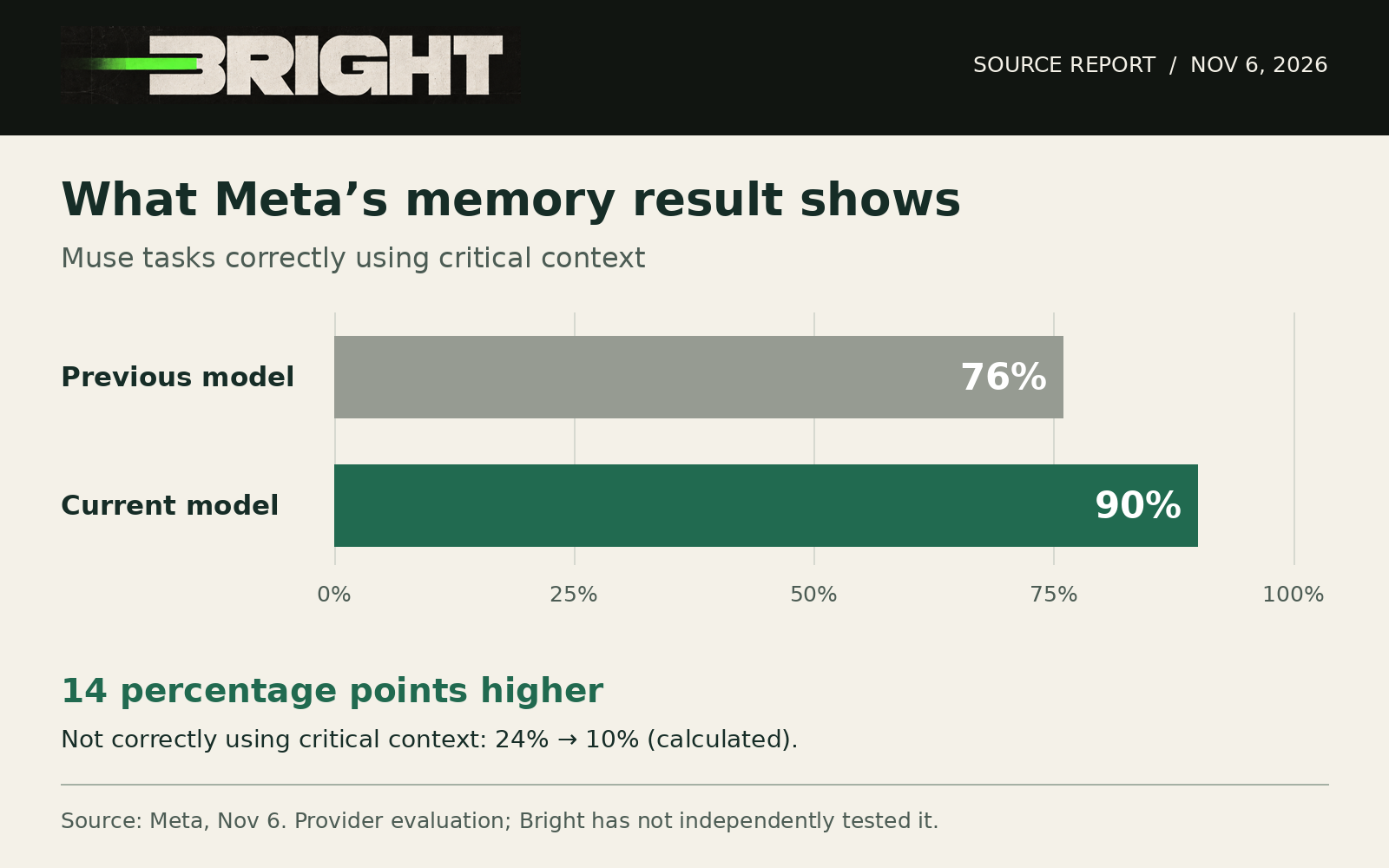
Bright chart of Meta’s reported Muse Active Memory evaluation: tasks correctly using critical context rose from 76% for the previous model to 90% for the current model. The 14-percentage-point gain is a provider evaluation, not a Bright test.

LeadingLatest coverage · Fri 6 Nov at 14:47 ET

Meta’s Muse update takes aim at an everyday AI frustration: repeating yourself

Meta is rolling out specialized models to Muse and Meta AI. Its memory results are promising, but the everyday test is whether people spend less time correcting the assistant.

On the record

Meta announced the rollout on November 6. Its Muse Active Memory evaluation reports 90% of tasks correctly using critical context, compared with 76% previously. These are provider-reported evaluation results, not an independent measure of user outcomes.

The nearest limit

Bright has not tested these specialized models or found independent tests of this rollout.

What would develop this storyBright’s open questions

  • How many ordinary tasks are completed without human repairs or missed constraints?
  • Which accounts, regions and tiers receive the specialized models, and when?
  • How reliably do the models replace outdated instructions without losing continuing preferences?
Evidence · 4 sources · Image credit and rights
Explanatory graphic. Bright chart of Meta’s reported Muse Active Memory evaluation: tasks correctly using critical context rose from 76% for the previous model to 90% for the current model. The 14-percentage-point gain is a provider evaluation, not a Bright test. Not an independent test, a measure of overall productivity or a separate evaluation of Meta AI. Original Bright chart from Meta-reported evaluation scores, Original Bright chart; all rights reserved.

Bright filed · 14:47 ET. Original source publication: 2026-11-06.

Evidence: Emerging.

Last source review: 2026-11-06T19:47:33.127Z. A source review is not independent verification.

Permanent story linkEvidence pack
Cite this update

Bright AI Future. “Meta’s Muse update takes aim at an everyday AI frustration: repeating yourself” Bright updated 2026-11-06. https://brightaifuture.com/discoveries/meta-muse-specialized-models-memory-focus

Read the record ↗

Brief · Emerging · Source published 2026-11-06 · Meta

The day so far

Stories published or updated today, using Eastern dates.

No new stories today yet. The latest coverage is above.

Thu 5 Nov

  1. DevelopingExplanatory graphic
    Conceptual illustration of interconnected mathematical structures: a geometric network, a curved mesh surface, and flowing contours in cream and lime on forest green.

    Explanatory graphic

    09:33 ET

    OpenAI’s mathematics release points to a new scale of AI-enabled discovery

    Initially 722 manuscripts across 17 research areas; OpenAI’s current catalogue lists 721 manuscripts in 373 families after three October 7 withdrawals and two October 26 additions.

    Open question: Which claims will withstand independent scrutiny and become useful to the mathematical community?

    Evidence · 18 sources · Image credit and rights
    Explanatory graphic. Conceptual illustration of interconnected mathematical structures: a geometric network, a curved mesh surface, and flowing contours in cream and lime on forest green. Not actual research results, proof figures, specific theorems, researchers or the generating OpenAI model. AI-generated Bright illustration · conceptual mathematical structures; not a proof figure or depiction of the actual research., Original AI-generated Bright illustration.

    Bright filed · 09:33 ET. Original source publication: 2026-10-06.

    Evidence: Emerging.

    The nearest limit: This collection does not establish a new medicine, energy technology or engineering capability.

    Last source review: 2026-11-05. A source review is not independent verification.

    Permanent story linkEvidence pack
    Cite this update

    Bright AI Future. “OpenAI’s mathematics release points to a new scale of AI-enabled discovery” Bright updated 2026-11-05. https://brightaifuture.com/discoveries/openai-mathematics-discovery

Wed 4 Nov

  1. DeployedBright briefingHow often do focused edits preserve every detail that should remain unchanged?

    Bright briefing

    19:22 ET

    OpenAI Images 2.6 targets the revisions that make AI pictures useful

    A practical guide to faster drafts, focused edits, vector graphics and short animations, with clear limits on what the launch evidence establishes.

    Open question: How often do focused edits preserve every detail that should remain unchanged?

    Evidence · 5 sources

    Bright filed · 19:22 ET. Original source publication: 2026-11-04.

    Evidence: Deployed.

    The nearest limit: Bright has not independently confirmed access across accounts or run a verified Images 2.6 test.

    Last source review: 2026-11-05. A source review is not independent verification.

    Permanent story linkEvidence pack
    Cite this update

    Bright AI Future. “OpenAI Images 2.6 targets the revisions that make AI pictures useful” Bright updated 2026-11-04. https://brightaifuture.com/discoveries/openai-images-2-6-practical-workflows

  2. DevelopingBright briefingHow many distinct fixes will maintainers accept, and which supported kernel versions will receive them?

    Bright briefing

    18:30 ET

    OpenAI reports 948 Linux security flaws. Reliable fixes are the next test.

    OpenAI says its AI pipeline found serious weaknesses and proposed repairs. Maintainers remain central to turning findings into protection.

    Open question: How many distinct fixes will maintainers accept, and which supported kernel versions will receive them?

    Evidence · 5 sources

    Bright filed · 18:30 ET. Original source publication: 2026-11-04.

    Evidence: Experimental.

    The nearest limit: The 948 total is not a count of repairs accepted into Linux or installed on people’s devices.

    Last source review: 2026-11-04. A source review is not independent verification.

    Permanent story linkEvidence pack
    Cite this update

    Bright AI Future. “OpenAI reports 948 Linux security flaws. Reliable fixes are the next test.” Bright updated 2026-11-04. https://brightaifuture.com/discoveries/openai-linux-security-research-reliable-fixes

Tue 3 Nov

  1. DevelopingBright illustration
    AI-generated conceptual illustration of an orbital computing satellite with blue solar arrays and pale radiator panels above Earth; not an actual deployed system.

    Bright illustration

    09:09 ET

    What space data centers could do for people

    The hardware already in orbit and the engineering still needed

    Open question: What useful work can a complete orbital system deliver reliably, at what quality, availability, cost and environmental footprint?

    Evidence · 62 sources · Image credit and rights
    Bright illustration. AI-generated conceptual illustration of an orbital computing satellite with blue solar arrays and pale radiator panels above Earth; not an actual deployed system. Not an actual deployed system, documented spacecraft design or photograph. Bright · AI-generated conceptual illustration, not an actual deployed system, Original Bright editorial artwork approved for this article.

    Bright filed · 09:09 ET.

    Evidence: Emerging.

    The nearest limit: Progress at each level can help the next. It does not certify it. Running an AI model in orbit establishes something important about hardware and operations. It does not establish the price, availability or environmental advantage of a future industrial-scale service.

    Last source review: 2026-11-03. A source review is not independent verification.

    Permanent story linkEvidence pack
    Cite this update

    Bright AI Future. “What space data centers could do for people” Bright updated 2026-11-03. https://brightaifuture.com/discoveries/space-data-centers-human-benefits

Mon 2 Nov

  1. DevelopingBright illustration
    House plans, an extension and an application document illustrate AI assistance with planning paperwork, not automated approval.

    Bright illustration

    18:30 ET

    An AI planning assistant is expanding to 15 English councils

    PlanAssist could give officers more time for judgment and families quicker answers. Early results concern assessment work, not a proven 58% reduction in the full wait for permission.

    Open question: Will performance transfer across additional urban and rural councils without new checking burdens?

    Evidence · 2 sources · Image credit and rights
    Bright illustration. House plans, an extension and an application document illustrate AI assistance with planning paperwork, not automated approval. Not A documentary photograph, actual interface, reproduced chart, automated approval or measured outcome. Bright editorial illustration, Original conceptual artwork created for Bright; cleared for publication.

    Bright filed · 18:30 ET. Original source publication: 2026-10-31.

    Evidence: Experimental.

    The nearest limit: Google’s October 31 account describes the expansion as a beta using live applications, with new councils joining in stages. It says broader rollout depends on successful testing. This is an expansion of a pilot, not a finished service already available to every homeowner.

    Last source review: 2026-11-02. A source review is not independent verification.

    Permanent story linkEvidence pack
    Cite this update

    Bright AI Future. “An AI planning assistant is expanding to 15 English councils” Bright updated 2026-11-02. https://brightaifuture.com/discoveries/google-planassist-council-planning-expansion

  2. DevelopingBright illustration
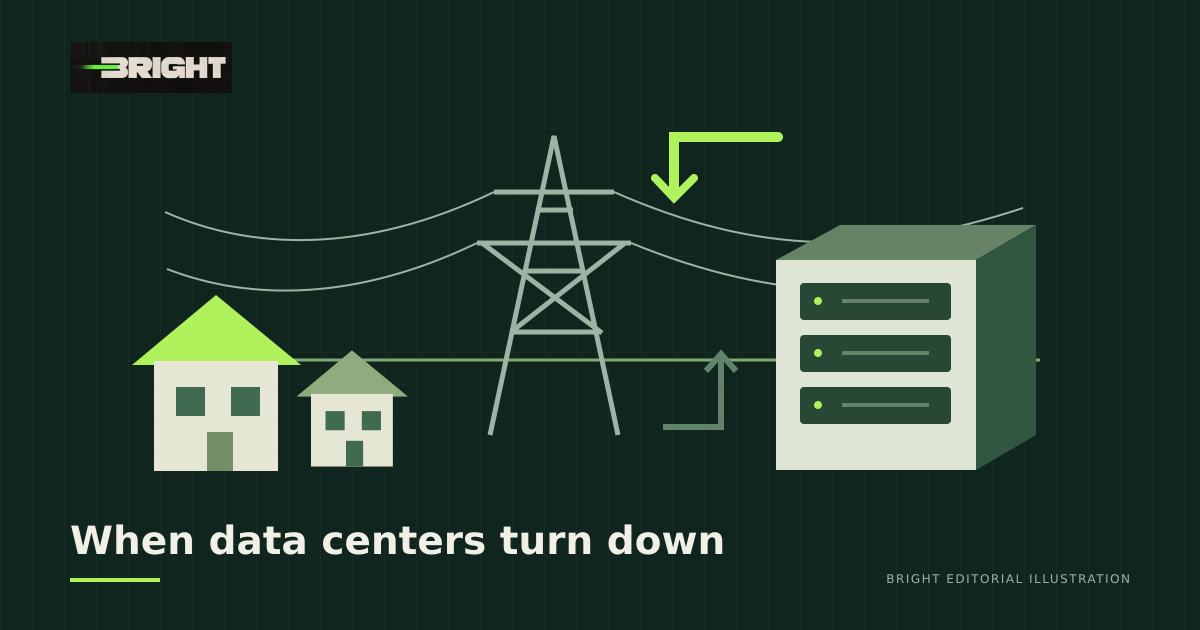
    A power pylon connects homes and a data center; directional arrows illustrate the concept of adjusting electricity demand.

    Bright illustration

    18:30 ET

    OpenAI wants its future data centers to turn down when communities need power

    Its new Grid Protectors Program would make flexible electricity demand part of future campuses. A Georgia agreement shows the idea, but household savings remain a forecast.

    Open question: How quickly and for how long will operating campuses reduce demand when called upon?

    Evidence · 3 sources · Image credit and rights
    Bright illustration. A power pylon connects homes and a data center; directional arrows illustrate the concept of adjusting electricity demand. Not A documentary photograph, actual interface, reproduced chart, automated approval or measured outcome. Bright editorial illustration, Original conceptual artwork created for Bright; cleared for publication.

    Bright filed · 18:30 ET. Original source publication: 2026-11-02.

    Evidence: Emerging.

    The nearest limit: OpenAI points to its planned campus in Effingham County, Georgia, as an intended pilot once it operates. The site is still in development.

    Last source review: 2026-11-02. A source review is not independent verification.

    Permanent story linkEvidence pack
    Cite this update

    Bright AI Future. “OpenAI wants its future data centers to turn down when communities need power” Bright updated 2026-11-02. https://brightaifuture.com/discoveries/openai-grid-protectors-electricity-demand

  3. DevelopingBright illustration
    A checklist, home, calendar and shopping bag represent everyday tasks in AI evaluation.

    Bright illustration

    18:30 ET

    OpenAI’s new AI test starts with the work of everyday life

    LifeVal asks whether AI can help with responsibilities beyond the office. The useful next question is how much work people still have to do themselves.

    Open question: How much time do people save after checking outputs and correcting errors?

    Evidence · 1 source · Image credit and rights
    Bright illustration. A checklist, home, calendar and shopping bag represent everyday tasks in AI evaluation. Not A documentary photograph, actual interface, reproduced chart, automated approval or measured outcome. Bright editorial illustration, Original conceptual artwork created for Bright; cleared for publication.

    Bright filed · 18:30 ET. Original source publication: 2026-11-02.

    Evidence: Experimental.

    The nearest limit: LifeVal is a developer-reported evaluation. Its displayed scores should not be read as the probability that an arbitrary household will successfully complete the same task. Bright has not independently reproduced the evaluation or tested its examples. This announcement does not establish that every illustrated workflow is available to every ChatGPT user.

    Last source review: 2026-11-02. A source review is not independent verification.

    Permanent story linkEvidence pack
    Cite this update

    Bright AI Future. “OpenAI’s new AI test starts with the work of everyday life” Bright updated 2026-11-02. https://brightaifuture.com/discoveries/openai-lifeval-everyday-ai-tasks

Sat 31 Oct

  1. DevelopingBright briefingWill the workflow transfer to independent institutions?

    Bright briefing

    20:04 ET

    AI helped research staff review cancer treatment side effects faster

    A small study found quicker review of medical notes for six immunotherapy side effects. It did not test whether patients received better care.

    Open question: Will the workflow transfer to independent institutions?

    Evidence · 2 sources

    Bright filed · 20:04 ET. Original source publication: 2026-10-29.

    Evidence: Experimental.

    The nearest limit: The accuracy findings were mixed, so faster review should not be read as uniformly more accurate review.

    Last source review: 2026-11-01. A source review is not independent verification.

    Permanent story linkEvidence pack
    Cite this update

    Bright AI Future. “AI helped research staff review cancer treatment side effects faster” Bright updated 2026-10-31. https://brightaifuture.com/discoveries/ai-cancer-chart-review-immunotherapy-side-effects

How this page works
  • The lead is the latest story. It hands off as news arrives; earlier leads stay in the day, in the order they were published or updated.
  • Exposure follows evidence. A photograph is shown in full colour only when the work is Demonstrated or Deployed. Everything else stays undeveloped, with Bright’s open questions beside it.
  • Photographs, explanatory graphics and Bright illustrations are labeled and credited. Editorial briefings frame a story’s central question. Captions distinguish context from evidence.
  • Story times are shown only when Bright recorded them. Times are Eastern, and the page’s light follows the hour.
  • Two clocks stay separate: when a source was published, and when Bright added it. Both are on every record and on the full timeline.

Explore Open Models → Compare 15 families, inspect what is open, and follow a documentation-led local setup guide.