
Anthropic’s compute commitments: why rising demand is only half the story
Claude’s customers can change their usage quickly. The infrastructure behind it requires commitments that can last years. Anthropic’s S-1 shows both sides of that mismatch.
- Maturity
- Emerging, stage 2 of 4
- Support
- 2 sources · government
- Evidence detail
- How we know ↓
Analysis · October 26, 2026
October 26, 2026 · Based on the public S-1 and its June 30 financial notes.
More demand for AI sounds like an uncomplicated success. More people use the product, revenue rises, and the company buys more computing power. Anthropic’s public filing describes a less flexible sequence: capacity often has to be secured well before customers need it, while bills can remain payable even if actual usage disappoints.
That matters beyond the company’s finances. For people building products around Claude, the balance between spare capacity and contractual exposure can affect how reliably the service expands. Growing demand does not automatically resolve the problem; it can make securing the next tranche of infrastructure more urgent.
Our first reading of Anthropic’s S-1 covers the broader financial and governance picture. Here, the question is narrower: what happens when customer demand and infrastructure obligations run on different clocks?
Two clocks, one business
Anthropic says most of its revenue is consumption-based, and much of it is not covered by long-term customer commitments. Its computing arrangements, by contrast, generally extend over multiple years. Some include minimum purchases or provisions requiring payment regardless of actual utilization. The company explicitly warns that revenue growth may not keep pace with these obligations. S-1, risk factors, pp. 31–32
This is not simply a question of whether AI remains popular. A provider can face strong demand overall yet have the wrong capacity available at the wrong time—or be committed to equipment that becomes less economical than newer alternatives.
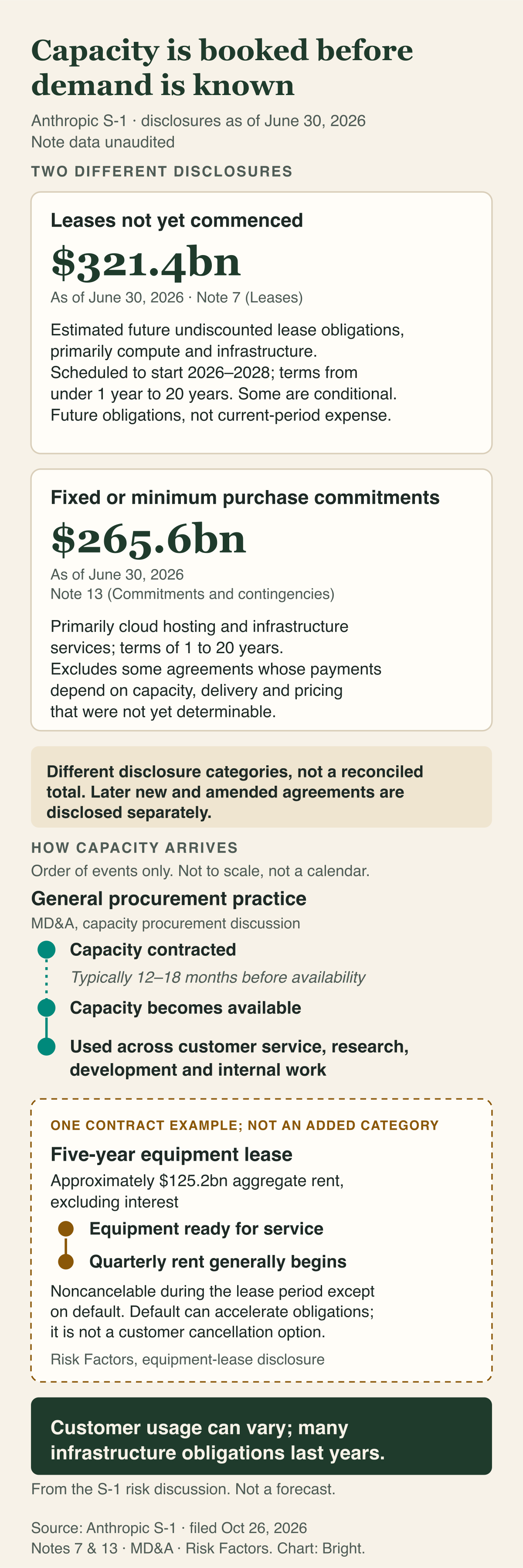
Anthropic says it typically procures its multi-year capacity 12–18 months before availability. When customer demand or research needs exceed that capacity, it buys shorter-term compute, generally at a higher unit cost. Management expects increased near-term use of that supply to compress operating margins. That is the company’s expectation, not a result already established for future periods. S-1, management discussion, p. 134
The large numbers are different disclosures—not a total
The June 30, 2026 unaudited notes identify two substantial categories:
$321.4 billion of estimated future undiscounted obligations for leases not yet commenced. These primarily concern compute and infrastructure. Some depend on contractual conditions. The leases are scheduled to begin between 2026 and 2028, with terms ranging from less than one year to 20 years. “Undiscounted” means the future payments have not been reduced to a present-value amount. S-1, Note 7, F-35
$265.6 billion of future fixed or minimum guaranteed purchase commitments, under agreements primarily covering cloud hosting and other infrastructure services, with terms of one to 20 years. Other agreements have payments dependent on capacity, delivery and pricing that were not yet determinable; those amounts are excluded, though Anthropic expects them to be significant. S-1, Note 13, F-58
These are not expenses already incurred, amounts all payable immediately, or a complete October snapshot. Subsequent-event disclosures describe additional and amended arrangements after June 30. Some aggregate dollar fields in the preliminary prospectus remain blank. Without a reconciliation across categories, amendments and measurement dates, adding the disclosures into one headline commitment number would create precision the filing does not provide. S-1, contractual obligations, pp. 169–170; Note 17, F-65
What one five-year lease actually requires
One arrangement makes the timing concrete. Anthropic describes approximately $125.2 billion in aggregate rent, excluding interest, over a five-year equipment lease. Payments are quarterly and generally begin when the infrastructure equipment becomes ready for service. During the applicable lease period, the agreement is noncancelable except in the event of default. Default is not a cost-free exit: certain uncured defaults can accelerate a substantial portion of the obligations. S-1, risk factors, p. 74
The filing also describes conditional capacity to issue up to $42 billion of convertible promissory notes solely to finance rent under a computing arrangement. Note 9 reports no amounts outstanding under that agreement as of June 30, 2026. The facility limit is potential financing, not customer revenue or a measure of cash received. Financing a payment changes how the obligation is funded; it does not make the infrastructure free. S-1, Note 9, F-42
Neither the five-year total nor the broader lease disclosures justify inventing equal annual payments. Delivery, readiness and contractual conditions determine when obligations become payable.
The strongest counterargument: too little capacity is also costly
Large commitments are not, by themselves, evidence that Anthropic bought too much. The company reports that it previously significantly underestimated its computing requirements, leaving it capacity-constrained and affecting product development and deployment. That is an actual disclosed experience, not merely a hypothetical risk. S-1, risk factors, p. 31
Its operating strategy also offers some flexibility. Anthropic describes a shared computing pool that can be directed toward research, model development, customer service and internal work. It says capacity comes online in large steps, before the associated revenue fully develops. Management argues that dedicated infrastructure can eventually replace more expensive short-term supply. These are reasons the commitments might support growth—not proof that every contract will earn an adequate return. S-1, management discussion, pp. 133–137
What this reveals—and what it cannot
Bright’s interpretation is that AI demand and the financial benefits of AI demand are different questions. If usage grows while prices fall, capacity arrives late, or hardware becomes less competitive, a model provider may not retain the benefits implied by a simple usage chart. Conversely, well-timed infrastructure can support more customers and reduce reliance on expensive temporary supply. The filing identifies these mechanisms; it does not establish which outcome will dominate. S-1, risk factors, pp. 31–34 and 60; management discussion, pp. 133–137
The useful questions are therefore practical: when does capacity arrive, when do payments start, how much can be reassigned, and what revenue must it support? Anthropic’s answers illuminate one company’s contracts and business model. They are not a verdict on every AI provider—or evidence that customers and society will receive a particular share of the value created.
Read more about the financial statements: Why Anthropic’s $80.7 billion loss is not its cash burn.
How we know2 sources · checked 2026-10-26 · no corrections
Original sources
- Anthropic, PBC · October 26, 2026 public Form S-1 ↗ · government
- SEC official filing index · accession 0001628280-26-067168 ↗ · government
Institutions: Anthropic · U.S. Securities and Exchange Commission
- Maturity
- Emerging
- Event date
- 2026-10-26
- Source published
- 2026-10-26
- Captured
- 2026-10-26
- Last source review
- 2026-10-26
- Editorial method
- AI-assisted source review
- Place / relevance
- Anthropic public filing analysis · unspecified
Bright compared this account with the linked original and supporting sources and kept reported, budgeted, projected, and observed claims distinct. Bright did not independently audit the underlying records.
Maturity describes the tested or operational setting. Confidence describes support for the particular claim; one does not determine the other.
Revision & correction history
2026-10-26T14:44:09.781Z · Initial checked compute analysis with source-linked qualifications, reviewed original cover, and links to verified published series articles.
2026-10-26T15:29:17.539Z · Added the reviewed computing-commitments diagram in a reformatted 1200×3596 export accepted by normal image validation. Existing article prose, figures, limitations, source links and cover unchanged.
No corrections recorded.
Keep exploring
Explore the shared question in another setting. These connections do not imply replication.