
Anthropic’s $80.7 billion loss is not $80.7 billion of cash burn
The S-1 reports positive first-half operating cash alongside a large net loss. Understanding the difference is essential to reading the business behind Claude.
- Maturity
- Emerging, stage 2 of 4
- Support
- 2 sources · government
- Evidence detail
- How we know ↓
Analysis · October 26, 2026
October 26, 2026 · Financial statement analysis
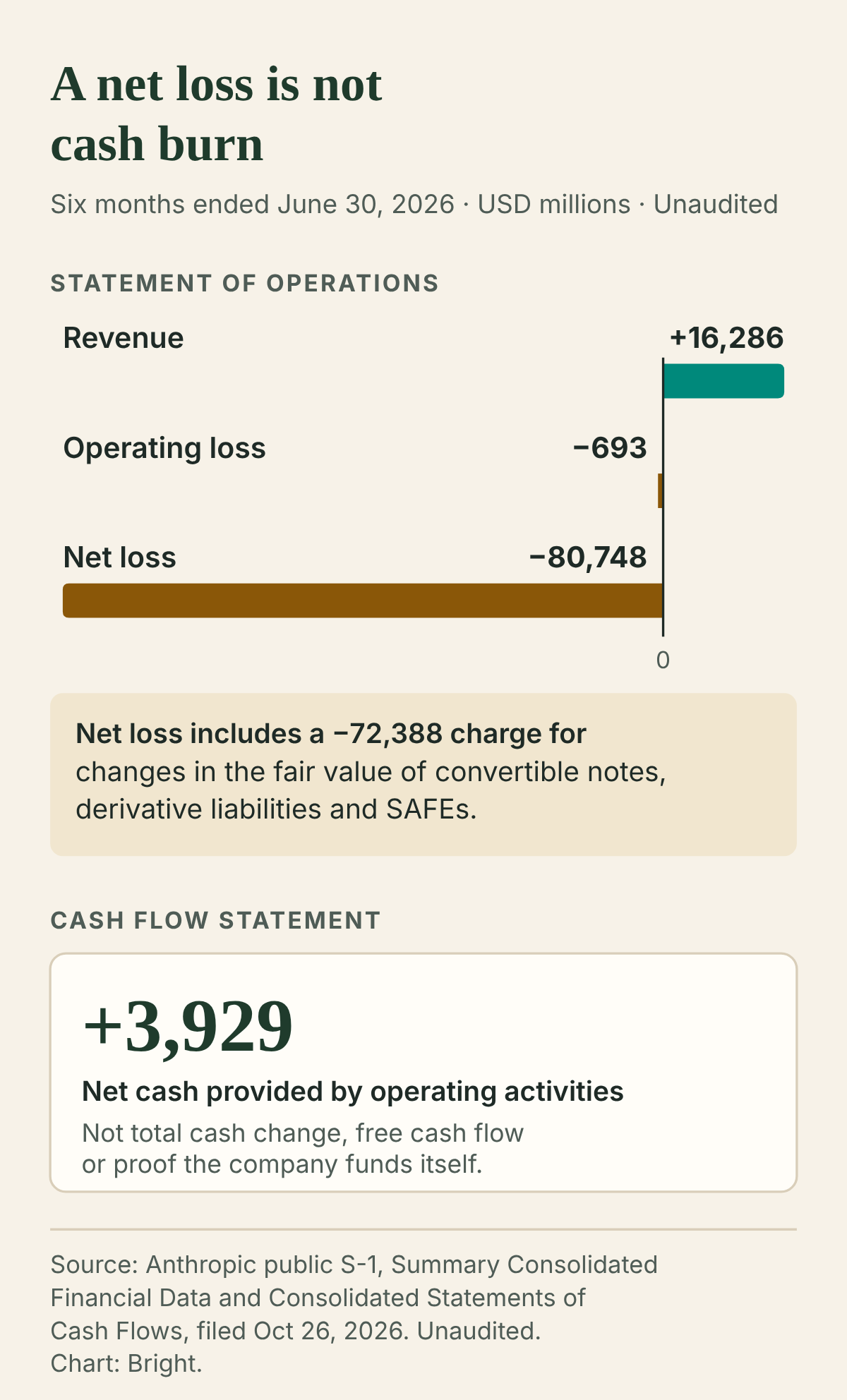
Anthropic reported an $80.748 billion net loss for the first half of 2026. It also reported $3.929 billion of cash generated by operating activities over the same period. Both figures appear in its public S-1. They answer different questions, and treating either as the complete financial story would mislead.
The largest driver of the gap is noncash accounting for financial instruments. Working-capital movements and other adjustments matter too. Understanding that distinction does not make the losses irrelevant, establish lasting profitability or prove that future computing expansion can fund itself. It gives us a better starting point.
All figures below are in US dollars and concern the six months ended June 30, 2026, unless stated otherwise. These interim statements are unaudited. The 2025 annual financial statements are audited. The source is Anthropic’s October 26 Form S-1.
Five numbers that should not be confused
Revenue: $16.286 billion — Sales recognized for the period.
Operating loss: $693 million — Revenue less operating expenses.
Net loss: $80.748 billion — The result after other income, expenses and taxes.
Cash provided by operations: $3.929 billion — Operating cash flow after noncash and working-capital adjustments.
Cash provided by financing: $110.774 billion — A separate source of cash, principally preferred-stock issuance.
Revenue was $1.163 billion in the comparable first half of 2025. The increase is substantial, but recognized revenue is not the same thing as cash collected, and financing proceeds are not sales. S-1, consolidated financial statements
Why the net loss is so much larger than the operating loss
The first-half net loss included $72.388 billion of expense from changes in the fair value of convertible notes, derivative liabilities and SAFEs. Anthropic attributes those changes primarily to increases in the value of outstanding convertible notes as its enterprise valuation increased.
The cash-flow reconciliation separately identifies $8.720 billion of noncash recognition and fair-value changes involving other financial instruments. Neither amount should be described as cash spent serving customers or training models during the period.
Those two figures are not an exhaustive bridge from net loss to operating cash. The statement also adjusts for stock-based compensation, depreciation and other items, then accounts for changes in operating assets and liabilities. Reading only the largest add-back would still leave an incomplete picture. S-1, statements of operations and cash flows; financial-instrument notes
Noncash does not mean economically meaningless. The instruments behind those accounting entries can carry contractual claims and affect eventual ownership or financing costs. But a change in their recorded value is different from a current cash payment. The financial question is what those instruments entitle their holders to receive, under which conditions, and when.
The operating business improved, with qualifications
Anthropic’s $693 million first-half operating loss combines a $1.667 billion operating loss in the March quarter with $974 million of operating income in the June quarter. One profitable operating quarter is a meaningful change, not evidence that profitability is permanent.
Note 8 helps explain why serving economics and the full business result differ. It reports $2.380 billion of cost of revenue and $9.741 billion of R&D expense for the first half. Revenue less the disclosed cost of revenue equals $13.906 billion, approximately 85.4% of revenue, calculated by Bright.
That percentage comes with important boundaries. Cost of revenue mainly covers customer-serving computing and some personnel and overhead. R&D includes model-development, research and internal workloads. Channel-partner costs are classified in sales and marketing, while cloud-marketplace revenue is recognized gross. The calculation cannot be read as an all-in profit margin or compared casually with a differently organized income statement. S-1, quarterly results; Notes 1 and 8
Positive operating cash includes timing effects
Operating activities generated $3.929 billion, compared with consuming $1.513 billion a year earlier. Management attributes the improvement to results adjusted for noncash items and working-capital changes, including the timing of vendor payments and customer receipts.
The distinction matters because cash can move before or after the related revenue or expense. Collecting advance payments, consuming previously prepaid services or paying suppliers later can affect a period’s cash flow. These timing effects belong in the analysis; they are not, by themselves, evidence of improper accounting.
Investing cash flow needs similar care. Anthropic reported $17.181 billion of investing outflows, net, but that is not a $17.181 billion capital-expenditure figure. Purchases of short-term investments dominated the category; purchases of property and equipment were $482 million. Moving cash into an investment is different from consuming it to operate the business. S-1, liquidity discussion and cash-flow statement
Financing and future obligations remain central
Financing supplied $110.774 billion in the first half. At June 30, the balance sheet reported $112.389 billion of cash and equivalents, $19.262 billion of short-term investments and, separately, $2.529 billion of restricted cash. Restricted funds should not be counted as freely available cash. These are June balances, not a verified October liquidity position. S-1, balance sheets and financing cash flows
Nor does positive historical operating cash settle whether future expansion is self-funding. Computing agreements can create payments over several years, with different commencement dates and conditions. Comparing them with cash requires a dated schedule, not simply dividing the cash balance by a supposed burn rate or adding overlapping commitment categories.
The defensible reading is narrower and more useful than either extreme. Anthropic’s reported net loss is not its cash burn. Its operating results and cash generation improved, while financing remained the largest source of new cash. Whether that develops into durable, self-supporting economics depends on future demand, costs and obligations, not one dramatic number.
For the wider picture, read Bright’s five findings from Anthropic’s S-1.
Source and update note: This analysis uses the October 26 public S-1, not leaked draft financials. We will identify material corrections and subsequent filing changes. It is explanatory journalism, not a recommendation to buy or sell a security.
How we know2 sources · checked 2026-10-26 · no corrections
Original sources
- Anthropic, PBC · October 26, 2026 public Form S-1 ↗ · government
- SEC official filing index · accession 0001628280-26-067168 ↗ · government
Institutions: Anthropic · U.S. Securities and Exchange Commission
- Maturity
- Emerging
- Event date
- 2026-10-26
- Source published
- 2026-10-26
- Captured
- 2026-10-26
- Last source review
- 2026-10-26
- Editorial method
- AI-assisted source review
- Place / relevance
- Anthropic financial statement analysis · unspecified
Bright compared this account with the linked original and supporting sources and kept reported, budgeted, projected, and observed claims distinct. Bright did not independently audit the underlying records.
Maturity describes the tested or operational setting. Confidence describes support for the particular claim; one does not determine the other.
Revision & correction history
2026-10-26T14:23:36.543Z · Initial independently checked cash-flow explanation, preserving unaudited period, noncash and working-capital distinctions, financing versus sales, June liquidity limits and future-obligation uncertainty.
No corrections recorded.
Keep exploring
Explore the shared question in another setting. These connections do not imply replication.