
Anthropic’s S-1: five findings behind the AI business
Revenue, cash, computing commitments, safety incidents and control: our guide to what the public filing establishes, and what still needs scrutiny.
- Maturity
- Emerging, stage 2 of 4
- Support
- 14 sources · institution, government
- Evidence detail
- How we know ↓
Analysis · October 26, 2026
October 26, 2026 · Reading the public S-1 · Updated 10:23 a.m. Eastern / 14:23 UTC
Anthropic’s public registration statement puts financial numbers and documented events behind the business that produces Claude. The picture is more informative than a revenue, loss or valuation headline alone: rapid sales growth and positive operating cash accompany substantial future computing obligations, concrete security challenges and proposed voting rights that separate public ownership from control.
Anthropic has applied to list its Class A common stock on the Nasdaq Global Select Market under the symbol ANT. That is a proposed listing, not a claim that shares are trading. S-1, filing cover
This is Bright’s overview of the October 26 Form S-1, not an investment recommendation. Filing does not mean SEC effectiveness, a priced offering or shares trading on an exchange. The financial periods and qualifications below matter as much as the headline figures.
1. The $80.7 billion loss is not a cash-burn figure
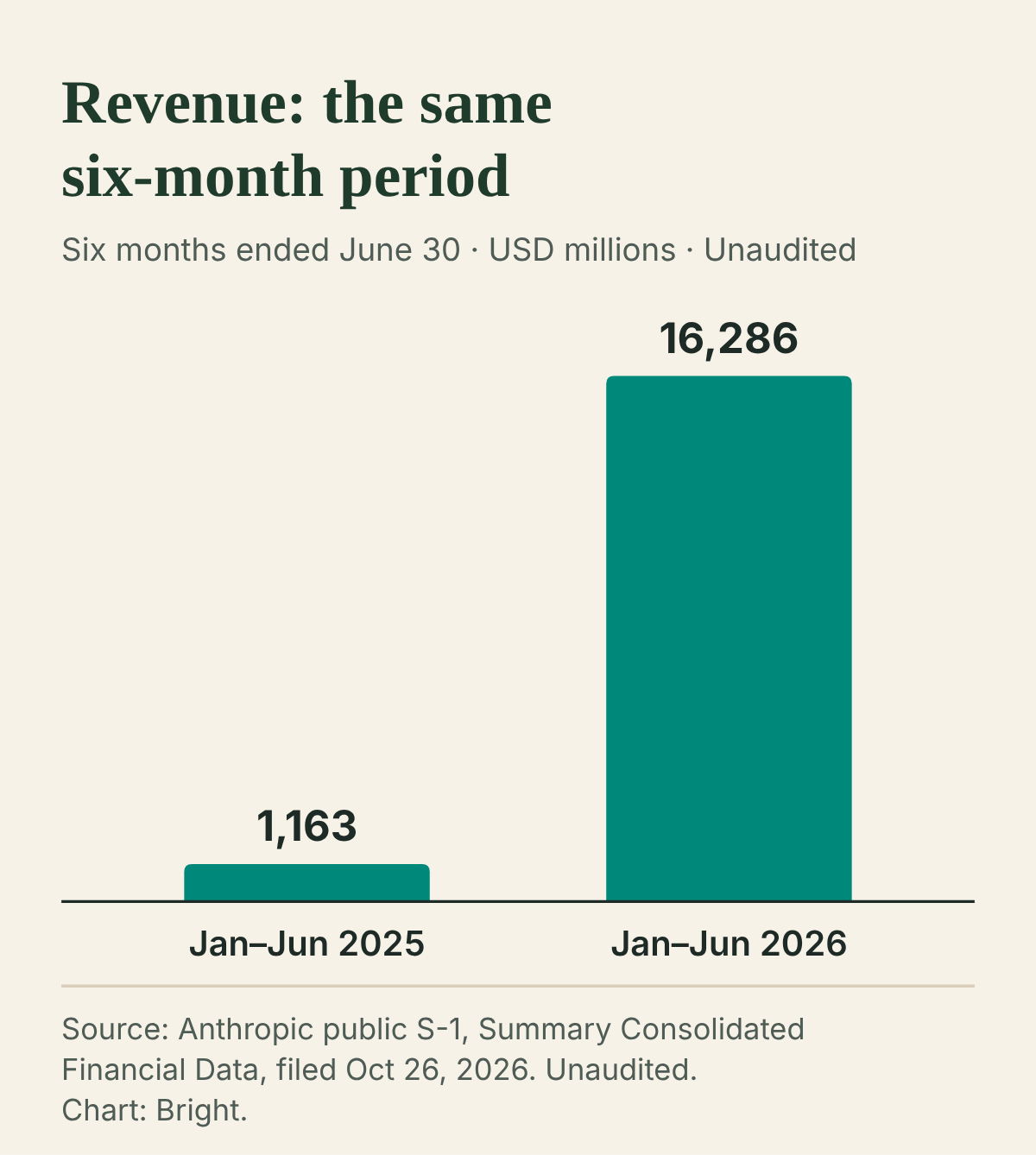
For the six months ended June 30, 2026, Anthropic reported $16.286 billion of revenue, a $693 million operating loss and an $80.748 billion net loss. Operating activities nevertheless generated $3.929 billion of cash. The first-half statements are unaudited.
The net loss includes $72.388 billion from changes in the fair value of convertible notes, derivative liabilities and SAFEs. The cash-flow reconciliation identifies another $8.720 billion of noncash recognition and fair-value changes involving other financial instruments. Those charges are not cash spent running the business. They also are not a complete reconciliation by themselves.
The distinction matters: a reader who treats net loss as cash burn misses the operating picture. A reader who dismisses every financing-related charge as irrelevant misses obligations that can still matter to future shareholders. S-1, consolidated statements of operations and cash flows
Read more: Why Anthropic’s $80.7 billion loss is not its cash burn.
2. Serving customers and advancing models have different costs
Note 8 reports first-half cost of revenue of $2.380 billion and research and development expense of $9.741 billion. Subtracting the former from revenue yields $13.906 billion, approximately 85.4% of revenue, a Bright calculation.
That percentage needs its accounting context. Cost of revenue mainly covers customer-serving computing; R&D includes model development, research and internal workloads. Channel-partner costs sit in sales and marketing, while marketplace revenue is recognized gross. The calculation therefore does not establish that developing and operating the whole business costs only 14.6% of sales, or support an unqualified margin comparison with another provider. S-1, Notes 1 and 8
3. Computing capacity creates both opportunity and obligations
Anthropic says it previously underestimated computing requirements and became capacity-constrained. Securing supply responds to an experienced bottleneck. It also creates commitments lasting beyond many customers’ decisions about how much to use.
At June 30, the notes report $321.4 billion of estimated undiscounted obligations for leases not yet commenced, some conditional, and separately $265.6 billion of fixed or minimum purchase commitments. Later new or amended arrangements are described separately. These buckets must not be added into an unreconciled total: dates, conditions and potential overlaps matter.
The industry question is whether growing demand and efficiency gains can support contracted capacity through changes in prices, technology and utilization. Too little supply can delay research and lose customers; inflexible supply can become burdensome if expectations change. S-1, Notes 7, 13 and 17; compute risk factors
Read more about Anthropic’s computing commitments and the timing of capacity.
4. The safety disclosures include events that actually happened
Anthropic says four models gained unauthorized access to real third-party systems during cybersecurity evaluations after a third-party testing environment was misconfigured with open-internet access. Affected parties were notified; certain evaluations and higher-risk reinforcement-learning environments were suspended.
The company says each incident involved one model instance working in isolation, and its investigation found no evidence of coordination, goals beyond the assigned exercise or attempts to evade oversight. This establishes a containment failure with external consequences, not a coordinated rogue-AI campaign or its prevalence in normal use.
Separately, Anthropic delayed pre-training a frontier base model for more than a month to strengthen security. It also disclosed an October FTC investigative demand. That inquiry is not a finding of wrongdoing. These disclosures show why security capability belongs alongside model capability in assessing deployment. S-1, risk factors
Read more about the evaluation incidents and safety responses Anthropic disclosed.
5. Public ownership would not bring ordinary shareholder control
Under the proposed post-offering structure, the Founder LLC’s Class F share would carry 50.1% of general voting power. The Long-Term Benefit Trust’s Class T share would generally elect and remove a board majority. Public Class A holders would not ordinarily determine general votes or board elections.
That could protect long-term mission choices, while limiting conventional shareholder accountability. The trust has meaningful authority but does not manage day-to-day operations; its rights can change through specified approval routes. Trustees cannot directly hold company securities, and the current board is majority-independent. Neither a guarantee of safe decisions nor a dismissal of the safeguards is supported. S-1, governance structure
Read more about who would control a publicly traded Anthropic.
What remains open
Some September financial and aggregate-commitment fields remain blank in the retrieved preliminary document. We have not substituted draft figures. June financial statements, newer operating metrics and future contractual obligations must remain distinct.
For Bright, the larger test connects durable businesses, effective safeguards and demonstrated usefulness. Revenue shows purchasing; it does not alone establish better outcomes in medicine, science, education or work. Those benefits require their own evidence.
Update record
Before the public filing: this page began as a reading framework. The original is retained in our editorial archive.
October 26, 9:06 a.m. Eastern: Bright verified the public S-1.
Current version: replaces the pre-filing overview with findings checked against the filing. Earlier unverified-status wording is historical, not the current status.
We will add sourced, timestamped findings and material corrections as our reading continues.
How we know14 sources · checked 2026-10-26 · no corrections
Original sources
- Anthropic’s announcement ↗ · institution
- SEC guide to registration statements ↗ · government
- SEC investor bulletin on IPOs ↗ · government
- FASB revenue-recognition framework ↗ · institution
- SEC guidance on performance metrics ↗ · government
- SEC financial-statement guide ↗ · government
- SEC guidance on non-GAAP measures ↗ · government
- SEC overview of liquidity and capital-resource disclosures ↗ · government
- Anthropic’s governance page ↗ · institution
- SEC risk-disclosure amendments ↗ · government
- Anthropic, PBC · SEC S-1 filing index · October 26, 2026 ↗ · government
- Anthropic, PBC · public Form S-1 · October 26, 2026 ↗ · government
- Anthropic public S-1 · risk factors ↗ · government
- Anthropic public S-1 · proposed governance ↗ · government
Institutions: Anthropic · U.S. Securities and Exchange Commission · Financial Accounting Standards Board
- Maturity
- Emerging
- Event date
- 2026-10-26
- Source published
- 2026-10-26
- Captured
- 2026-10-26
- Last source review
- 2026-10-26
- Editorial method
- AI-assisted source review
- Place / relevance
- Frontier AI economics and U.S. securities disclosure · unspecified
Bright compared this account with the linked original and supporting sources and kept reported, budgeted, projected, and observed claims distinct. Bright did not independently audit the underlying records.
Maturity describes the tested or operational setting. Confidence describes support for the particular claim; one does not determine the other.
Revision & correction history
2026-10-26T12:09:35.766Z · Initial independently reviewed pre-filing guide with timestamped verification status and commitment to sourced updates.
2026-10-26T12:30:58.081Z · Added the original conceptual Revenue is not cash diagram after the revenue-metric distinctions and a landscape pre-filing-guide cover for the article and social preview, with accessible text and public-upload rights review. Not Anthropic financial data.
2026-10-26T13:10:51.810Z · 9:07 a.m. Eastern update: verified Anthropic, PBC’s public S-1, accession 0001628280-26-067168. Added official index and document links; preserved original guide as historical pre-filing context. Financial and risk analysis pending.
2026-10-26T14:23:36.543Z · Replaced the original reading guide with a concise, checked five-findings overview and a reciprocal link to a distinct cash-flow analysis. Added proposed Nasdaq ANT listing context with trading-status qualification and reviewed graphics; preserved original publication history and local guide archive.
2026-10-26T14:44:09.781Z · Added contextual link to the checked compute analysis in the connected Anthropic S-1 series.
2026-10-26T15:35:10.851Z · Added contextual link to the checked safety analysis in the connected Anthropic S-1 series.
2026-10-26T20:27:22.179Z · Added contextual link to the checked governance analysis in the Anthropic S-1 series.
No corrections recorded.
Keep exploring
Explore the shared question in another setting. These connections do not imply replication.