
Who would control a publicly traded Anthropic?
The proposed IPO gives public investors economic ownership, founders a majority of general voting power, and the Long-Term Benefit Trust a separate route to board control.
- Maturity
- Emerging, stage 2 of 4
- Support
- 3 sources · government
- Evidence detail
- How we know ↓
Analysis · October 26, 2026
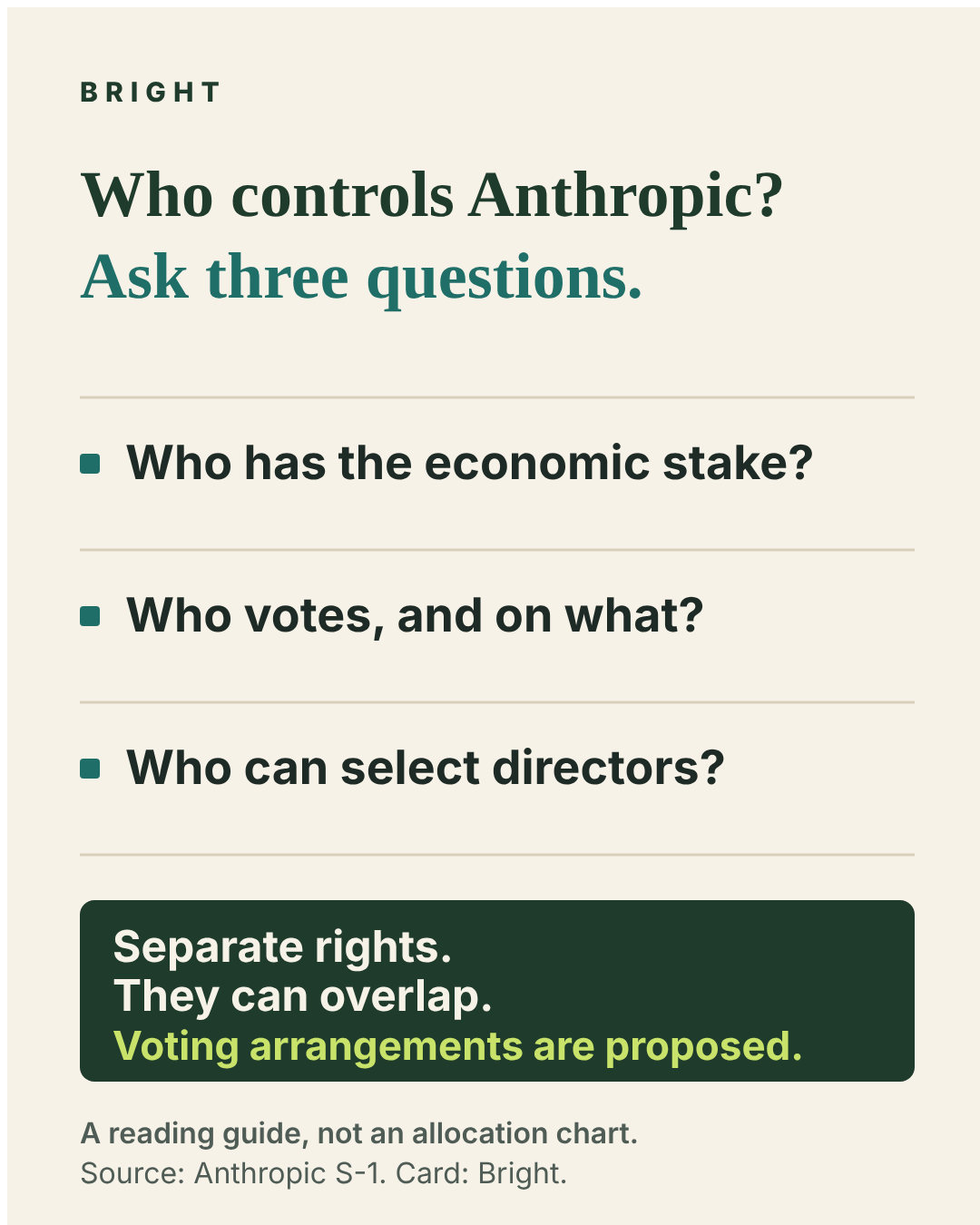
Buying a share in Anthropic would not mean acquiring the usual ability to help change the company’s direction through shareholder voting. The S-1 proposes a structure that separates economic ownership, general voting power and the right to choose a board majority.
The distinction matters before discussing whether the arrangement is good or bad. Founders would have one kind of control; the Long-Term Benefit Trust would have another. Public shareholders would have real rights, but ordinarily could not determine the outcome of general votes or board elections.
These are the proposed offering arrangements. Filing an S-1 does not itself complete the IPO or make every IPO-triggered provision effective. S-1, Description of Capital Stock, printed p.292.
Three kinds of power
Public investors would buy Class A shares. These carry economic rights, including participation in dividends and distributions, and one vote per share on matters submitted to shareholders generally. That includes voting for directors outside the trust’s designated category. Economic ownership and a formal vote, however, would not usually translate into control over the result. S-1, printed pp.292–293.
The Founder LLC would hold one Class F share. Issued immediately before the offering’s completion, that single share would carry 50.1% of voting power on general shareholder matters. The company’s seven designated co-founders would initially be the LLC’s members. Its majority is designed to persist through further share issuance: raising more capital would not by itself dilute that special voting percentage.
The 50.1% figure describes the Class F share’s general voting power. It is not the founders’ economic ownership percentage, nor a measure of their board-election rights. S-1, Our Governance Structure and Its Goals, printed pp.247–248.
The trust would exercise separate Class T rights. It would generally elect and remove directors constituting a majority of the authorized board. Class T has no economic rights and does not provide a general shareholder-voting majority. The trust itself does not conduct day-to-day management or set company strategy; its principal lever is selecting directors. S-1, printed p.244.
These powers cannot be added together in a single ownership chart. The founders’ general-vote majority does not give them the trust’s board seats. The trust’s ability to select a board majority does not give it all shareholder powers. Anthropic nevertheless expects the founders and trust, collectively, to determine the entire board. S-1, Risk Factors, printed p.108.
Limited shareholder influence is not zero rights
Two provisions illustrate the difference. If the required founder majority cannot agree how to vote Class F, it generally follows Class A votes proportionately, subject to the stated quorum. And some routes for changing the trust’s rights require Class A approval as a separate constituency.
Neither provision gives public investors ordinary control. But saying Class A has no meaningful rights would omit powers the document expressly preserves. Class A is also not synonymous with the public float: founders can hold ordinary Class A shares alongside their participation in the Founder LLC. S-1, printed pp.245 and 248.
The trust’s authority has boundaries
One specified Class T director seat has an additional procedure. The trust needs the nominating and governance committee’s concurrence to nominate that director, remove them without cause, or change the designated director. If concurrence is withheld, the proposal can go to an employee Class E vote. The committee would consist of one Class T director and two other directors. Removal for cause has different provisions.
The trust’s rights can also be amended. One route requires approval from 80% of authorized board members and 80% of serving trustees, subject to rounding rules. While Class F exists, other routes combine specified founder, employee and Class A approvals without trustee consent. The details vary by timing and whether Class F still exists.
This is neither an irreversible safety veto nor a unilateral management override. Multiple constituencies and substantial thresholds stand between a disagreement and a change to the structure. S-1, printed pp.244–245.
Independence and accountability are different questions
There are concrete safeguards. Trustees are prohibited from directly holding Anthropic securities, and their cash compensation is not tied to the company’s financial performance. Anthropic says its current board is majority-independent and its audit and compensation committees are entirely independent. Although it qualifies for controlled-company exemptions, it expects to rely on them only for the nominating and governance committee. S-1, printed pp.247 and 251.
Independence does not resolve how outsiders judge success. As a public benefit corporation, Anthropic says its board must balance shareholder financial interests, the interests of people materially affected by its conduct, and its public-benefit purpose. It plans public-benefit reporting at least every two years, but its governing documents would not require an objective third-party measurement standard. It expects its standards to be qualitative. S-1, printed p.243.
What the structure could change
Bright’s reading is that the strongest argument for this design is room to make costly, long-term decisions, including slowing development for safety, without immediately yielding to shareholder pressure. The strongest concern is accountability when the people insulated from that pressure make poor decisions.
Both can be true. Financial obligations and competition would still constrain the business; special voting rights do not remove them. Conversely, public investors’ limited control does not show that mission safeguards are empty.
The revealing evidence will be how directors use their authority, how changes to the trust are justified, and whether public-benefit reporting lets outsiders evaluate difficult choices. The structure creates a way to protect a mission. Its existence cannot guarantee the mission’s success.
For the wider picture, read Bright’s five findings from Anthropic’s S-1. Read more about the computing commitments and the safety disclosures.
How we know3 sources · checked 2026-10-26 · no corrections
Original sources
- Anthropic public S-1 · proposed governance structure ↗ · government
- Anthropic public S-1 · description of capital stock ↗ · government
- Anthropic public S-1 · risk factors ↗ · government
Institutions: Anthropic · U.S. Securities and Exchange Commission
- Maturity
- Emerging
- Event date
- 2026-10-26
- Source published
- 2026-10-26
- Captured
- 2026-10-26
- Last source review
- 2026-10-26
- Editorial method
- AI-assisted source review
- Place / relevance
- Anthropic proposed governance analysis · unspecified
Bright compared this account with the linked original and supporting sources and kept reported, budgeted, projected, and observed claims distinct. Bright did not independently audit the underlying records.
Maturity describes the tested or operational setting. Confidence describes support for the particular claim; one does not determine the other.
Revision & correction history
2026-10-26T20:27:22.179Z · Initial checked governance analysis with citations, qualitative reading-guide card and links to verified series articles.
No corrections recorded.
Keep exploring
Explore the shared question in another setting. These connections do not imply replication.