
AI’s $2.4 Billion Science Push: What It Could Make Possible
New company commitments and federal research awards promise practical help for research teams. The next test is what scientists can actually do with it.
- Maturity
- Emerging, stage 2 of 4
- Support
- 9 sources · institution, report, government
- Evidence detail
- How we know ↓
A digital version of a fusion machine gives researchers somewhere to test better ways of controlling it. More efficient calculations could help physicists understand the particles that make up matter. These are two concrete tasks behind the latest expansion of the U.S. Genesis Mission, an effort to put AI to work in scientific research.
Carnegie Mellon researchers are contributing to both. Jeff Schneider, a research professor in the university’s Robotics Institute, will collaborate on a Commonwealth Fusion Systems project to develop an AI-enabled digital twin of its SPARC fusion demonstration machine. The aim is to improve control strategies through simulation. Physics professor Colin Morningstar will help an MIT-led team investigate whether AI can improve the simulations and analysis used to study the strong force, which holds the components of atomic nuclei together.
Those are research plans, with results still to establish. They also give the announcements a tangible purpose: helping scientists decide what to calculate, test and improve. Carnegie Mellon’s project account
Two different kinds of support
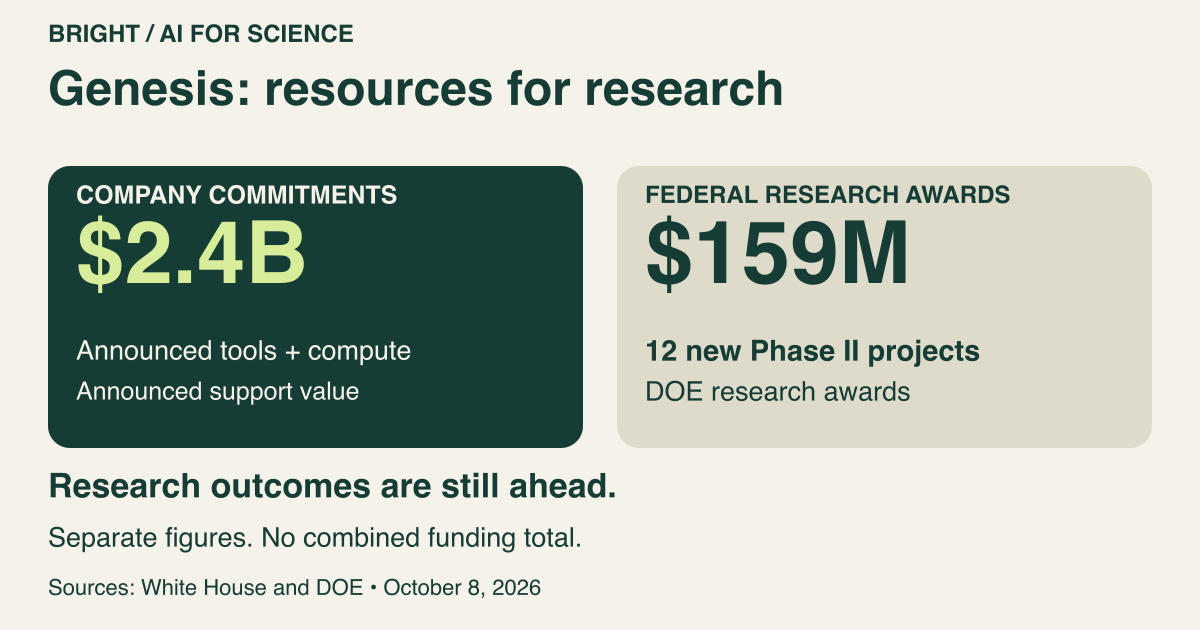
On October 8, the White House announced company commitments valued at $2.4 billion in tools and computing credits for the Genesis Mission Consortium, supporting more than 15 federal agencies. Bright has already covered NVIDIA’s contribution. The larger package involves 11 companies. White House announcement
Separately, DOE announced $159 million for 12 new Phase II research projects, plus six Phase I selections. Two earlier awards, GridFM 2.0 and Prometheus, bring Phase II’s total to 14. Corporate commitment values and federal research awards should remain separate figures. DOE announcement
The distinction matters. A dollar value assigned to software access or computing credits does not tell a laboratory how much money it can spend on equipment or staff. The usefulness of the offer depends on the research task, the conditions attached and the support available to use it well.
What a research team could receive
Anthropic describes a $150 million commitment over three years. It plans to provide Claude, Claude Code and API credits to several hundred Genesis projects, with training, onboarding and technical assistance. Its announcement names NASA, the National Institutes of Health and the National Science Foundation among participating agencies, and identifies fusion and quantum computing as priorities. It does not provide a project allocation list or an open application process for this particular offer. Anthropic’s announcement
That practical help could be important. Researchers need to connect AI tools to existing work, understand their limitations and check their answers. Access becomes valuable when it helps a team produce reliable science without creating more work than it saves.
AWS offers up to $50 million in cloud credits over three years through its Golden Age of Science Accelerator. It describes an interest form, consultation and proposal process; selected projects would receive credits against existing contracts. AWS’s announcement
How access works
There is no verified universal sign-up that gives every researcher a share of the announced support. The Genesis Mission Consortium describes access to computing, data, facilities and expertise through project agreements. Universities can seek membership, while selected partnerships may involve non-members. The consortium also directs researchers toward future funding calls. Consortium guidance
AWS’s public accelerator page checked for this article still describes earlier programs and directs inquiries to program teams. Researchers should confirm the new offer’s route and eligibility before relying on that older process. AWS program page
For a team considering these resources, the useful questions are specific: which work qualifies, when access starts, which costs remain, how research data is handled and what happens when credits expire. Reproducible results should remain the goal as tools change.
What to watch next
The White House also announced a Southeast Regional SI Computing Consortium spanning more than 14 universities across 10 states, and a $1 billion Georgia computing and workforce initiative. Their detailed access arrangements warrant separate scrutiny. White House fact sheet
Earlier Genesis pledges complicate any cumulative total. DOE reported more than $800 million in partner support in July; the reviewed announcements do not reconcile overlap across rounds. DOE’s July announcement
The next meaningful evidence will come from working laboratories: resources delivered, useful simulations completed and findings that withstand checking. The opportunities are substantial. Their scientific value will become clearer as research teams show what changed.
Follow the evidence
See what AI is making possible for people. Bright Weekly brings five source-checked stories and one useful thing to try. Sign up with the form below, or join Bright Weekly.
How we know9 sources · checked 2026-10-08 · no corrections
Original sources
- Carnegie Mellon’s project account ↗ · institution
- NVIDIA’s contribution ↗ · report
- White House announcement ↗ · government
- DOE announcement ↗ · government
- Anthropic’s announcement ↗ · institution
- AWS’s announcement ↗ · institution
- Consortium guidance ↗ · institution
- AWS program page ↗ · institution
- DOE’s July announcement ↗ · government
Institutions: U.S. Department of Energy · Genesis Mission Consortium · Carnegie Mellon University
- Maturity
- Emerging
- Event date
- 2026-10-08
- Source published
- 2026-10-08
- Captured
- 2026-10-08
- Last source review
- 2026-10-08
- Editorial method
- AI-assisted source review
- Place / relevance
- United States · unspecified
Bright compared this account with the linked original and supporting sources and kept reported, budgeted, projected, and observed claims distinct. Bright did not independently audit the underlying records.
Maturity describes the tested or operational setting. Confidence describes support for the particular claim; one does not determine the other.
Revision & correction history
2026-10-08T18:13:20.617Z · Owner-approved Genesis science explainer, with separate industry commitments and federal awards, concrete CMU research plans, qualified access routes and original Bright graphic.
No corrections recorded.
Keep exploring
Explore the shared question in another setting. These connections do not imply replication.