
UW protein designers get more room to test new ideas
A computing grant gives UW researchers more capacity to explore protein designs, with open tools planned and laboratory evidence still essential.
- Maturity
- Emerging, stage 2 of 4
- Support
- 6 sources · institution, paper
- Evidence detail
- How we know ↓
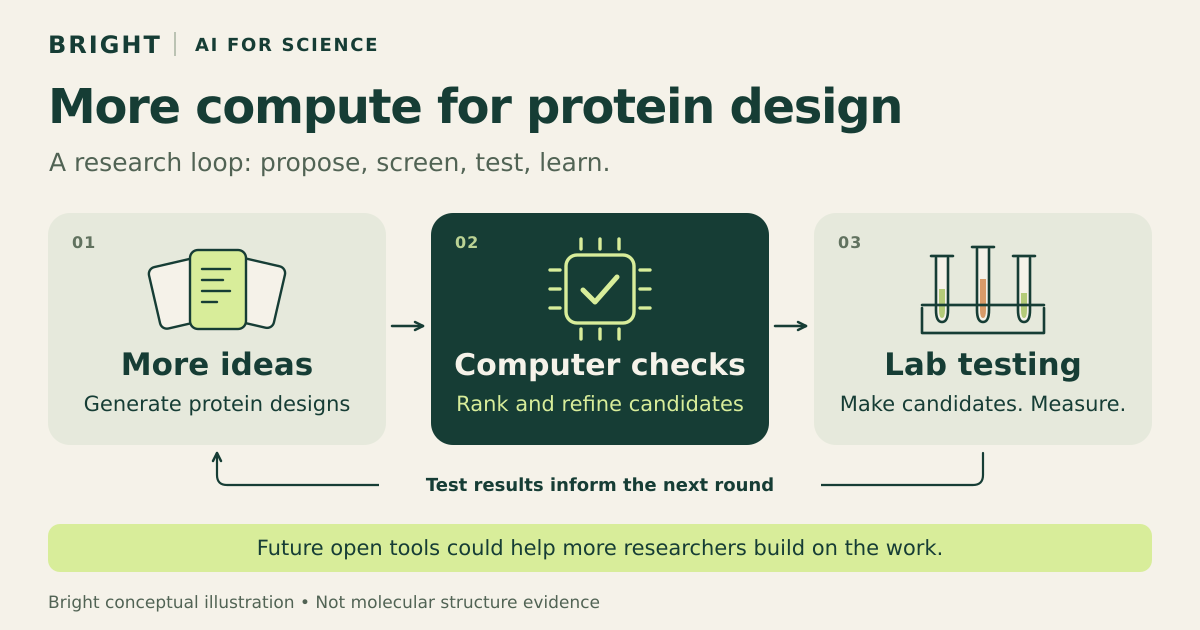
For protein researchers, extra computing power can mean something simple: trying an idea that would otherwise have to wait. A different training dataset, or a change to an AI model, might improve its designs. Running those experiments separately helps scientists understand which change made the difference.
On October 8, UW Medicine announced an in-kind grant of nearly seven million compute hours to its Institute for Protein Design. The Jen-Hsun and Lori Huang Foundation is providing access through CoreWeave using NVIDIA GPUs. Initial model releases are expected in late 2026 and early 2027, subject to progress and experimental validation. Goals include cancer treatments, durable vaccines and enzymes that break down persistent pollutants and plastics. UW announcement
What changes inside the research team
In a same-day interview with GeekWire, institute director David Baker described faster experimentation already underway. GeekWire reported that access began in June. Previously, computing constraints could push researchers to change several things at once, making it harder to isolate what helped. More capacity lets them explore alternatives more systematically. That account describes a change in how research gets done; it does not measure how quickly a medicine will reach patients. GeekWire’s interview
The scientific possibilities become clearer through the institute’s earlier work. Those studies provide context for this grant, rather than evidence of what the newly announced support has achieved.
What protein design can already do
In a paper published on December 3, 2025, researchers described RFdiffusion2, an AI method for designing the surrounding protein structure that holds an enzyme’s working parts in place. On a computer-based benchmark, it generated suitable structures for all 41 test cases, compared with 16 for the earlier method. The team also made and tested designed enzymes, finding candidates that carried out chemical reactions.
The distinction between those checks matters. A computer can identify a promising arrangement; a laboratory experiment establishes whether a molecule actually does something useful. The authors also reported an important limitation: their designed enzymes were less active than natural enzymes. More computing leaves that experimental challenge intact. Nature Methods paper
A separate paper, first published on May 21, 2026, explored proteins that attach to receptors involved in conditions including pain, cancer and migraine. Researchers designed small proteins that could activate or block these cellular switches. Structures of five receptor-bound designs closely matched their computer models. That gives researchers another way to investigate how a proposed molecule interacts with its target. Clinical usefulness would still need its own evidence. Nature paper
Making the tools useful beyond one lab
UW plans to share the new models, software and research data openly. Existing tools show how that can work: RFdiffusion2 already has a public code repository with installation guidance and example design tasks. Such resources give other researchers a starting point for trying the method, checking it and building on it. Availability alone does not supply the expertise or laboratory facilities needed to validate a design. RFdiffusion2 repository
This foundation grant has a different named funder from NVIDIA’s separate five-year, $1 billion science commitment, announced the same day. NVIDIA links its corporate commitment to the wider Genesis Mission. Neither announcement establishes that the UW grant is an allocation from that pledge; their values should remain separate.
For readers, the useful thing to watch is the chain of evidence: tools released, designs checked, experiments completed and results others can examine. Each step can make the next question easier to ask. The grant expands the opportunity to do that work.
Follow the evidence with Bright Weekly: five source-checked stories and one useful thing to try, free each week.
Related Bright coverage: NVIDIA’s five-year science commitment · The wider Genesis science commitments
What was shown, and what wasn’t
Shown
UW Medicine announced an in-kind Huang Foundation grant of nearly seven million compute hours through CoreWeave using NVIDIA GPUs. Earlier protein-design studies provide context, not results caused by this grant.
Not shown · limits
- Institutional plans and researcher experience are attributed; no independent acceleration benchmark is established.
- The earlier studies predate this announcement and do not establish grant outcomes.
- Computational designs need laboratory validation; no patient benefit or demonstrated environmental cleanup is established.
- The Huang Foundation grant has a different named funder from NVIDIA’s corporate Genesis commitment; no allocation link or cumulative value is established.
Bright editorial interpretation
More capacity can let researchers test alternatives more systematically, with open tools planned for other researchers.
Still open
Which models and data will be released, and when?
Which new designs will survive experimental validation?
How we know6 sources · checked 2026-10-08 · no corrections
Original sources
- UW announcement ↗ · institution
- GeekWire’s interview ↗ · institution
- Nature Methods paper ↗ · paper
- Nature paper ↗ · paper
- RFdiffusion2 repository ↗ · institution
- NVIDIA’s separate five-year, $1 billion science commitment ↗ · institution
Institutions: University of Washington Institute for Protein Design · Jen-Hsun and Lori Huang Foundation · CoreWeave
- Maturity
- Emerging
- Event date
- 2026-10-08
- Source published
- 2026-10-08
- Captured
- 2026-10-08
- Last source review
- 2026-10-08
- Editorial method
- AI-assisted source review
- Place / relevance
- Seattle, Washington, United States · institution-location
Bright compared this account with the linked original and supporting sources and kept reported, budgeted, projected, and observed claims distinct. Bright did not independently audit the underlying records.
Maturity describes the tested or operational setting. Confidence describes support for the particular claim; one does not determine the other.
Revision & correction history
2026-10-08T23:24:38.769Z · UW protein designers get more room to test new ideas
2026-10-09T10:34:08.342Z · Clarified the October 8 original UW source publication date while preserving the October 9 Bright filing date. Article prose and approved conceptual image are unchanged.
2026-10-09T11:26:57.796Z · Removed obsolete preparation-only status from the UW review metadata. Source publication remains October 8; Bright publication remains October 9. Research limitations, sources, article text and image unchanged.
No corrections recorded.
Keep exploring
Explore the shared question in another setting. These connections do not imply replication.